
Welcome to this week’s Field Notes, a 10-year project of mine documenting humankind’s digital transition from the field. These notes are shaped by what I’m seeing, building, and discussing as our physical and digital lives continue to converge.
- Ryan
(Connect with me on LinkedIn)

News is surface-level. Signals live underneath. This section captures developments that hint at deeper shifts in how digital systems are being built, governed, and adopted — often before they’re obvious in the mainstream narrative.
The data archive that doesn’t need electricity
We have become remarkably good at creating and storing digital information. Every photograph, document, message and video eventually finds its way onto some form of storage, often in a data centre somewhere. Yet preserving that information over long periods remains surprisingly difficult. Hard drives wear out, storage formats become obsolete, and maintaining an archive requires a continuing investment in equipment, electricity and the systems needed to keep everything accessible.
This week, researchers in Switzerland demonstrated an interesting alternative, using one of the oldest information-storage materials on Earth. A team from the University of Geneva and the University of Applied Sciences and Arts Western Switzerland has developed an automated microfactory capable of converting digital files into synthetic DNA. The project, called DNAMIC, forms part of a wider European research collaboration exploring whether DNA could become a practical medium for preserving digital information over centuries or even millennia. (University of Geneva)
The underlying idea is relatively straightforward. Computers normally represent information using combinations of zeros and ones. DNA uses a different alphabet, consisting of four chemical building blocks represented by the letters A, T, G and C. By translating binary information into sequences of these four letters, researchers can manufacture strands of synthetic DNA that contain the original digital information. The DNA is then sealed inside small stainless-steel capsules designed to protect it from oxygen, moisture, light and heat. Once stored under suitable conditions, the material requires no continuing electricity to preserve the information it contains. Retrieving the data involves sequencing the DNA and converting the resulting genetic code back into a digital file.
To demonstrate the system, the researchers chose something particularly appropriate to their surroundings: historical records from Switzerland’s watchmaking industry. Working at the HE-Arc engineering campus in Saint-Imier, they used the microfactory to encode a heritage archive held by the Jura Centre for Economic Archives and Research.
There is a nice connection between the subject of the archive and the technology being developed. Switzerland’s watchmaking industry has spent centuries refining extraordinarily precise mechanical systems, and some of its historical records are now being preserved through molecular engineering.
The technology is still a long way from replacing conventional storage. Writing information into DNA can take several hours, while retrieving it requires specialised laboratory equipment. Manufacturing synthetic DNA also remains expensive, and ensuring that future generations can recover the information involves preserving the necessary decoding instructions as carefully as the material itself.
But speed is not necessarily the point. Most of our digital infrastructure has been designed around information that needs to be accessed frequently. We expect files to open almost instantly, databases to respond in milliseconds and information to move continuously between devices. Long-term archives operate under different conditions. A historical record might not need to be accessed for decades, but when somebody eventually needs it, the information must still be there.
DNA offers some unusual advantages for that kind of work. It can hold an extraordinary amount of information in a very small physical space, and under appropriate preservation conditions, DNA can survive for exceptionally long periods. Scientists have recovered genetic information from biological material tens of thousands of years old, although engineered archives will need their own evidence of long-term reliability.
There is also something interesting about the relationship between the material and our ability to interpret it. A hard drive manufactured today may become difficult to read within a few decades as its interfaces and supporting equipment disappear. DNA, by contrast, is fundamental to biology, which gives future generations a continuing reason to develop the tools needed to read it.
That doesn’t guarantee that an archive will remain accessible indefinitely, but it offers a different approach to the problem of technological obsolescence. What stood out to me was the decision to use a biological molecule for something we generally associate with electronics. Nature has been storing and transmitting genetic information for billions of years, long before humans developed writing, let alone computers. Researchers are now adapting some of those same chemical properties to preserve the records of our own civilisation.
The DNAMIC project is still experimental, and the economics of DNA storage remain unresolved. Yet it introduces a different way of thinking about what a digital archive might eventually look like.
For now, most of the world’s information lives on equipment that needs to be maintained, replaced and supplied with energy. In a Swiss laboratory, researchers have demonstrated that at least some of it can instead be written into molecules, sealed in a capsule and left undisturbed until somebody needs to read it again..

Storing Data in DNA: The Future of Digital Storage
What it is
In this short video from UBC Okanagan, Dr Luca Piantanida and his research team demonstrate a different approach to storing digital information using DNA. Working alongside Dr William Hughes, the researchers are investigating how the molecular structures of DNA can be arranged to represent the same binary information normally held in electronic memory.
Their approach uses a technique called DNA origami, where strands of DNA are folded into microscopic shapes using shorter strands that hold them in place. The researchers can then create specific patterns on those structures, with individual positions representing either a one or a zero. Specialised microscopes allow them to read those patterns and recover the encoded information.
What stood out
The most interesting distinction is that the team is using the physical arrangement of DNA to store information, rather than relying entirely on the sequence of its four chemical letters. It is another way of exploiting the extraordinary precision with which DNA molecules can be assembled.
I also enjoyed seeing the students working through the practical challenges. Their days involve preparing DNA samples, running gels, operating microscopes and writing software to interpret the results. It is a useful reminder that something as apparently futuristic as molecular data storage still involves considerable hands-on laboratory work.
The interdisciplinary nature of the project is particularly apparent. Chemistry, biology, computer science and engineering all need to work together before a digital file can be reliably translated into a molecular structure and read back again.
Why it matters
The research provides an interesting companion to this week’s news about the Swiss DNAMIC microfactory. Both projects are exploring DNA as a storage material, but they approach the problem differently. The Swiss researchers are encoding digital information into sequences of synthetic DNA, while the Canadian team is investigating how the physical arrangement of DNA structures can represent binary data.
Neither approach is close to replacing conventional storage. Writing and retrieving information still requires specialised equipment, and considerable work remains to make these systems economical and reliable at scale.
What connects them is the possibility of designing archives around much longer periods of time. We have become accustomed to digital information being instantly available, but much of what we create may only need to be preserved and occasionally retrieved.
Near the end of the video, one of the researchers asks where all the photographs, videos and documents we create today will exist in a thousand years. It is an interesting question, particularly when so much of our information currently depends on infrastructure that must be continually maintained and replaced.
There is something appealing about the possibility that some of those records could eventually survive as carefully arranged molecules, long after the computers that created them have disappeared.

Digital assets now sit less as an idea and more as infrastructure in progress. As physical and digital life continue to converge, money and digital asset infrastructure are doing the same. What was once framed as “crypto” is increasingly showing up as rails, balance sheets, and policy conversations.
🔥🗺️Heat map shows the 7 day change in price (red down, green up) and block size is market cap

🎭 Crypto Fear and Greed Index is an insight into the underlying psychological forces that drive the market’s volatility. Sentiment reveals itself across various channels - from social media activity to Google search trends - and when analysed alongside market data, these signals provide meaningful insight into the prevailing investment climate. The Fear & Greed Index aggregates these inputs, assigning weighted value to each, and distils them into a single, unified score.


This section captures developments at the edge of digital systems. New interfaces, tools, and capabilities that feel early, unfinished, or slightly ahead of their moment. I’m less interested in what’s impressive today and more interested in what might quietly reshape how people work, coordinate, and interact over time.
Making mirrors from plants
Some of the most remarkable colours in nature don’t come from pigments at all. The iridescent wings of butterflies, the metallic shells of beetles and the shifting colours of certain bird feathers are produced by microscopic structures that interact with light. Rather than absorbing some wavelengths and reflecting others through chemical pigments, these surfaces use their physical arrangement to determine which colours we see.
Scientists have been studying these structures for decades, hoping to reproduce their optical properties in manufactured materials. This week, researchers at the University of Osaka demonstrated an interesting development in that work: a highly reflective film made entirely from two familiar plant-derived substances.
The research, published in Advanced Materials, uses cellulose, the material that provides much of the structure in plant cell walls, and pectin, a natural substance commonly used to thicken jams. Neither material is particularly reflective on its own, but the researchers discovered that arranging them into alternating microscopic layers could produce a surface capable of reflecting more than 97% of visible light at selected wavelengths. (University of Osaka, Advanced Materials)
The technique draws inspiration from structural colour in nature, particularly the brilliant metallic appearance of jewel beetles. Their shells contain microscopic layers that reflect particular wavelengths of light, producing vivid colours without relying on conventional pigments. The Osaka researchers wanted to reproduce that effect using materials that could eventually biodegrade rather than persist in the environment.
The difficulty was getting two plant-derived substances to interact with light differently enough to produce strong reflections. Their solution was to make one layer dense and the next highly porous. The pectin forms a relatively compact layer, while the cellulose nanofibres create a sponge-like structure containing tiny pockets of air. Because light travels differently through these materials, the repeated boundaries between them create an optical effect that can produce exceptionally strong reflection.
Using a process called electrodeposition, the team assembled approximately 100 alternating layers, each around 100 nanometres thick. For perspective, a human hair is hundreds of times thicker than an individual layer. By adjusting the thickness of these layers, the researchers could control which wavelengths of light the material reflected, producing different colours and even combining multiple reflective effects within a single film.
The result is not quite a conventional mirror that reflects an entire scene. The strongest measurements relate to particular wavelengths, and the researchers are developing a material that can be engineered to control specific parts of the light spectrum. That distinction is important because it opens up applications beyond making something look shiny.
One possibility is in buildings. A transparent coating that allows visible light to pass through while reflecting near-infrared radiation could help reduce unwanted heat entering through windows. Other potential uses include optical sensors, anti-counterfeiting features and decorative surfaces that don’t require conventional metallic coatings or synthetic pigments.
There is also an environmental consideration. The researchers demonstrated that, after adjusting the material’s composition, their films could achieve approximately 80% degradation over two months under the conditions they tested. That offers a potential advantage over some conventional optical materials, although durability remains an unresolved problem. In particular, the team acknowledges that improving resistance to moisture will be necessary before many practical applications become possible.
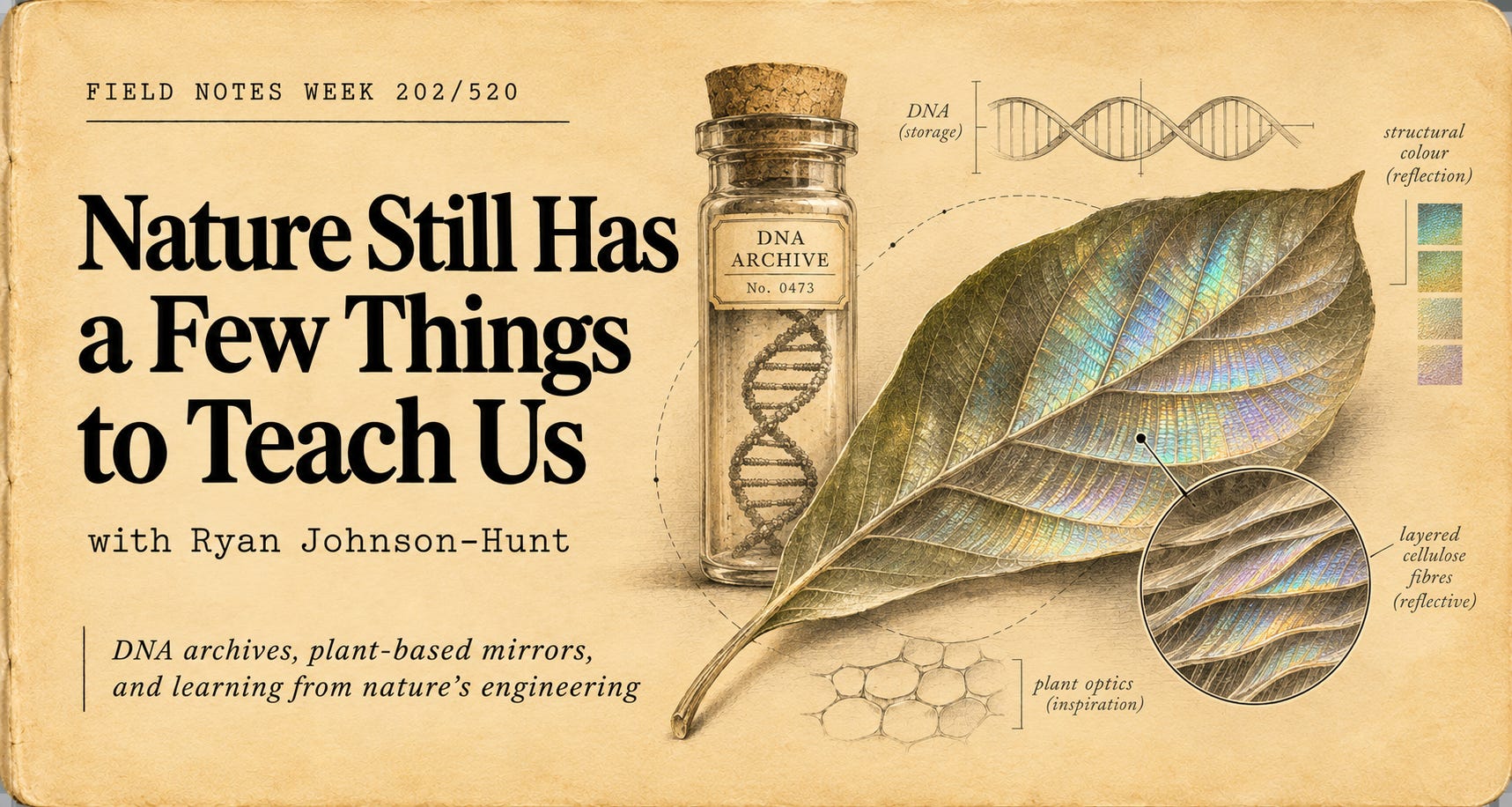
What interests me is how much of the performance comes from the arrangement of the material rather than the materials themselves. Cellulose and pectin are hardly exotic substances, and nature has been producing them for an extraordinarily long time. Yet when researchers organise them at a sufficiently small scale, they begin to behave in ways that neither material could achieve independently. There is a connection here to the DNA storage research in this week’s News section. In one case, scientists are adapting a biological molecule that evolved to preserve genetic information, using it to store digital records. In the other, researchers are borrowing principles from natural optical structures and recreating them with materials derived from plants.
Neither approach removes the need for sophisticated engineering, and both remain experimental. The DNA archive still requires specialised equipment to write and retrieve information, while the reflective films need further work before they can survive ordinary environmental conditions. But the common thread is interesting. As our ability to work with matter at increasingly small scales improves, researchers are finding new uses for materials and biological structures that have existed around us for millions of years. There may be considerably more to learn from how nature stores information, manipulates light and organises matter than we’ve yet managed to put into practice.

“It’s a completely different way to do science, to learn from rather than just about.”
Janine Benyus
Biologist and author Janine Benyus has spent much of her career exploring biomimicry, the practice of studying nature for ideas that can inform human engineering and design. In a conversation with Krista Tippett, she described a shift from simply understanding how living systems work towards asking what we might learn from the ways they have adapted over billions of years.
This week’s two discoveries seem to fit that observation particularly well. DNA evolved to preserve biological information across generations, while the microscopic structures found in beetle shells and butterfly wings manipulate light in ways that researchers are still learning to reproduce. Neither was designed for the purposes we’re now exploring, yet both offer properties that have proven difficult to achieve through conventional engineering.
There is something appealing about the idea that, as our technology becomes more sophisticated, we may find ourselves spending more time looking carefully at things that have been around us all along.