
Welcome to this week’s Field Notes, a 10-year project of mine documenting humankind’s digital transition from the field. These notes are shaped by what I’m seeing, building, and discussing as our physical and digital lives continue to converge.
- Ryan
(Connect with me on LinkedIn)

News is surface-level. Signals live underneath. This section captures developments that hint at deeper shifts in how digital systems are being built, governed, and adopted — often before they’re obvious in the mainstream narrative.
Designing the building blocks of quantum computing
Most of the computers we use today depend on silicon chips manufactured through extraordinarily precise industrial processes. Over decades, engineers have learned to fit increasingly complex circuits onto smaller pieces of material, creating the computing infrastructure that now supports much of our daily lives.
Quantum computing has followed a less settled path. Researchers are still experimenting with different ways to create and control the fundamental units of quantum information, known as qubits. Some use superconducting circuits, others trap individual atoms or manipulate defects within crystals. Each approach presents different challenges, particularly when trying to build systems containing large numbers of qubits that can operate reliably together.
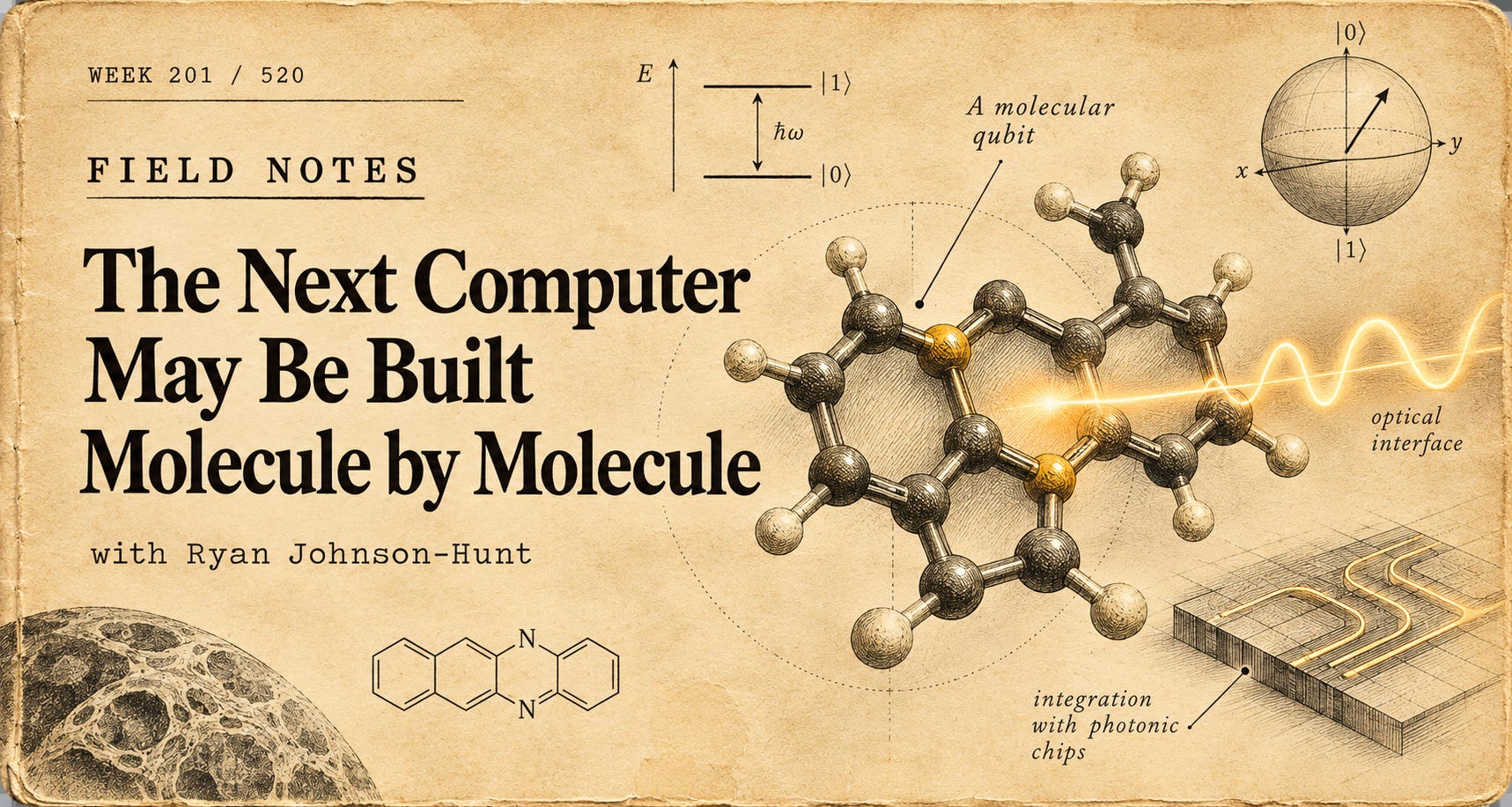
This week, researchers at German quantum technology company NVision published a paper in Nature demonstrating another possibility: a qubit built from a specially designed organic molecule. The researchers were able to manipulate the quantum state of a single molecule and read information from it using light, something that could eventually allow quantum components to communicate through optical connections. (Nature)
What makes the research particularly interesting is how the team approached the problem. Rather than beginning with an existing material and trying to work around its limitations, the researchers started with the properties they wanted a qubit to have and worked backwards to design a suitable molecule.
Using computational chemistry, they investigated hundreds of potential molecular structures before synthesising around 40 candidates. The resulting molecule was embedded within a carefully matched crystal, creating an environment stable enough for the researchers to isolate and manipulate its quantum behaviour. (Reuters)
The experiment took place at approximately 4.5 kelvin, just a few degrees above absolute zero. At those temperatures, researchers demonstrated that the molecule could retain its quantum state for milliseconds under carefully controlled conditions. They also showed that individual molecules could be addressed using lasers, allowing their states to be manipulated and measured rather than observing only the average behaviour of a large collection of molecules.
These may sound like small achievements, but they address some of the practical difficulties involved in building quantum computers. Qubits are extremely sensitive to their surroundings, and the quantum information they carry can be lost through interactions with the environment. Finding ways to preserve that information, control individual qubits and connect them to one another remains central to the field.
NVision believes its approach could eventually offer another advantage: manufacturing. Organic molecules can be synthesised chemically and potentially deposited as thin films onto conventional semiconductor components. The company has announced a partnership with US photonic-chip manufacturer HyperLight to explore integrating the molecular qubits with circuits that use light to move information. (NVision)
There is still considerable distance between the laboratory experiment and a functioning quantum computer. The researchers demonstrated the behaviour of an individual molecular qubit, not a processor performing calculations with thousands or millions of them. Integrating these molecules into chips, connecting them reliably and correcting errors remain substantial engineering challenges.
What stood out to me was the way this research connects two fields that we don’t normally associate with one another. We tend to think of computing progress in terms of semiconductor manufacturing, processor design and software. Yet here, some of the work is happening through chemical synthesis, with scientists designing the physical structure of a molecule to produce particular computational properties.
It also emerged from an unexpected direction. NVision’s earlier work involved improving magnetic resonance imaging, using techniques that manipulate the spin of electrons to make certain molecules easier to detect. That experience helped inform its approach to quantum information, where controlling electron spin is also central.
There is something worth observing in the possibility that future computing components might be designed and manufactured partly through chemistry. Rather than continuously refining the same materials and processes, researchers are exploring whether they can create the properties they need directly within matter itself.
It remains one experimental approach among several competing architectures, and we are still some distance from knowing which will prove practical at scale. But the research offers a glimpse of how the physical foundations of computing may continue to change, even as the technology built on top of them becomes increasingly familiar.

Molecular Quantum Systems: Powering the Next Era of Quantum Technologies
What it is
In this presentation from Q2B Copenhagen, Dr Sella Brosh, CEO of German quantum technology company NVision, explains how the company moved from developing advanced medical imaging systems into designing molecular components for quantum computing.
The connection is less obvious than it first appears. NVision originally worked with the quantum properties of molecules to make them more visible to MRI scanners. Its Polaris system uses specially engineered sugar-derived molecules to help researchers observe metabolic activity inside the body, with potential applications in understanding how cancers behave and respond to treatment.
That experience led the company towards a different question: whether molecules could be designed to perform the functions required of a quantum computer.
What stood out
Brosh describes an important limitation in conventional quantum hardware development. Researchers often begin with a material that has useful quantum properties, then spend years developing ways to control its behaviour and work around its limitations.
NVision decided to approach the problem through synthetic chemistry. Just as chemists have designed molecules for medicines, dyes and OLED displays, the company began investigating whether molecules could be designed specifically for their quantum properties.
The presentation follows several years of experimentation, culminating in a molecule that combines a quantum information component with the ability to emit light. This is significant because connecting qubits becomes increasingly difficult as quantum systems grow. NVision’s proposed architecture uses photons to connect molecular qubits rather than relying entirely on placing them close together.
The company is also exploring whether these molecules can be deposited as extremely thin films onto photonic chips, potentially drawing on established semiconductor and display manufacturing techniques.
I found the medical imaging work particularly interesting because it provides a view of the same underlying research at two very different stages. Polaris systems are already being deployed to research institutions, where clinicians are investigating practical applications. The molecular quantum computer remains much earlier, with considerable engineering work still required.
Why it matters
Quantum computing is often presented as a race to build machines with more qubits. Brosh’s presentation makes clear that the difficulty is also about how those qubits are manufactured, connected and kept stable as the system grows.
There is an interesting possibility in designing quantum behaviour directly into molecules. Chemistry allows researchers to change molecular structures and investigate how those changes affect their properties, potentially providing another way to develop computing components.
The presentation was recorded before NVision’s research appeared in Nature this week, so some of the work Brosh describes as forthcoming has since been published. That gives the video useful context alongside the news, while the company’s broader manufacturing and scaling ambitions remain to be demonstrated.
What stayed with me was the path from medical imaging to quantum computing. The company began by finding ways to make molecules more useful for observing biological processes, then found that some of the same knowledge could be applied to designing the components of a computer.
It is still unclear how far molecular quantum computing can be taken, but the work offers an interesting reminder that advances in one field often emerge from techniques developed to solve problems somewhere else.

Digital assets now sit less as an idea and more as infrastructure in progress. As physical and digital life continue to converge, money and digital asset infrastructure are doing the same. What was once framed as “crypto” is increasingly showing up as rails, balance sheets, and policy conversations.
🔥🗺️Heat map shows the 7 day change in price (red down, green up) and block size is market cap

🎭 Crypto Fear and Greed Index is an insight into the underlying psychological forces that drive the market’s volatility. Sentiment reveals itself across various channels - from social media activity to Google search trends - and when analysed alongside market data, these signals provide meaningful insight into the prevailing investment climate. The Fear & Greed Index aggregates these inputs, assigning weighted value to each, and distils them into a single, unified score.


This section captures developments at the edge of digital systems. New interfaces, tools, and capabilities that feel early, unfinished, or slightly ahead of their moment. I’m less interested in what’s impressive today and more interested in what might quietly reshape how people work, coordinate, and interact over time.
A quantum memory inside a molecule
One of the persistent difficulties in quantum computing is keeping information intact long enough to do something useful with it. Unlike conventional bits, which can remain reliably stored in electronic circuits, quantum states are unusually sensitive to their surroundings. Small interactions with the environment can disturb them, making it difficult to preserve the information they carry.
Researchers have spent years exploring different ways to overcome this problem, including an interesting distinction between two components of an atom: its electrons and its nucleus. Electrons are relatively easy to manipulate using magnetic fields and, in some systems, light. But their sensitivity to the surrounding environment also makes them vulnerable to interference. Atomic nuclei interact more weakly with their surroundings, meaning their quantum states can sometimes remain stable for considerably longer. The challenge is finding practical ways to access and control them.
Earlier in October, researchers from the University of Glasgow and Imperial College London reported an experiment demonstrating how these two properties might be combined inside an organic molecule. The team used a molecule called 6,13-diazapentacene, a modified version of an existing organic compound containing two nitrogen atoms. By placing the molecules within a carefully prepared crystal, they were able to manipulate the quantum states associated with the nitrogen nuclei and detect those changes using light, all at room temperature. (Research paper)
The technique relies on an interaction between the electrons and nuclei inside the molecule. Light is used to prepare and observe the electronic state, while radio-frequency signals manipulate the nuclear spins. Changes in the nuclear state influence the electrons, allowing the researchers to detect what has happened through the light emitted by the system.
The arrangement effectively gives researchers a way to access quantum information held within the nucleus using the more accessible electronic system around it. In principle, that combination could allow molecular devices to benefit from the relative stability of nuclear spins without losing the ability to control and measure them.
What makes the experiment particularly interesting alongside NVision’s work is the role of chemistry. The Glasgow and Imperial researchers were not simply working with an existing material. The molecular structure, including the placement of nitrogen atoms, is part of what determines the quantum behaviour they can observe. This creates opportunities to design materials around particular requirements, including how strongly different quantum states interact, how they respond to light and how effectively they can be isolated from their surroundings.
The research remains at an early stage. The team demonstrated coherent control of nuclear spins within a molecular system, not a functioning quantum memory or computer. The possible applications currently centre on quantum sensing, where sensitive molecular devices might eventually measure tiny magnetic or other physical changes in materials and biological environments. Further work is needed to establish how reliably the nuclear states can store information and whether the approach can operate in practical devices.
Still, it adds another dimension to the possibility that quantum technologies could be built through molecular design. We have become accustomed to electronics being manufactured through increasingly precise methods of shaping and depositing materials. Researchers are now exploring whether some computational and sensing capabilities can instead be introduced through the chemical structure of the materials themselves.
The two experiments approach different problems, but they share an interesting starting point: that the behaviour required for a quantum device might be designed into a molecule before the device is assembled. There is still a considerable gap between controlling quantum states in a laboratory and manufacturing reliable technology around them. For now, much of the work involves understanding which molecular properties can be controlled, which remain unstable and how those properties might be combined into something useful.

“What would the properties of materials be if we could really arrange the atoms the way we want them?”
Richard Feynman, 1959
In his famous lecture There’s Plenty of Room at the Bottom, physicist Richard Feynman explored what might become possible if scientists could deliberately arrange matter at the atomic scale. He imagined a time when we might move beyond working with the materials nature provides and begin designing structures with properties of our choosing.
More than six decades later, this week’s molecular quantum research feels like a small step towards that idea. Researchers are beginning with the behaviour they want from a computing component and working backwards to design the molecule that might produce it.
Feynman’s question was ultimately about how much control we could develop over matter itself. We have learned a great deal since 1959, although the distance between designing a useful molecular property and manufacturing a reliable technology around it remains considerable.