
Welcome to this week’s Field Notes, a 10-year project of mine documenting humankind’s digital transition from the field. These notes are shaped by what I’m seeing, building, and discussing as our physical and digital lives continue to converge.
- Ryan
(Connect with me on LinkedIn)

News is surface-level. Signals live underneath. This section captures developments that hint at deeper shifts in how digital systems are being built, governed, and adopted — often before they’re obvious in the mainstream narrative.
We’ve spent much of the digital era developing better ways to reproduce what we see and hear. Cameras have become extraordinarily sophisticated, audio can be transmitted around the world almost instantaneously, and enormous amounts of human communication now happen through screens and speakers. Yet one of our most familiar senses has remained largely absent from the digital experience.
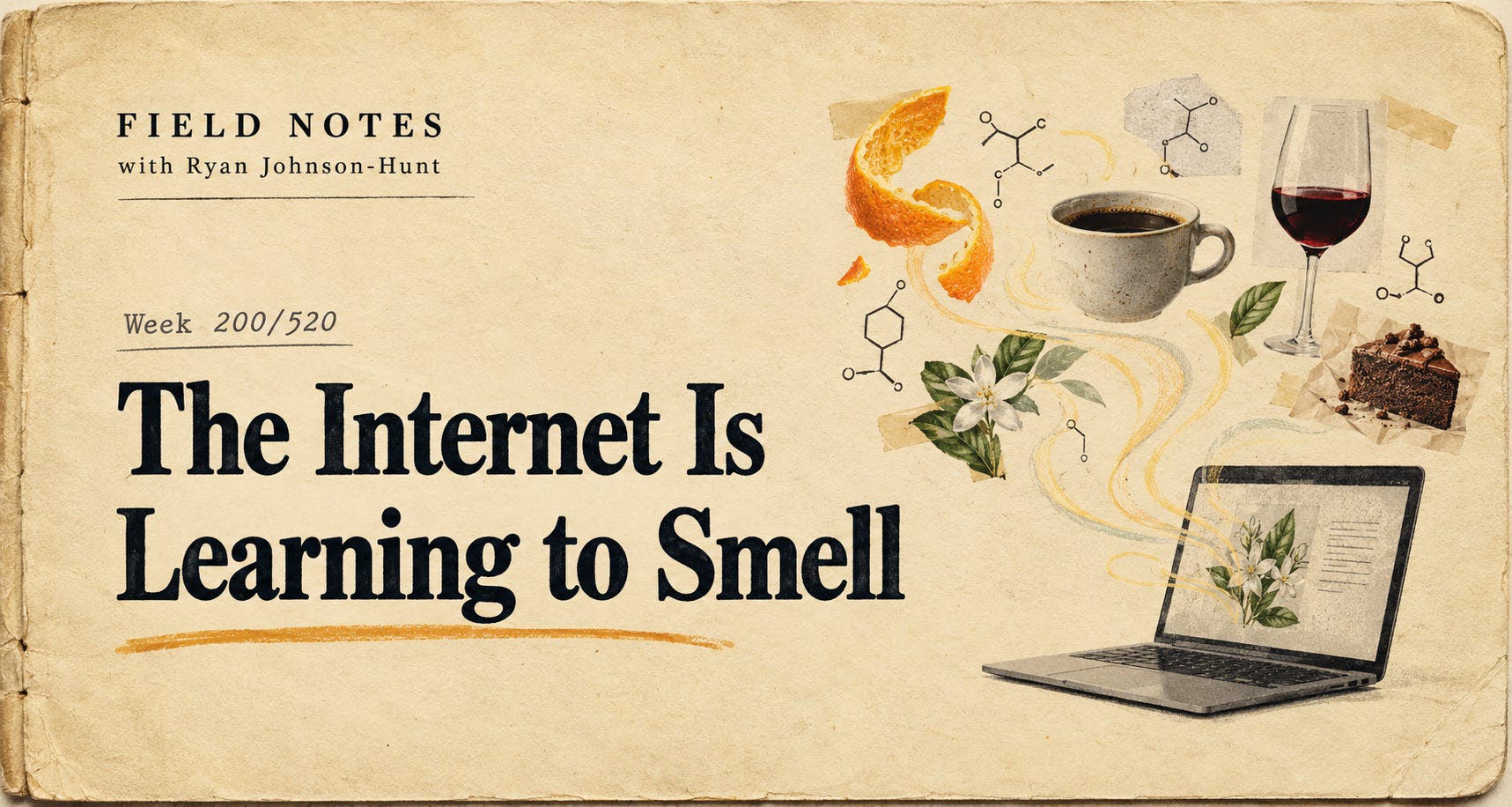
That may be beginning to change. Researchers at Ohio State University have developed an experimental system called Scentronic, which can recognise certain smells in one location and recreate them through a device somewhere else. The research, published in Science Advances on 21 October, combines chemical sensors, machine learning and small fragrance-dispensing devices to demonstrate something that has been attempted in various forms for decades: transmitting information about smell over a network. (Science Advances)
The process begins with an electronic nose, a device containing sensors that respond to chemical compounds in the surrounding air. A machine-learning model analyses those responses and identifies which smell it has encountered. That information is then transmitted over the internet to a receiving device, which releases an appropriate fragrance from its own supply of scented liquids.
For now, the system recognises just five familiar smells: coffee, oranges, cake, beer and red wine. The researchers have developed several versions of the receiving device, including a wristband, necklace and handheld unit. In experiments involving 14 volunteers, participants correctly identified approximately 73% of the individual scents released by the handheld device. (Reuters)
There is an important limitation to what has been demonstrated. Scentronic isn’t transmitting the chemical composition of a smell in the way a camera transmits the information needed to reproduce an image. The receiving device must already contain the appropriate fragrances, and the system effectively communicates which of those prepared scents should be released. Recognising unfamiliar smells, reproducing complex mixtures and creating a much larger library of aromas remain substantial technical problems.
Even so, the experiment highlights something interesting about the way we’ve developed digital communication. Sight and hearing have proven relatively straightforward to represent as information. A microphone converts changes in air pressure into an electrical signal, while a camera captures information about incoming light. Both can be represented numerically, transmitted and reconstructed with increasingly high fidelity.
Smell works differently. When we encounter the aroma of freshly brewed coffee, we’re detecting molecules released into the air. Those molecules interact with receptors in our noses, producing signals that our brains interpret as a particular smell. The experience involves chemistry as well as information, which makes reproducing it somewhere else considerably more complicated.
The researchers imagine applications ranging from online shopping to more immersive virtual environments, where users might experience some of the aromas associated with the places or products they are seeing. There are possibilities for remote healthcare and communication too, although these remain potential uses rather than established applications.
What interests me is the broader attempt to make another part of human experience digitally transferable. We’ve become accustomed to separating information from the place where it originated. A photograph can travel without the object being present, and a conversation can happen without either person sharing the same room.
Scentronic suggests researchers are beginning to apply a similar approach to smell, although the technology is still far from reproducing the richness of the real experience. It is easy to overlook how much of our relationship with the physical world remains outside the internet. Smell is particularly connected to memory, place and emotion, often in ways that are difficult to put into words. The prospect of capturing even a small part of that experience digitally opens up an unfamiliar set of possibilities.
For now, the internet can recognise five prepared aromas and instruct a device to release something similar. That’s a modest beginning, but it makes visible how much work remains before smell can become another form of everyday digital communication.

What it is
In this episode of the TWIML AI Podcast, host Sam Charrington speaks with Alex Wiltschko, founder and CEO of Osmo, a company attempting to digitise our sense of smell. Their conversation explores why smell has proven so difficult to represent computationally, how artificial intelligence is helping researchers understand the relationship between molecules and human perception, and what might eventually become possible if computers develop a reliable way to recognise and reproduce scents.
Wiltschko describes Osmo’s ambition in terms of reading, mapping and writing smells. Much as computers can capture an image, represent it digitally and reconstruct it on another screen, the company is investigating whether a comparable process could eventually work for odours. The difference is that smell involves chemical molecules interacting with hundreds of different receptor types in the human nose, making it considerably more difficult to translate into a predictable digital representation.
What stood out
One of the more interesting parts of the conversation concerns Osmo’s Principal Odor Map. By training graph neural networks on the molecular structures of thousands of substances, researchers have developed a way to organise smells according to how humans perceive them. Molecules associated with floral, fruity or sweet aromas tend to occupy related regions of this computational space, even when their underlying chemical structures are quite different.
The approach is an attempt to develop something resembling the colour spectrum for smell. With colour, we can describe and reproduce an enormous range of visual experiences using a relatively small number of components. Smell has never had an equivalent system, partly because the relationship between molecular structure and perception is so complicated.
The scale of the data collection also stood out. Wiltschko says Osmo has accumulated more than 5.4 million individual smell observations to train its models. Unlike internet text or photographs, much of this information has to be generated through specialised experiments and human sensory evaluations. The company is effectively building a dataset for a sense that has never been systematically digitised at anything approaching the scale of vision or language.
Why it matters
The immediate applications are in fragrance development, where better models could help researchers predict how unfamiliar molecules might smell and design new ingredients without relying entirely on trial and error. But the conversation becomes more interesting when Wiltschko discusses applications beyond perfume.
Our sense of smell provides information about the chemical environment that cameras and microphones cannot capture. It helps us recognise spoiled food, detect smoke and identify substances that might be harmful. Researchers are also investigating whether the chemical signatures associated with certain diseases could become useful diagnostic signals.
Wiltschko imagines a future in which small chemical sensors might become ordinary components of consumer devices, providing another source of environmental information alongside cameras and microphones. These applications remain largely experimental, and reproducing the sophistication of human smell would require much more capable sensors, models and chemical output systems than are available today.
What I found interesting was the reminder that the digital world has developed around only a narrow portion of what humans can perceive. We’ve become remarkably good at recording images and sounds, but there is an enormous amount of chemical information in our surroundings that our devices largely ignore.
As researchers begin developing ways to represent that information, we may discover that giving computers a sense of smell is useful for reasons quite different from those that initially motivated the technology.

Digital assets now sit less as an idea and more as infrastructure in progress. As physical and digital life continue to converge, money and digital asset infrastructure are doing the same. What was once framed as “crypto” is increasingly showing up as rails, balance sheets, and policy conversations.
🔥🗺️Heat map shows the 7 day change in price (red down, green up) and block size is market cap

🎭 Crypto Fear and Greed Index is an insight into the underlying psychological forces that drive the market’s volatility. Sentiment reveals itself across various channels - from social media activity to Google search trends - and when analysed alongside market data, these signals provide meaningful insight into the prevailing investment climate. The Fear & Greed Index aggregates these inputs, assigning weighted value to each, and distils them into a single, unified score.


This section captures developments at the edge of digital systems. New interfaces, tools, and capabilities that feel early, unfinished, or slightly ahead of their moment. I’m less interested in what’s impressive today and more interested in what might quietly reshape how people work, coordinate, and interact over time.
Mapping the language of smell
One reason digital smell has been so difficult to develop is that scientists are still working out how our own sense of smell operates. We understand the basic process. Molecules enter the nose and interact with specialised receptors, triggering signals that travel to the brain. But predicting what something will smell like from its molecular structure remains surprisingly difficult. Two molecules that look similar chemically can smell completely different, while molecules with very different structures can produce remarkably similar impressions.
Unlike vision, which relies on three types of colour-sensitive cone cells, human smell involves roughly 400 functioning types of olfactory receptors. Individual smells activate combinations of these receptors, creating patterns that the brain interprets as recognisable experiences. Understanding those combinations has become an important research problem, particularly as scientists explore whether smell can be modelled computationally.
In September, researchers from Microsoft Research and Stanford University published a system called MolOR, which uses deep learning to investigate the relationship between odour molecules, the receptors they activate and the smells people perceive. Rather than attempting to predict smell directly from a molecule’s chemical structure alone, MolOR introduces an intermediate step. It first predicts which olfactory receptors are likely to respond to a particular molecule, then uses that predicted activity to help estimate how a person might describe its smell. (Cell Systems)
The researchers combined data about molecular structures, receptor proteins and human descriptions of different odours. Their model was able to identify patterns suggesting that chemically different molecules associated with similar smells may activate overlapping groups of receptors. That is an interesting distinction. Instead of treating descriptions such as nutty, roasted or fruity as labels attached to particular chemicals, the researchers are trying to understand the biological signals that produce those perceptions.
The results are still early. Including predicted receptor activity improved the model’s ability to classify odours, but the overall gains were modest, and much of the analysis relies on computational predictions rather than direct measurements of how people experience each smell. There are also gaps in the available experimental data, with many possible interactions between odour molecules and receptors remaining poorly understood.
Still, the approach points towards a different way of working with smell. Much of the fragrance industry has historically relied on accumulated human experience. Perfumers learn how individual ingredients behave, how they interact when combined and how a fragrance changes over time. That knowledge is difficult to capture in a simple formula because the relationship between chemical composition and human perception is complicated.
If researchers can gradually build more accurate models of that relationship, it may become possible to design scents computationally, predict how unfamiliar molecules will smell or identify combinations that reproduce a particular aroma.
That could eventually become relevant to technologies like Scentronic. Today’s prototype requires preloaded fragrances corresponding to known smells. A more sophisticated system would need some way to describe an unfamiliar aroma, determine which chemical components could reproduce it and instruct a receiving device to assemble an approximation.
We’re a considerable distance from that, and MolOR doesn’t provide a complete solution. It is a research model exploring one part of a much larger biological problem. But the two developments are interesting to consider together. One group of researchers is building a device capable of recognising and recreating a small selection of smells remotely. Another is trying to understand the underlying relationship between molecules and the sensations they produce.
We’ve already developed remarkably effective ways to represent images and sounds as digital information. Smell remains more stubbornly attached to the physical world, partly because we haven’t yet worked out how to describe it with comparable precision. That gap between recognising a smell and understanding how to reproduce it seems to be where much of the work is now taking place.

“Smell is a potent wizard that transports us across a thousand miles and all the years we have lived.”
Helen Keller
Writing in The World I Live In in 1908, Keller reflected on the extraordinary role smell played in her experience of the world. Having lost her sight and hearing as a young child, she described how familiar scents could bring back entire places, people and moments from her past, often with a vividness that words struggled to capture.
More than a century later, we’re beginning to explore how those same sensations might be represented digitally. We can already preserve the appearance of a place through photographs and its sounds through recordings, but the particular smell of a childhood home, a familiar garden or the air after rain remains much harder to capture.
I wonder what it would mean to preserve those experiences too, and whether reproducing the chemistry of a smell would be enough to bring back everything we associate with it.