
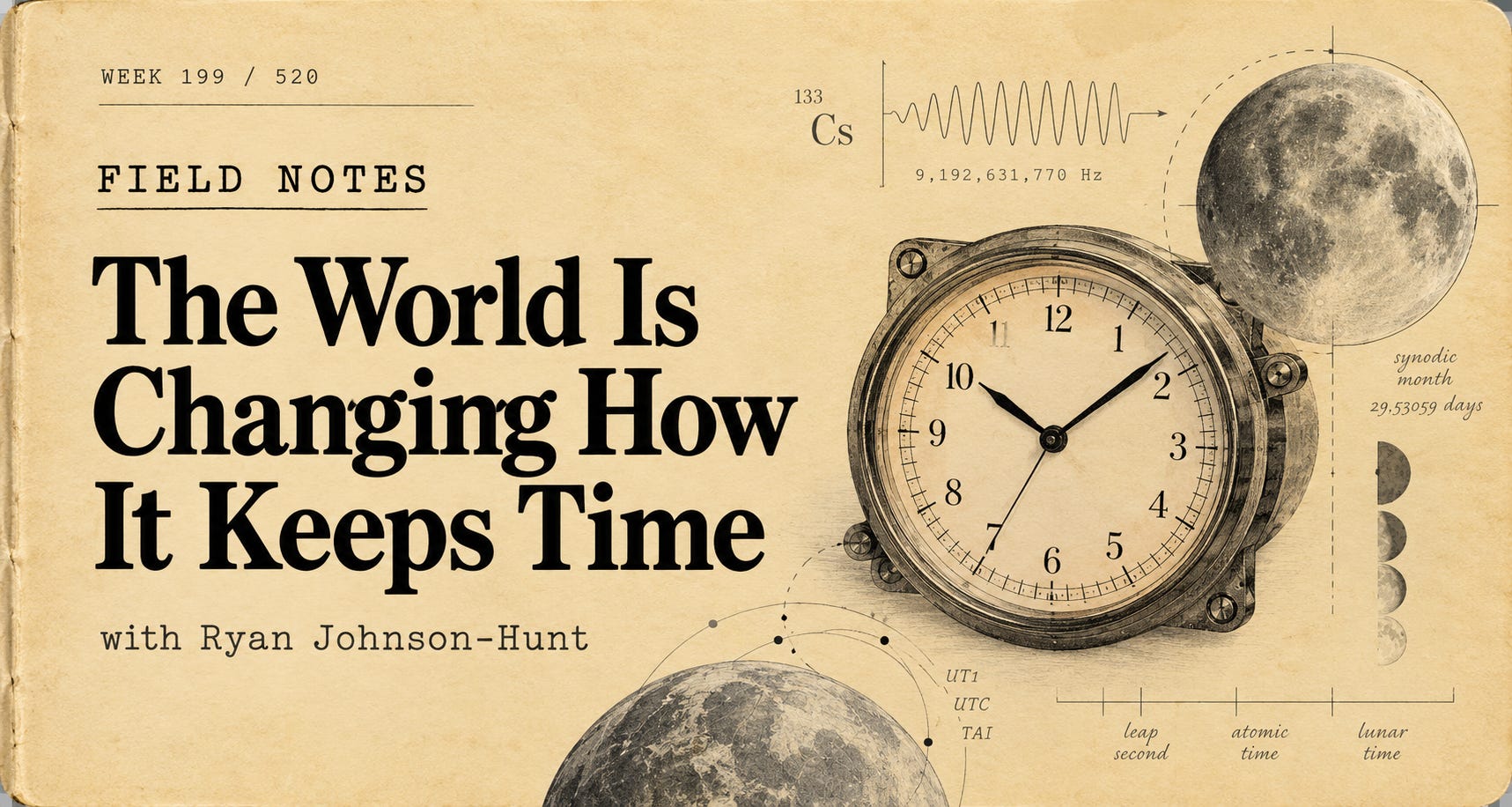
Welcome to this week’s Field Notes, a 10-year project of mine documenting humankind’s digital transition from the field. These notes are shaped by what I’m seeing, building, and discussing as our physical and digital lives continue to converge.
- Ryan
(Connect with me on LinkedIn)

News is surface-level. Signals live underneath. This section captures developments that hint at deeper shifts in how digital systems are being built, governed, and adopted — often before they’re obvious in the mainstream narrative.
The end of the leap second
For most of human history, keeping time meant observing the movement of the Earth. The rising and setting of the Sun gave us the day, and the rotation of the planet provided a natural reference for organising our lives. Modern timekeeping works somewhat differently. Our most accurate clocks now measure the behaviour of atoms, which provide a far more consistent reference than the irregular rotation of the planet beneath us.
For the past 54 years, we’ve maintained a compromise between these two systems. Whenever atomic time and the Earth’s rotation began to drift too far apart, an additional second could be inserted into Coordinated Universal Time (UTC). These leap seconds have been introduced 27 times since 1972, most recently at the end of 2016.
Last Thursday, that arrangement came to an end. At the General Conference on Weights and Measures in Versailles, representatives adopted a resolution that will make UTC continuous from 20 May 2027. Rather than keeping atomic time and the Earth’s rotation aligned to within roughly one second, the new rules permit the difference to grow as large as an hour. That provides sufficient room for the two measures of time to drift apart for centuries without further adjustments. (BIPM Resolution 5)
The reason for the change is largely technological. Leap seconds have become an awkward problem for computer systems that assume time moves forward in a predictable sequence. Previous adjustments have disrupted services including Reddit and LinkedIn, while different technology companies have developed their own methods for gradually spreading an additional second across a longer period. This has created inconsistencies between systems that are supposed to share the same reference.
The problem has become more pressing because the Earth’s rotation has recently been speeding up. While leap seconds have historically been added, scientists have been considering the possibility of needing to remove one for the first time. A negative leap second would be particularly difficult because much of the world’s software has never been tested against that possibility. (The Guardian)
The new arrangement doesn’t mean that our clocks will suddenly change or that a leap hour is about to be introduced. It simply removes the requirement to keep correcting civil time in increments of one second, allowing the physical rotation of Earth and our internationally agreed time standard to diverge gradually.
What interests me is how much infrastructure now depends on this agreement. Satellite navigation, telecommunications, financial transactions, electricity networks and distributed computing all rely on machines having a consistent understanding of time. An error of a few milliseconds may be irrelevant to someone checking a wristwatch but can be consequential when computers are coordinating activity across large networks.
The decision also says something about the relationship between our technology and the natural world. We originally designed our clocks around the movement of the planet, then developed instruments capable of measuring time with far greater precision. Now the systems we’ve built have become so dependent on that precision that we’re changing the international rules to accommodate them.
The Earth’s rotation hasn’t stopped mattering. Astronomers, navigators and others will continue to measure it, and the difference between astronomical and civil time will remain publicly available. But for the infrastructure underpinning much of modern life, the predictable passage of atomic time has become the more useful reference.
It’s an unusual moment in the digital transition when something as fundamental as the way the world keeps time is being revised, largely because of the requirements of the machines we’ve built.

What it is
In this short video from 2015, British science and technology presenter Tom Scott explains why adding a single second to the world’s clocks can create surprisingly complicated problems for computers. He begins with Unix time, the system widely used in computing to represent time as a numerical count from 1 January 1970, and explains why the occasional addition of a leap second creates an awkward exception to something programmers generally expect to behave predictably.
The video was recorded ahead of the leap second introduced on 30 June 2015, making it an interesting piece to revisit following this week’s international decision to move away from leap seconds altogether.
What stood out
Scott walks through two possible approaches to handling leap seconds, neither of which is particularly satisfactory. Systems can account for every leap second, but that requires maintaining an accurate record of previous adjustments and ensuring that devices receive updates whenever another is announced. This becomes complicated when equipment is operating in space or deliberately disconnected from external networks.
Alternatively, systems can ignore leap seconds when counting elapsed time, creating an unusual situation where the same numerical timestamp can effectively occur twice. Scott uses the simple example of software saving a file every second. If two files receive the same timestamp, a poorly designed programme could overwrite information or fail unexpectedly. In more complex infrastructure, the consequences can be considerably harder to anticipate.
What I found particularly interesting was how different organisations had already developed their own solutions. Google introduced a technique called a leap smear, gradually distributing the extra second across a day to avoid an abrupt adjustment. Some financial exchanges took a more cautious approach, suspending trading around the leap second rather than risking problems in systems operating at millisecond speeds.
Why it matters
There is something revealing about watching this explanation eleven years after it was recorded. The problems Scott describes were largely invisible to ordinary users, yet they required considerable engineering effort across technology companies, financial infrastructure and other systems that depend on accurate timekeeping.
The video also illustrates an important distinction between the way humans experience time and the way computers need to measure it. For most of us, an occasional additional second is inconsequential. For software coordinating transactions, communications or physical equipment, the predictability of time can be just as important as its accuracy.
This week’s decision to move towards continuous UTC reflects the accumulation of those practical difficulties. Rather than requiring countless systems to accommodate occasional irregularities in the world’s clocks, the international timekeeping framework itself is being adjusted.
Scott’s explanation is a useful reminder that even the simplest assumptions in computing, such as one second reliably following another, depend on agreements and infrastructure that are considerably more complicated than they first appear.

Digital assets now sit less as an idea and more as infrastructure in progress. As physical and digital life continue to converge, money and digital asset infrastructure are doing the same. What was once framed as “crypto” is increasingly showing up as rails, balance sheets, and policy conversations.
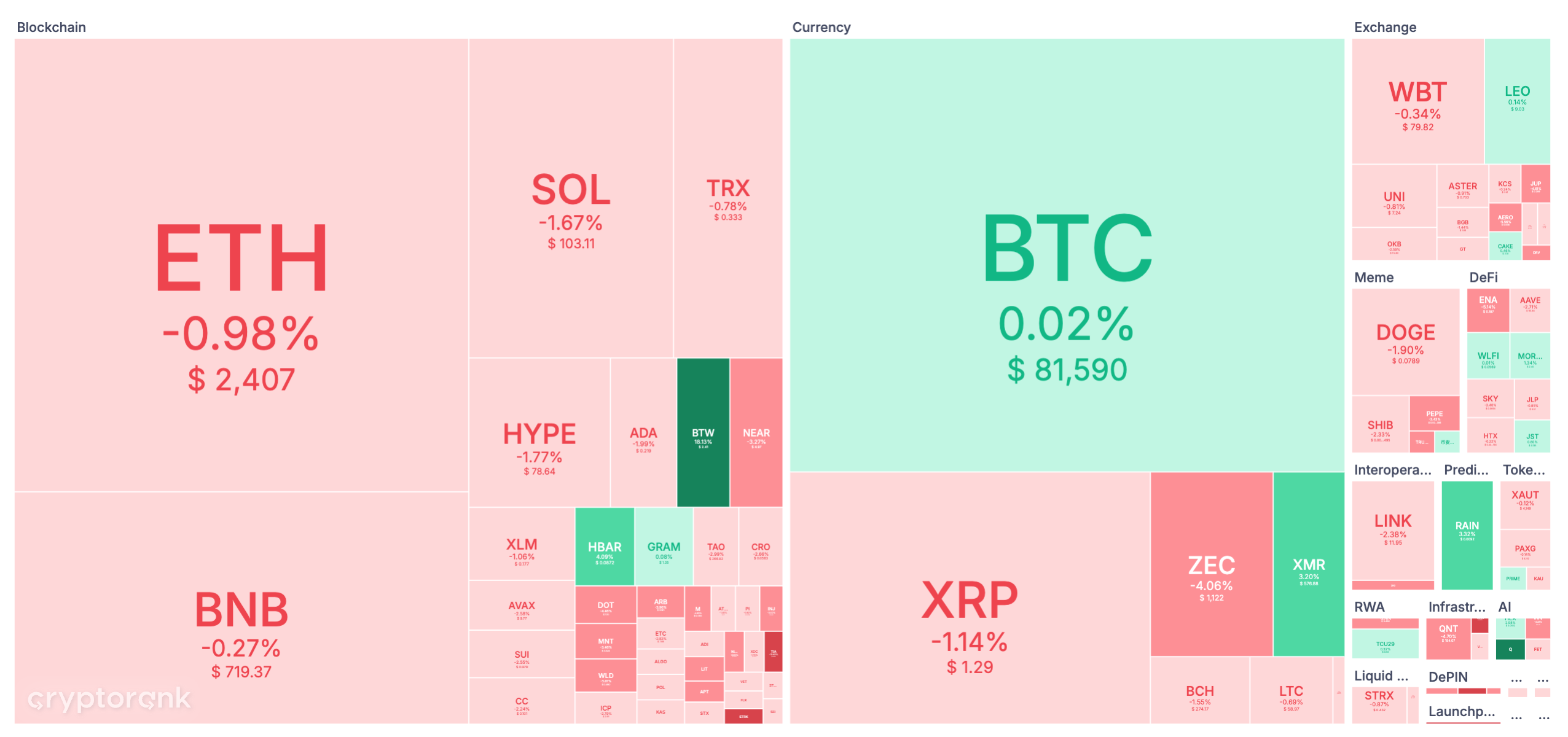
🔥🗺️Heat map shows the 7 day change in price (red down, green up) and block size is market cap
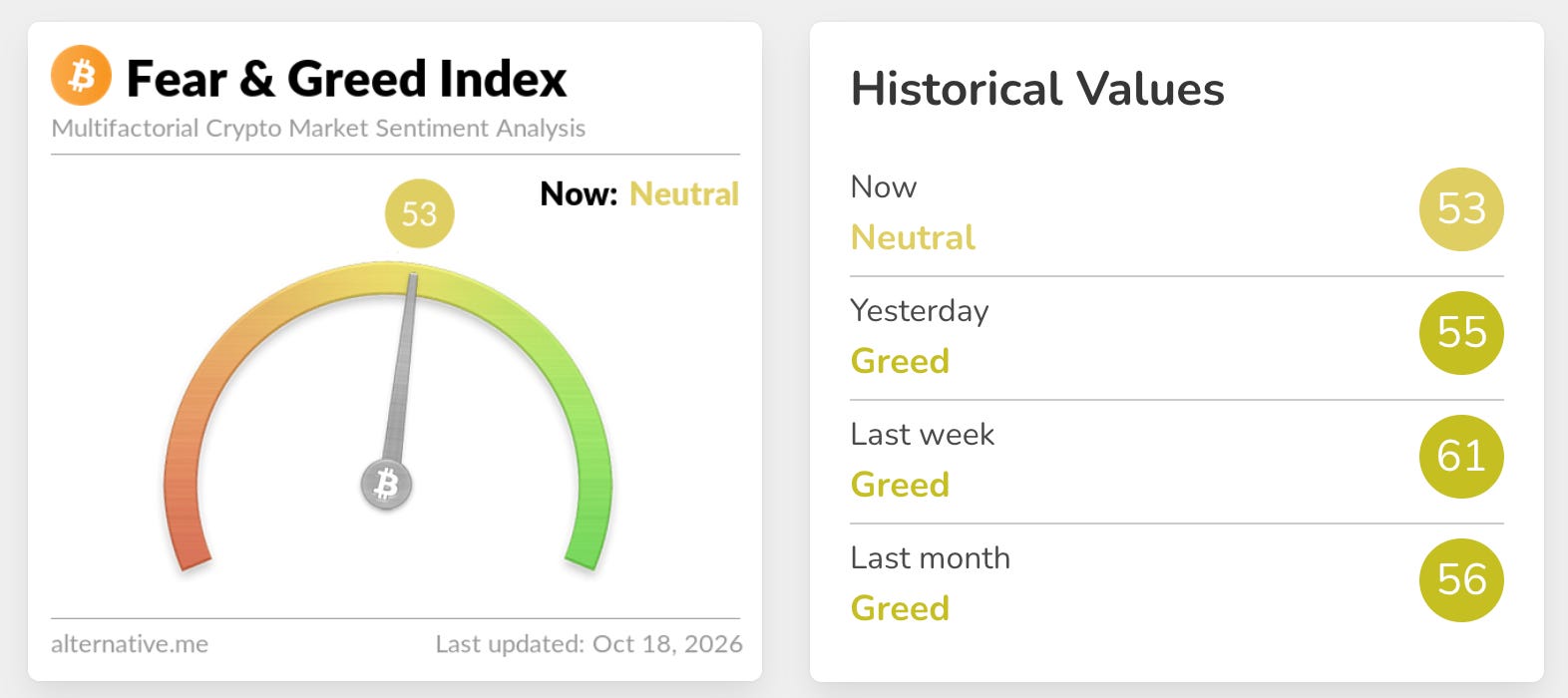
🎭 Crypto Fear and Greed Index is an insight into the underlying psychological forces that drive the market’s volatility. Sentiment reveals itself across various channels - from social media activity to Google search trends - and when analysed alongside market data, these signals provide meaningful insight into the prevailing investment climate. The Fear & Greed Index aggregates these inputs, assigning weighted value to each, and distils them into a single, unified score.

This section captures developments at the edge of digital systems. New interfaces, tools, and capabilities that feel early, unfinished, or slightly ahead of their moment. I’m less interested in what’s impressive today and more interested in what might quietly reshape how people work, coordinate, and interact over time.
The Moon needs its own clock
The decision to retire leap seconds wasn’t the only development in timekeeping this week. At the same meeting in Versailles, delegates also adopted a resolution supporting the development of an internationally coordinated lunar reference time, with a clearly defined relationship to Earth’s UTC. It doesn’t yet establish a fully operational lunar clock system, but it provides a framework for organisations working towards one. (BIPM Resolution 6)
At first glance, the idea of giving the Moon its own time standard seems unnecessary. We already have extraordinarily accurate clocks on Earth, and spacecraft have been using them for decades. But the problem becomes more complicated when you try to establish a permanent network of satellites, landers, instruments and eventually people operating around another celestial body.
According to Einstein’s theory of relativity, time passes at slightly different rates depending on gravity and motion. The Moon’s weaker gravitational environment means that an atomic clock on its surface would tick approximately 56 microseconds faster each day than an equivalent clock on Earth. The difference is imperceptible in ordinary life, but it matters when positioning and navigation systems calculate distance by measuring how long radio signals take to travel. (NIST)
On Earth, satellite navigation systems already account for these effects. GPS satellites carry highly accurate clocks and apply corrections for the differences between time experienced in orbit and time measured on the ground. Building a comparable system around the Moon requires a new set of calculations, common reference points and an agreed way for different spacecraft to synchronise with one another.
This week, the European Space Agency introduced a mission called NovaMoon, designed to help establish some of that infrastructure. The project aims to place atomic clocks and precision measurement instruments on future lunar landers, creating a reference station that could help spacecraft and surface vehicles determine their positions far more accurately. ESA is targeting sub-metre positioning around the lunar south pole by providing corrections to satellite navigation signals. (ESA)
NovaMoon would complement ESA’s wider Moonlight programme, which is developing a network of five satellites around the Moon. Four are intended for navigation and one for communications, with coverage focused particularly on the lunar south pole. The objective is to give future missions some of the same infrastructure we now take for granted on Earth: reliable positioning, navigation and communications without every spacecraft having to build its own independent system. (ESA Moonlight)
These are still developing programmes, and none of this amounts to a functioning lunar equivalent of GPS today. The clocks, reference stations and satellite systems must operate together, and the various space agencies need to agree on standards that allow their equipment to exchange information reliably.
What stood out to me is how quickly a problem that sounds theoretical becomes practical. A few millionths of a second can determine whether a navigation system knows where a spacecraft is. As more independent missions begin operating on and around the Moon, sharing a common understanding of time becomes part of the basic infrastructure required to coordinate them.
We’ve spent centuries improving the accuracy of clocks on Earth, eventually building an international system that supports much of modern digital life. Now researchers and space agencies are beginning to work through the same questions in an environment where gravity, distance and communication delays create different conditions.
The Moon is still a long way from having anything resembling Earth’s everyday infrastructure. Yet some of its most foundational systems are already being designed, including the agreement about how its inhabitants and machines will measure the passage of time.

“The clock, not the steam-engine, is the key-machine of the modern industrial age.”
Lewis Mumford
In his 1934 book Technics and Civilization, Mumford argued that the mechanical clock was among the most consequential inventions of industrial society. By dividing time into consistent, measurable units, it made possible new ways of coordinating factories, commerce and everyday life. The clock gradually changed not only how people measured their days, but how they organised them.
Almost a century later, we’ve reached an interesting point in that relationship. Our clocks have become so precise, and our digital systems so dependent on their consistency, that we’re beginning to loosen the connection between official time and the rotation of the Earth itself.
Mumford saw the clock as a machine that helped organise modern civilisation. We’re still adjusting that machine, even as we begin extending its reach beyond our planet.