
Welcome to this week’s Field Notes, a 10-year project of mine documenting humankind’s digital transition from the field. These notes are shaped by what I’m seeing, building, and discussing as our physical and digital lives continue to converge.
- Ryan
(Connect with me on LinkedIn)

News is surface-level. Signals live underneath. This section captures developments that hint at deeper shifts in how digital systems are being built, governed, and adopted — often before they’re obvious in the mainstream narrative.
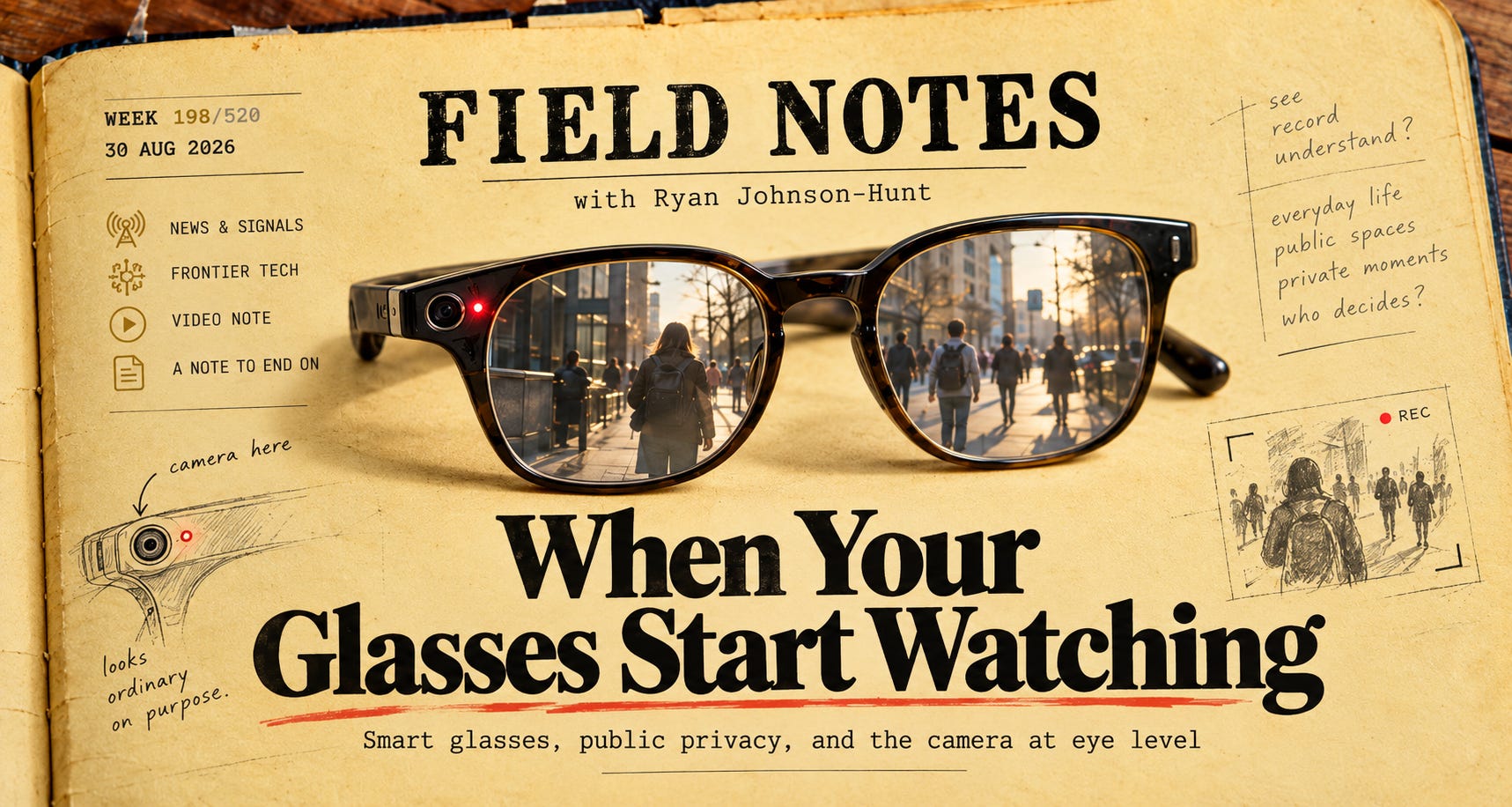
We have spent more than a decade becoming accustomed to cameras being present almost everywhere. Smartphones made photography and video recording ordinary parts of daily life, but there has generally been a recognisable gesture involved. Someone raises a phone, points it in a direction and starts recording. Even when we don’t welcome it, we can usually see what is happening. Smart glasses are beginning to change that arrangement.
This week, Norway announced plans to introduce a temporary ban on AI-enabled glasses in selected public places. The proposed restrictions could cover schools, parks, beaches, healthcare facilities and other settings where people reasonably expect some privacy. The government is also establishing an expert group to consider longer-term regulation of wearable technologies. The restrictions have not yet become law, and officials have been careful to leave room for private use, accessibility and other beneficial applications. (Norwegian Government)
A few days later, Australia’s privacy regulator opened a formal investigation into Shenzhen Qingcheng, the company behind the HeyCyan application used by inexpensive smart glasses sold through retailers including Kmart. The regulator wants to understand how information is collected, who can access it and where it is stored. The investigation follows preliminary inquiries to several manufacturers and distributors, and does not itself establish that a privacy breach has occurred. (OAIC)
These stories are arriving as the devices become more common. Market researcher Omdia estimates that 8.7 million AI glasses were shipped worldwide in 2025, followed by another 4.2 million during the first half of 2026. For now, much of their practical appeal remains relatively simple: recording photos and video without holding a phone, listening to audio and accessing an AI assistant through an ordinary-looking pair of frames. (Omdia)
What makes the technology different is the position it occupies between the person wearing it and everyone around them. A camera mounted at eye level can capture interactions without the familiar behaviour of someone holding up a recording device. Add microphones and AI capable of interpreting what the wearer sees, and the boundary becomes less about whether an image has been taken and more about what can be learned from an ordinary encounter.
There are legitimate applications here, particularly for accessibility, hands-free work and people who need assistance navigating their surroundings. Yet those benefits sit alongside a practical question about consent. The wearer may have chosen to use the technology, while the people sharing the space have made no equivalent decision.
What stood out this week was how quickly that question is moving beyond technology companies. Governments, privacy regulators, schools and retailers are beginning to establish their own boundaries, often before there is any settled agreement about what those boundaries should be.
We seem to be entering a period where the social meaning of looking at someone may become harder to separate from the technology being used to look.

Are AI smart glasses the future, or have they gone too far?
What it is
BBC News brings together AI ethicist Dr Stephanie Hare, Silkie Carlo from privacy organisation Big Brother Watch, and technology analyst Ben Hatton to examine the growing presence of AI-powered smart glasses.
The discussion moves between the practical benefits of devices such as Meta’s Ray-Ban glasses and the privacy concerns emerging as cameras become increasingly difficult to distinguish from ordinary eyewear. The programme also features women who describe being secretly recorded by men wearing smart glasses, providing a more immediate view of how the technology can affect people who have not chosen to use it.
What stood out
The accessibility discussion provides an important counterweight to the privacy concerns. For someone who is blind or visually impaired, glasses capable of describing surroundings, identifying objects or reading a menu can offer a meaningful degree of independence. The same camera and AI capabilities that make these applications possible can also be used to record people without their knowledge.
I also found the comparison with Google Glass interesting. That earlier attempt at wearable computing was conspicuous enough to attract considerable social resistance. Meta’s partnership with EssilorLuxottica has produced devices that look much closer to ordinary glasses, making them easier to adopt but also making their capabilities less obvious to everyone else.
The programme raises the idea of cognitive offloading, where people increasingly delegate remembering, interpreting and understanding their surroundings to technology. That seems worth watching alongside the more immediate recording concerns, particularly as the glasses become capable of responding to what their wearer sees in real time.
Why it matters
What comes through in the discussion is that the technology creates different experiences depending on which side of the camera you occupy. The person wearing the glasses may experience convenience, accessibility or a useful extension of their memory. Someone standing nearby may experience the same interaction very differently, especially if they cannot tell whether they are being recorded.
We have gradually developed social conventions around smartphones, even if those conventions are imperfect. Smart glasses are arriving without many of the familiar signals that help people understand when a camera is being used.
The reports from women who have been secretly filmed make clear that some of these concerns are already being experienced, rather than remaining hypothetical. At the same time, the accessibility benefits suggest that simply removing cameras from wearable technology would come with costs of its own.
The technical capabilities are developing faster than the shared expectations around their use. It is still unclear how much of that gap will be addressed through better device design, regulation or the everyday behaviours people develop around one another.

Digital assets now sit less as an idea and more as infrastructure in progress. As physical and digital life continue to converge, money and digital asset infrastructure are doing the same. What was once framed as “crypto” is increasingly showing up as rails, balance sheets, and policy conversations.
🔥🗺️Heat map shows the 7 day change in price (red down, green up) and block size is market cap

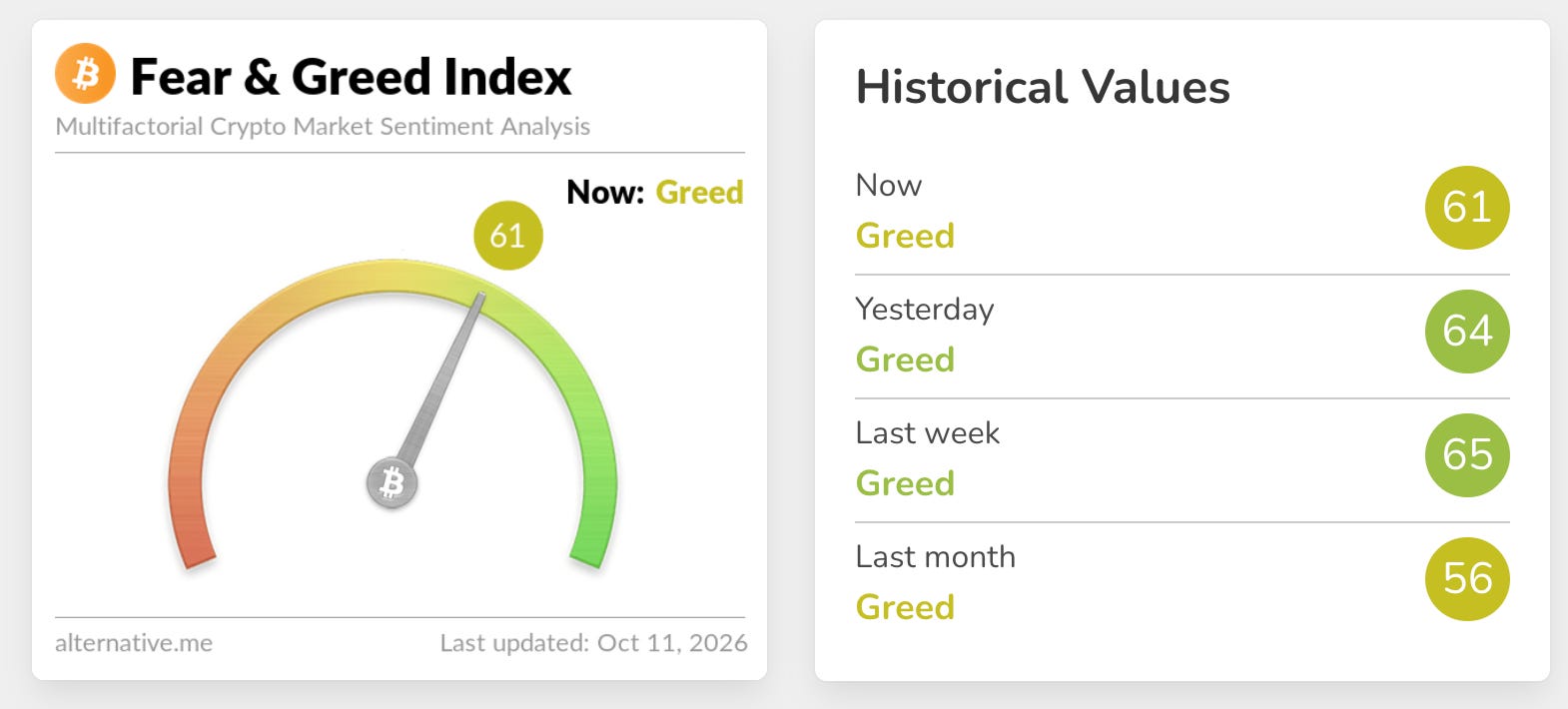
🎭 Crypto Fear and Greed Index is an insight into the underlying psychological forces that drive the market’s volatility. Sentiment reveals itself across various channels - from social media activity to Google search trends - and when analysed alongside market data, these signals provide meaningful insight into the prevailing investment climate. The Fear & Greed Index aggregates these inputs, assigning weighted value to each, and distils them into a single, unified score.

This section captures developments at the edge of digital systems. New interfaces, tools, and capabilities that feel early, unfinished, or slightly ahead of their moment. I’m less interested in what’s impressive today and more interested in what might quietly reshape how people work, coordinate, and interact over time.
Can a camera learn not to remember you?
One of the awkward things about smart glasses is that the people being recorded usually have little control over what happens to their image. Most privacy settings belong to whoever owns the camera, while the people appearing in the recording are left to rely on the wearer’s judgement or ask not to be filmed.
Some researchers are beginning to approach this as a technical problem rather than something that can only be addressed through rules and social expectations.
A research paper published in September describes a system called MIRAGE, designed to protect people who appear in footage captured by smart glasses. Instead of recording everyone normally and applying privacy protections afterwards, the system identifies people in the camera’s field of view and obscures their bodies before the footage is stored or shared. It also explores replacing a person’s appearance with a synthetic version, while retaining encrypted information that could allow their original appearance to be restored with consent. (MIRAGE research paper)
The researchers went beyond conventional facial blurring because faces are only one way people can be identified. Our posture, silhouette and the way we walk can also provide identifying information. In their experiments, obscuring the body substantially reduced the ability of a computer-vision system to recognise an individual from those characteristics.
The technology is still a research prototype, tested using a Raspberry Pi, companion phones and cloud-based processing rather than a commercially available pair of smart glasses. Its reported results also come from controlled evaluations, and the paper has not yet undergone peer review.
Another research project, called BlindSpot, approaches the problem from the perspective of the person being filmed. It explores ways for someone to communicate their privacy preferences directly to a nearby camera, including hand gestures, small light signals and short-range wireless communication. A compatible device could then respond by obscuring that person’s face in its recording. (BlindSpot research)
Both projects remain early, and their limitations are practical as much as technical. A system must identify people reliably, respond quickly, distinguish genuine consent from accidental signals and operate within the limited processing capabilities of wearable hardware. It also depends on manufacturers choosing to implement these protections.
What interests me is the change in how privacy is being approached. Until now, most recording devices have been built around the assumption that the camera owner controls what gets captured. These experiments are beginning to ask what it would look like if the people in front of the camera had some control as well.
That seems like an important distinction as cameras become less visible and more capable of interpreting the world around them.

A Note to End On
“Instantaneous photographs and newspaper enterprise have invaded the sacred precincts of private and domestic life.”
Samuel D. Warren and Louis D. Brandeis, 1890
In their influential essay The Right to Privacy, Warren and Brandeis were responding to the arrival of new photographic technologies and newspapers increasingly willing to publish details of people’s private lives. They argued that the law needed to recognise something beyond the protection of property or reputation: the right to be left alone.
It is interesting how familiar their concerns feel 136 years later. Cameras have become smaller, more accessible and increasingly capable of interpreting what they capture, but the underlying tension has changed surprisingly little. Technology continues to expand what we can observe and record about one another, while our expectations of privacy develop more slowly.
Perhaps what has changed most is how little effort it now takes to turn an ordinary encounter into a permanent record.