
Welcome to this week’s Field Notes, a 10-year project of mine documenting humankind’s digital transition from the field. These notes are shaped by what I’m seeing, building, and discussing as our physical and digital lives continue to converge.
- Ryan
(Connect with me on LinkedIn)

News is surface-level. Signals live underneath. This section captures developments that hint at deeper shifts in how digital systems are being built, governed, and adopted — often before they’re obvious in the mainstream narrative.
When the laboratory starts running itself
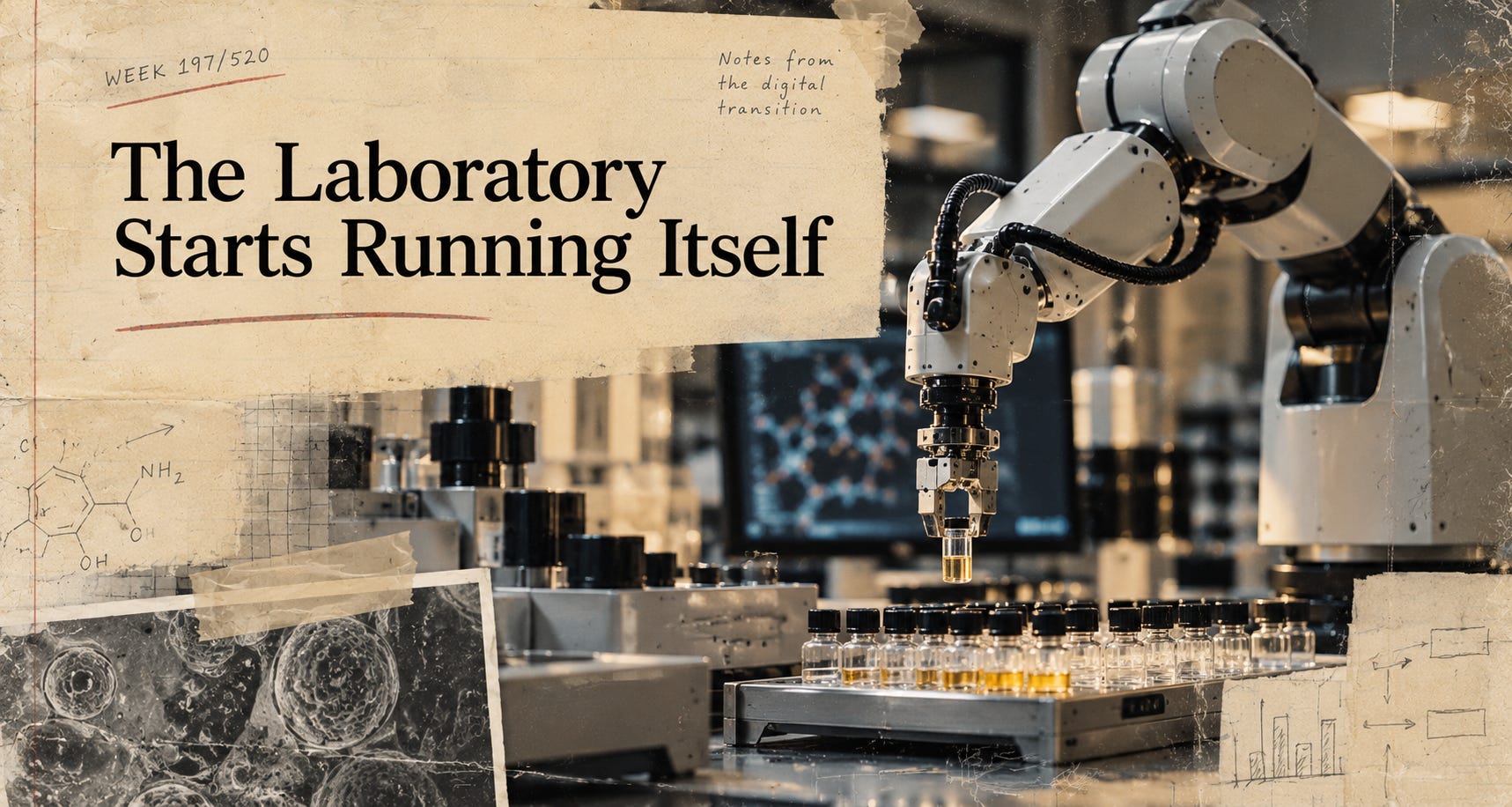
For most of the AI era, the laboratory has remained one of the places where the boundary between digital and physical work is fairly clear. Models can search scientific literature, predict molecular structures and help researchers decide where to look, but eventually somebody still has to run the experiment.
That boundary is beginning to move. Roche said last week that it has started building autonomous AI laboratories as part of its pharmaceutical research operation. The idea is to connect AI models with laboratory automation so that parts of the experimental cycle can run continuously: choosing what to test, carrying out an experiment, measuring the result and feeding what was learned back into the system. (Reuters) Reuters
The concept is usually called a self-driving laboratory, and it has been developing quietly across chemistry and materials science for several years. A recent Nature Reviews Chemistry review describes systems that combine autonomous experimentation, robotics and AI, with algorithms increasingly able to propose, execute and interpret experiments with limited human intervention. The field is still constrained by how difficult it is to make these systems scalable and general enough to move between different kinds of science. (Nature Reviews Chemistry) Nature
What stood out about Roche is less the individual technology than where it is appearing. This is no longer confined to a university robotics laboratory trying to prove that autonomous experimentation works. One of the world’s largest pharmaceutical companies is beginning to build the approach into its research infrastructure.
There is a useful distinction here between automation and autonomy. Laboratories have been automated for decades. Machines already pipette liquids, screen compounds and perform repetitive measurements. Autonomy begins when the system uses the result of one experiment to decide what experiment should happen next. That changes the loop.
A scientist can still define the problem and the boundaries of the search, but some of the exploration between question and answer can increasingly be handed to a system capable of running experiments around the clock. Scientific progress has always been constrained partly by the time and cost required to test ideas in the physical world. Autonomous laboratories are an attempt to compress that part of the process.
It feels early, and the distinction between a genuinely autonomous scientist and sophisticated laboratory optimisation matters. But something structural is starting to appear. AI is slowly moving from analysing the record of what humans have already discovered toward participating in the process through which new experimental evidence is created.

Inside the Lab Where AI Runs the Experiments
What it is
FutureHouse is trying to automate more of the scientific process than simply analysing data or searching research papers. Co-founder Andrew White describes the goal as an “AI scientist”: systems that can find questions worth investigating, search the existing evidence, develop hypotheses and ultimately connect those ideas to experiments in a physical laboratory.
The organisation has built its own wet lab for this reason. White makes an interesting distinction between building AI tools for scientists and using those tools to actually make discoveries. The laboratory provides somewhere for ideas generated by the system to encounter the physical world.
What stood out
One of the earlier projects behind FutureHouse was ChemCrow, which connected a language model to chemistry tools and a self-driving robotic laboratory. White describes being able to give it an objective such as creating a molecule with a particular property, then allowing the system to work through the tools required to make it without human involvement.
But the larger constraint becomes clearer later in the video. White notes that science is not simply an intelligence problem. Researchers need access to literature, specialised databases, computational tools and, eventually, physical experiments. Making the model more capable only addresses part of that system.
FutureHouse is effectively trying to assemble the rest of it around the model.
The scale becomes interesting when those pieces are connected. White gives one example involving roughly 40,000 individual investigations into relationships between hormones and observed behaviours in mice. AI agents searched the literature for each relationship and assembled information that would have been difficult for a researcher to investigate individually.
Why it matters
There is a tendency to think about scientific AI in terms of a smarter researcher: a model that reads more papers, understands more disciplines or generates better hypotheses. This video makes the infrastructure around that intelligence more visible.
A hypothesis still has to meet reality.That requires instruments, samples, measurements and experiments, followed by some way of returning those results to the system so it can decide what to investigate next. Once those pieces begin connecting, the interesting change is not simply that individual scientific tasks become faster. The entire cycle between question and evidence can begin to shorten.
White imagines scientists increasingly delegating workflows to groups of agents and spending more of their own time deciding which questions deserve attention and checking the work being produced. His timeline may or may not prove accurate, but the shift in the structure of the work is already worth watching.
For now, the scientist remains very much inside the loop. What is changing is how much can happen before they need to step back into it.

Digital assets now sit less as an idea and more as infrastructure in progress. As physical and digital life continue to converge, money and digital asset infrastructure are doing the same. What was once framed as “crypto” is increasingly showing up as rails, balance sheets, and policy conversations.
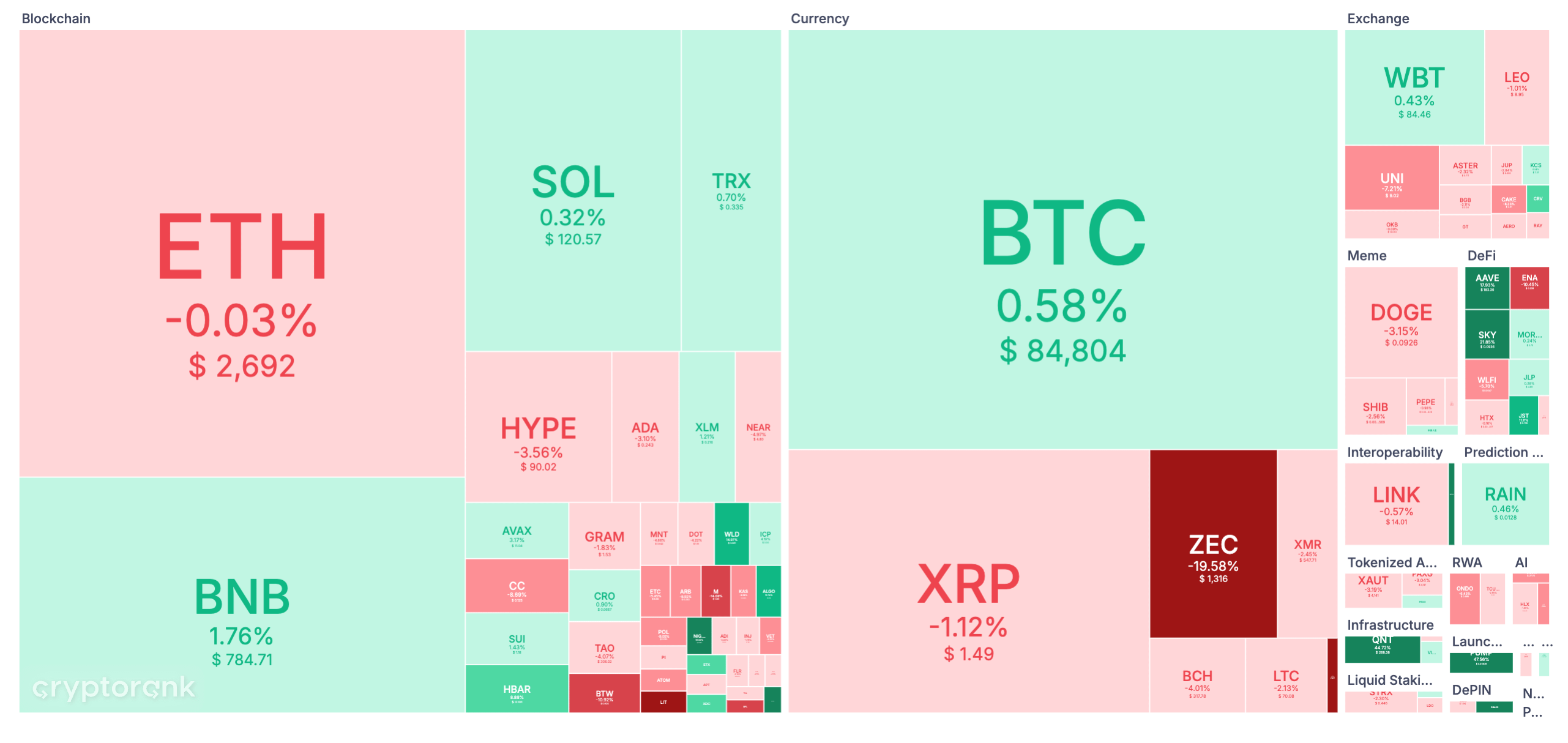
🔥🗺️Heat map shows the 7 day change in price (red down, green up) and block size is market cap
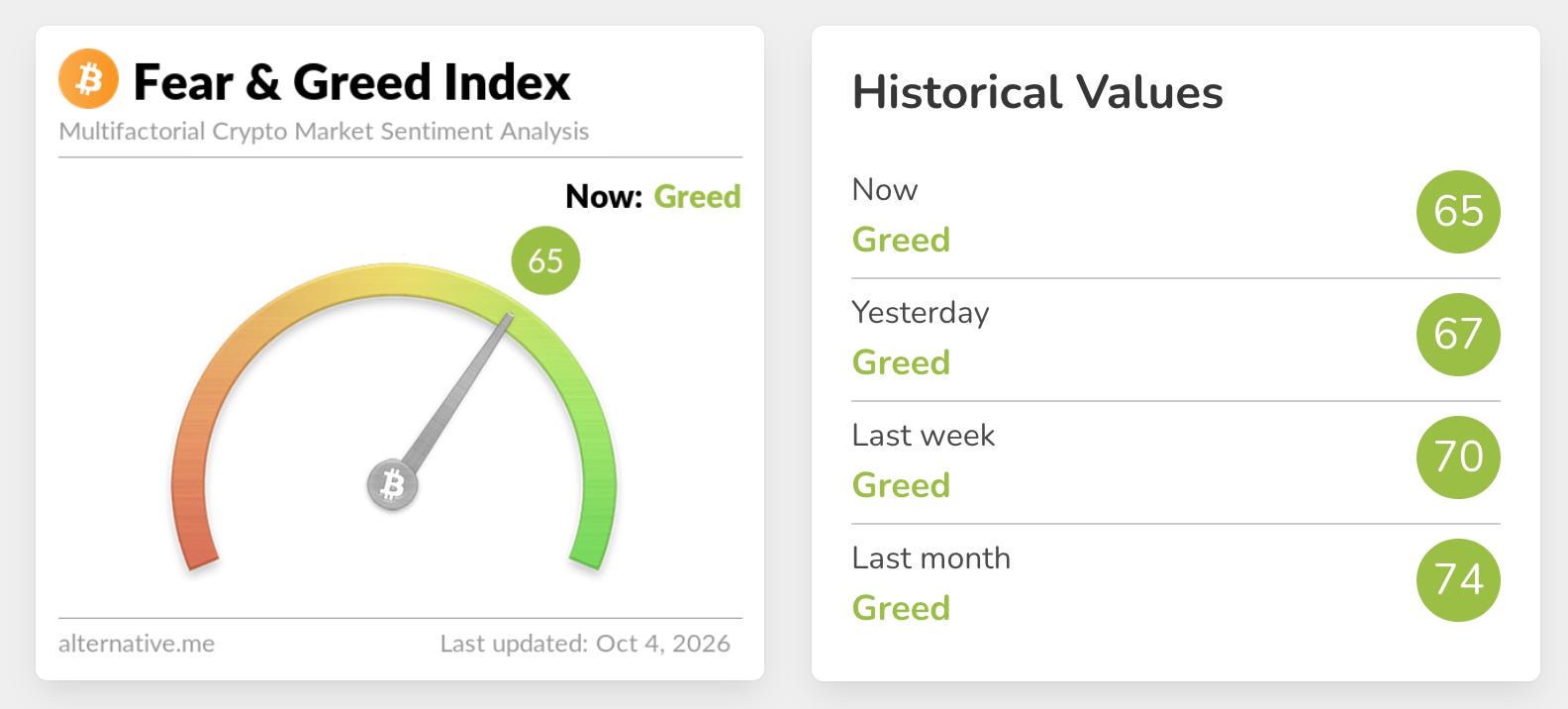
🎭 Crypto Fear and Greed Index is an insight into the underlying psychological forces that drive the market’s volatility. Sentiment reveals itself across various channels - from social media activity to Google search trends - and when analysed alongside market data, these signals provide meaningful insight into the prevailing investment climate. The Fear & Greed Index aggregates these inputs, assigning weighted value to each, and distils them into a single, unified score.

This section captures developments at the edge of digital systems. New interfaces, tools, and capabilities that feel early, unfinished, or slightly ahead of their moment. I’m less interested in what’s impressive today and more interested in what might quietly reshape how people work, coordinate, and interact over time.
A laboratory that decides what experiment comes next
Researchers reported the system in Nature Synthesis earlier this year. It is a modular self-driving chemistry laboratory designed specifically to make autonomous experimentation cheaper and more accessible. Rather than requiring an enormous bespoke robotic facility, it combines relatively affordable custom hardware with software that can control laboratory equipment and decide how to alter subsequent experiments. (Nature Synthesis) Nature
This is where the idea becomes much easier to understand. A researcher gives the system an objective, such as finding better conditions for a particular chemical reaction. RoboChem-Flex performs an experiment and analyses the result. An optimisation algorithm then uses what happened to choose the conditions for the next experiment. Temperature, concentrations, reaction times or other variables can change as the system explores the available chemical space.
The important part is that it doesn’t necessarily test every possible combination. It learns from the experiments it has already performed and uses that information to decide where it should look next. The researchers demonstrated the platform across six different chemistry problems, including photocatalysis, biocatalysis and thermal reactions, and showed that it could operate either autonomously or with a scientist remaining inside the loop. Nature
There is a useful connection here to the way we normally imagine scientific discovery. A human researcher doesn’t blindly perform every conceivable experiment either. Experience gradually creates intuition about which direction might be worth exploring. Self-driving laboratories are beginning to build a much narrower computational version of that process.
The technology remains highly specialised. A machine capable of optimising a chemical reaction is not independently deciding which scientific questions matter, and the broader field still struggles with moving autonomous systems between different laboratory environments. A 2026 review of self-driving laboratories identifies scalability, generalisability and complete experimental provenance as some of the problems that still need to be solved. (Nature Reviews Chemistry) Nature
But RoboChem-Flex makes the direction tangible. The interesting development isn’t simply that a robot can perform an experiment. Laboratory robots have done that for years. It is that the result can become an input into the decision about what the robot should do next.
Last week I was looking at the enormous effort required to give machines physical experience. This feels like another version of the same transition, but in a different setting. Once a machine can interact with the physical world, the question becomes what it can learn from those interactions. In the laboratory, we are beginning to get an answer.

“The important thing is not to stop questioning.”
Albert Einstein
The line comes from a short reflection Einstein gave late in his life about curiosity and the value of continuing to ask questions even when answers remain incomplete.
It feels appropriate this week because autonomous laboratories don’t remove the question from science. If anything, they make the quality of the question more important. A system might eventually search thousands of papers, generate possible explanations and run experiments at a pace no individual researcher could match, but somebody still has to decide what is worth looking for.
For a long time, experimentation has placed a natural limit on curiosity. There are only so many experiments a person, laboratory or institution can run. We may be starting to loosen that constraint.