
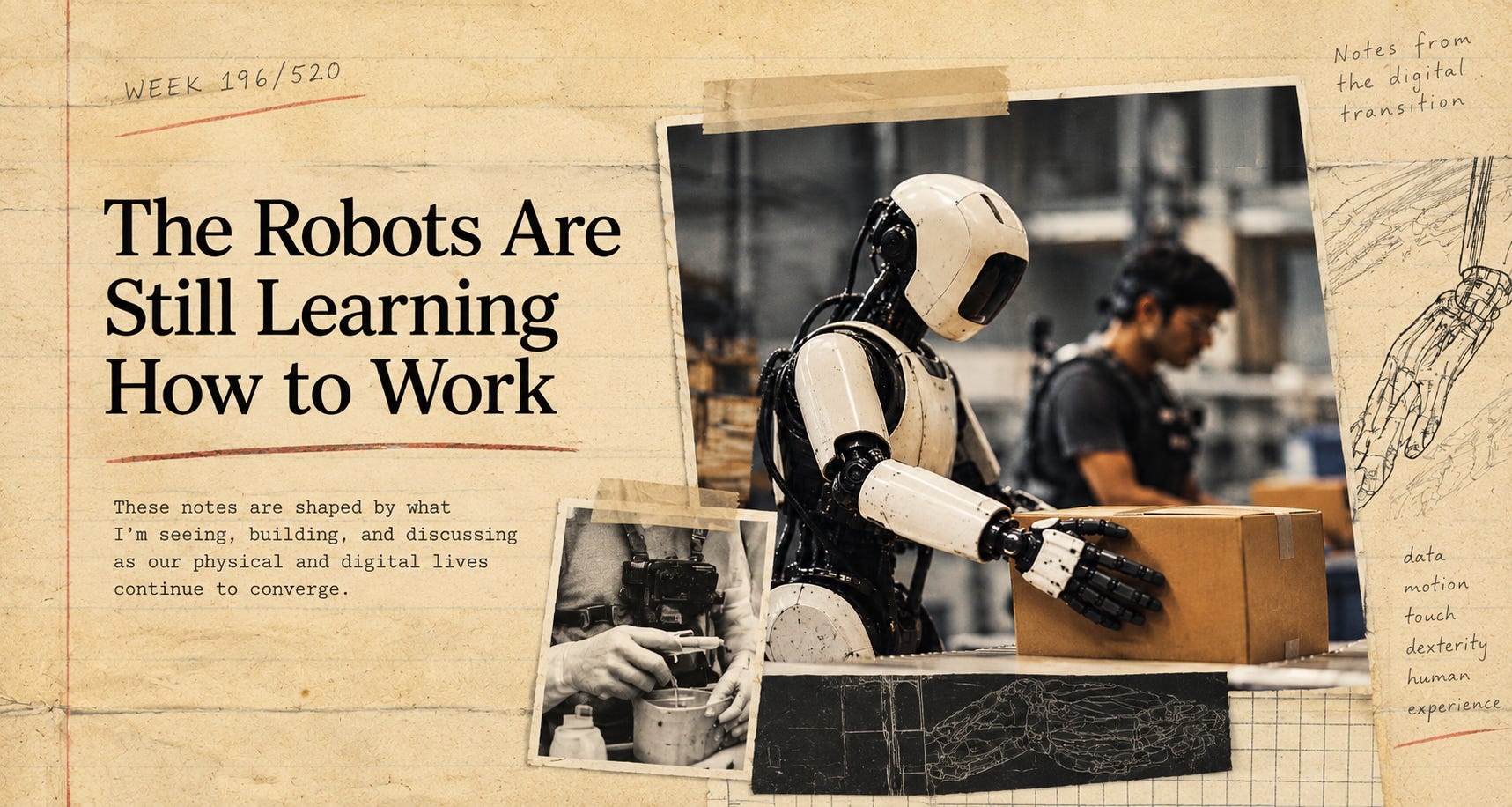
Welcome to this week’s Field Notes, a 10-year project of mine documenting humankind’s digital transition from the field. These notes are shaped by what I’m seeing, building, and discussing as our physical and digital lives continue to converge.
- Ryan
(Connect with me on LinkedIn)

News is surface-level. Signals live underneath. This section captures developments that hint at deeper shifts in how digital systems are being built, governed, and adopted — often before they’re obvious in the mainstream narrative.
The robots are still learning how to work
For several years, humanoid robots have existed in a strange space between industrial machinery and demonstration. They walk across stages, carry boxes through carefully arranged warehouses and occasionally fold a shirt. The videos suggest a technology moving quickly. What has been harder to see is how much of that activity has made its way into ordinary work.
This week we got a better measure. The International Federation of Robotics has begun tracking humanoids separately for the first time, estimating that only around 7,000 humanoid robots were sold globally in 2025 for industrial and professional use. That remains a small number beside the hundreds of thousands of conventional industrial robots installed each year. Even manufacturers experimenting seriously with humanoids are generally working with fleets measured in single digits or low double digits. (Reuters)
What stood out wasn’t really the number. It was what many of those robots are being used for. A significant share are going to research institutions, robotics companies and industrial pilots where their immediate purpose isn’t necessarily productive work. They are collecting data. Every attempt to pick something up, navigate an unfamiliar space or recover from a mistake produces another example that can be used to improve the models controlling the machine.
There is a useful contrast here with the development of large language models. By the time the current generation of AI arrived, humans had already spent decades creating an enormous digital record of language and behaviour. Books, websites, photographs, video, software and code existed before anyone decided to use them as training material.
Robotics inherited no comparable record of the physical world. We don’t have trillions of neatly captured examples showing how a hand adjusts when a cardboard box begins to slip, how someone moves around an unexpected obstacle on a factory floor, or how much pressure is required to handle thousands of slightly different objects. Much of what humans know about moving through the physical world was never written down because it never needed to be.
So the machines are beginning to collect it themselves. That helps explain another development this week. In China, where investment in humanoid robotics has accelerated particularly quickly, regulators are beginning to scrutinise companies seeking public listings and asking harder questions about where their revenue actually comes from. Some robotics businesses have been generating income through data-collection centres, facilities where robots repeatedly perform tasks specifically to produce training data. Investors and regulators are now trying to distinguish that activity from sustainable demand for robots doing economically useful work.
That distinction feels worth recording. It doesn’t necessarily mean the humanoid thesis is weakening. It may simply tell us where the technology actually is. Elsewhere in robotics, the picture is much more mature. Conventional industrial robots already operate at enormous scale, doing repetitive tasks inside environments designed around them. A welding robot doesn’t need to understand a factory. Its section of the factory has been engineered so that understanding is largely unnecessary.
The proposition behind humanoids is almost the reverse. Our warehouses, factories, hospitals, kitchens, tools, stairs and doorways were designed around human bodies. Rather than redesigning those environments around machines, the industry is trying to build a machine capable of entering environments designed for us. That requires something closer to general physical competence. And physical competence appears to require experience.
For now, some of the first humanoid robots aren’t replacing workers. They aren’t really workers yet. They are gathering the experience that the robots coming after them may need.

The Indian workers training AI robots to take their jobs
What it is
This short AFP report visits workers in India who are being paid to record themselves carrying out ordinary household tasks. Wearing a camera system, they repeat actions from different positions, with different objects and against changing backgrounds. One worker says they produce more than 90 videos a day, systematically changing angles and actions so that each recording adds another variation to the dataset.
The work is mundane by design. These are the kinds of movements humans perform without thinking, but which need to be captured and labelled if machines are eventually going to learn how to reproduce them.
What stood out
The economics are interesting. One worker describes being paid 250 rupees an hour to perform household tasks that would normally go unpaid. There is something unusual about physical knowledge that has never had an obvious market value suddenly becoming useful because a machine needs to learn it.
The repetition also gives a sense of how much data is required. The same action is recorded from different angles and positions, with different objects and surroundings. What looks to us like a single task becomes dozens of slightly different examples once you try to describe it to a machine.
The most revealing observation comes near the end. One worker expects a future filled with robotics and AI, but doesn’t see humans disappearing from it because, as he puts it, “without human data… those can’t run.”
Why it matters
That line captures much of what stood out to me about humanoid robotics this week. The machines are becoming more capable, but underneath that progress sits an increasingly large human effort to capture things we have never previously needed to record.
The internet gave language models an enormous archive of what humans had written, photographed and coded. There is no equivalent archive for how we move through a kitchen, pick up an unfamiliar object or adjust our hands when something starts to slip. That knowledge exists largely in our bodies.
For now, teaching machines physical intelligence still requires humans to turn some of that tacit knowledge into data. There is an unresolved tension in people being paid to record the very movements that machines may eventually learn to perform without them.
The robots are learning from us while we are still figuring out what that means for the people doing the teaching.


Digital assets now sit less as an idea and more as infrastructure in progress. As physical and digital life continue to converge, money and digital asset infrastructure are doing the same. What was once framed as “crypto” is increasingly showing up as rails, balance sheets, and policy conversations.
🔥🗺️Heat map shows the 7 day change in price (red down, green up) and block size is market cap

🎭 Crypto Fear and Greed Index is an insight into the underlying psychological forces that drive the market’s volatility. Sentiment reveals itself across various channels - from social media activity to Google search trends - and when analysed alongside market data, these signals provide meaningful insight into the prevailing investment climate. The Fear & Greed Index aggregates these inputs, assigning weighted value to each, and distils them into a single, unified score.


This section captures developments at the edge of digital systems. New interfaces, tools, and capabilities that feel early, unfinished, or slightly ahead of their moment. I’m less interested in what’s impressive today and more interested in what might quietly reshape how people work, coordinate, and interact over time.
The robots are growing a sense of touch
We tend to think about robots understanding the world primarily through cameras. Better vision, better models and more computing power have allowed machines to recognise an extraordinary range of objects and environments, but working with those objects introduces a different problem. Humans don’t rely on sight alone when we pick something up. As soon as our fingers make contact, we are sensing pressure, texture and movement, making small adjustments to our grip without really thinking about them.
Touch remains much less developed in robotics. This week, researchers gathering at the IROS robotics conference are looking specifically at scalable tactile sensing for dexterous manipulation, including the difficult problem of giving robotic hands useful information about contact while they are moving and handling objects. Existing sensors still have limitations around resolution, coverage, speed and durability, particularly when compared with the sensitivity packed into a human hand. (IROS 2026)
The technology is gradually starting to look less like a simple pressure sensor and more like an artificial layer of skin. Sensors distributed across robotic fingers and hands can detect where contact is occurring, how pressure is distributed and whether an object is moving against the hand. That information can then be combined with cameras and information about the position of the robot’s joints, giving the model controlling the machine another way of understanding what is happening.
Synaptics recently demonstrated one version of this approach with a capacitive tactile sensing system for robotic hands and grippers. It captures contact and pressure information alongside vision and motor-control signals, and has been integrated into NVIDIA’s Isaac Sim environment so that some of these interactions can be modelled and trained in simulation before being attempted by a physical robot. (Synaptics)
This is still early technology, but it helps explain why dexterity remains such a difficult part of humanoid robotics. Recognising a glass on a table is quite different from knowing how firmly to hold it, noticing that it has started to slip, or adjusting when it turns out to be heavier than expected. Factories, homes and hospitals are full of objects that bend, move, break, spill and behave slightly differently each time they are handled. Humans manage most of that variation without consciously processing it.
It also connects with the wider training problem emerging around humanoid robots. The industry is not simply trying to build stronger motors or more articulated hands. It is gradually assembling the sensory systems and physical experience that allow a machine to understand what happens when it interacts with the world.
The first generation of AI had an enormous advantage in this respect. Much of the information it needed had already been recorded by humans in books, websites, photographs, videos and code. Physical intelligence has no equivalent archive waiting to be scraped. Some of the information these machines need has never been recorded because, for us, it has always been something we simply feel.

“We know more than we can tell.”
Michael Polanyi
Polanyi introduced this idea in The Tacit Dimension in 1966. He was interested in the knowledge humans carry without necessarily being able to explain it: recognising a face, riding a bicycle, using our hands, or developing a feel for a task through repetition.
It feels particularly relevant to the workers recording themselves for robot training. Much of what they are capturing was never written down because there was never much reason to write it down. It existed in movement, habit and accumulated experience. For machines to learn some of these things, that tacit knowledge is having to become visible for the first time.
Perhaps one of the more interesting records of this period will be how much we discover about what humans know only when we try to teach it to something else.