

Welcome to this week’s Field Notes, a 10-year project of mine documenting humankind’s digital transition from the field. These notes are shaped by what I’m seeing, building, and discussing as our physical and digital lives continue to converge.
- Ryan
(Connect with me on LinkedIn)

News is surface-level. Signals live underneath. This section captures developments that hint at deeper shifts in how digital systems are being built, governed, and adopted — often before they’re obvious in the mainstream narrative.
News
The rules stalled. Tokenisation didn’t.
For much of the past few years, the assumption around digital assets in the United States has been that meaningful institutional adoption would eventually require Congress to settle the rules. This week offered a more complicated picture. On Tuesday, the Senate failed to advance the CLARITY Act, the most significant attempt yet to establish a comprehensive federal market structure for digital assets. Two days later, the SEC opened a new pathway for tokenised US-listed stocks to trade on blockchain infrastructure. Legislation stalled. The underlying transition continued.
The Senate vote was a genuine setback for the CLARITY Act. The bill received a simple majority but fell short of the 60 votes required to advance, after disagreements spanning ethics provisions, investor protections and the treatment of different parts of the crypto market. One senator changed his vote for procedural reasons, preserving the possibility that the legislation could be reconsidered, so the bill is stalled rather than necessarily dead. But with the US midterm elections approaching, the window for passing comprehensive market-structure legislation has narrowed considerably. (Reuters)
What happened 48 hours later was therefore particularly interesting. On 17 September, the US Securities and Exchange Commission introduced a five-year Innovation Exemption for certain tokenised US-listed stocks. Under tightly defined conditions, qualifying venues will be able to let permissioned participants trade tokenised shares using automated market makers and liquidity pools running on public, permissionless blockchains. The exemption also creates limited relief for firms supplying liquidity to those markets. It runs until September 2031, giving regulators several years to observe how this architecture behaves before deciding what should become permanent. (SEC)
The detail matters because this goes further than simply putting a digital representation of a share on a blockchain. The SEC framework explicitly contemplates tokenised stocks trading against other tokenised stocks, qualifying stablecoins or tokenised money-market funds through automated liquidity pools. In other words, some of the market structure developed inside crypto is being allowed to touch conventional US equities. The underlying stock remains a regulated security with the same economic rights, including dividends and voting rights. What changes is part of the infrastructure through which that asset can be held and exchanged.
This is still an experiment, not a wholesale migration of Wall Street onto public blockchains. The SEC has imposed limits on the number of stocks that can be offered and the proportion of their trading volume that can move through these venues. Platforms must meet disclosure, recordkeeping and transparency requirements, participants must be permissioned, and issuers can object to unaffiliated third parties tokenising their shares. The exemption also doesn’t remove the underlying securities from existing investor-protection and anti-fraud laws.
But the timing is difficult to ignore. Congress spent years trying to agree on a comprehensive framework for digital assets and this week failed, at least for now, to get that framework through the Senate. Meanwhile, regulators are beginning to use the authority they already have to create narrower pathways through which parts of traditional finance can experiment with the same infrastructure.
There are other signals accumulating around this. Banks are experimenting with stablecoins and tokenised deposits. Funds and government securities are increasingly being represented on-chain. India has just begun a pilot in which tokenised corporate bonds can settle against its digital rupee. Now the SEC is creating a controlled environment in which actual US-listed equities can meet stablecoins and automated market makers on public blockchain rails. The political system is still negotiating what digital-asset markets should look like. Parts of the financial system are already beginning to test them.

CLARITY Act Fails Key Senate Vote: What’s Next for Bitcoin, Other Crypto Assets?
What it is
Schwab Network speaks with Ray Salmond following the CLARITY Act’s failure to clear a key procedural vote in the US Senate. The immediate discussion is framed around what the setback means for crypto markets, but it also gets into the more structural question running through this week’s Field Notes: whether the development of digital financial infrastructure actually waits for Congress to establish a comprehensive set of rules.
What stood out
Salmond’s central observation is that the failed vote is a setback for regulatory clarity, but not necessarily a derailment of what is already underway. The SEC and CFTC still have their own rulemaking processes, while large financial institutions have existing regulatory pathways through which they can continue experimenting with digital assets and tokenisation.
He points specifically to institutions such as BlackRock, ARK Invest and Fidelity potentially making greater use of the SEC’s tokenisation framework. That is the part of the conversation that stood out to me. The political process and the infrastructure build are increasingly moving on different clocks.
The immediate market reaction was less patient. Bitcoin was down around 4.4% at the time of the discussion and Coinbase had fallen more than 11%, although the CLARITY vote was only one part of the backdrop, with markets also waiting on an upcoming Federal Reserve interest-rate decision. Salmond remains constructive on Bitcoin over the longer term, but the price discussion feels almost secondary to the institutional movement happening underneath it.
Why it matters
For years, regulatory clarity has been treated as one of the prerequisites for traditional finance moving meaningfully on-chain. This week complicates that assumption.
Congress still matters. Comprehensive legislation would provide something that individual exemptions and agency rulemaking cannot: a more durable framework defining how digital assets fit within the US financial system. But institutions aren’t necessarily waiting for every part of that framework to be settled before building.
That distinction feels increasingly important. Markets can react to a failed vote in hours. Legislation can take years. Infrastructure tends to accumulate somewhere in between.
This week, all three were visible at once.

Digital assets now sit less as an idea and more as infrastructure in progress. As physical and digital life continue to converge, money and digital asset infrastructure are doing the same. What was once framed as “crypto” is increasingly showing up as rails, balance sheets, and policy conversations.
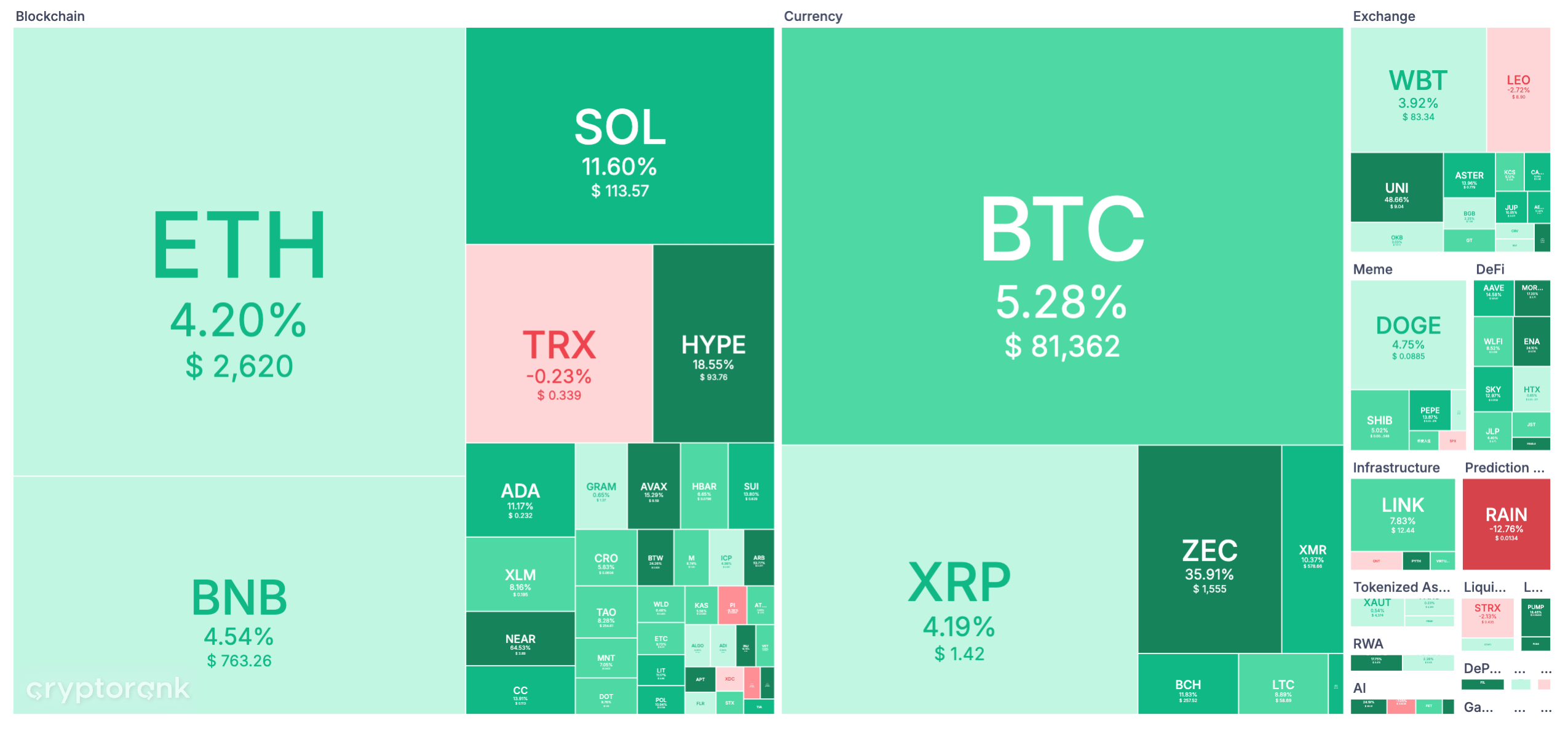
🔥🗺️Heat map shows the 7 day change in price (red down, green up) and block size is market cap
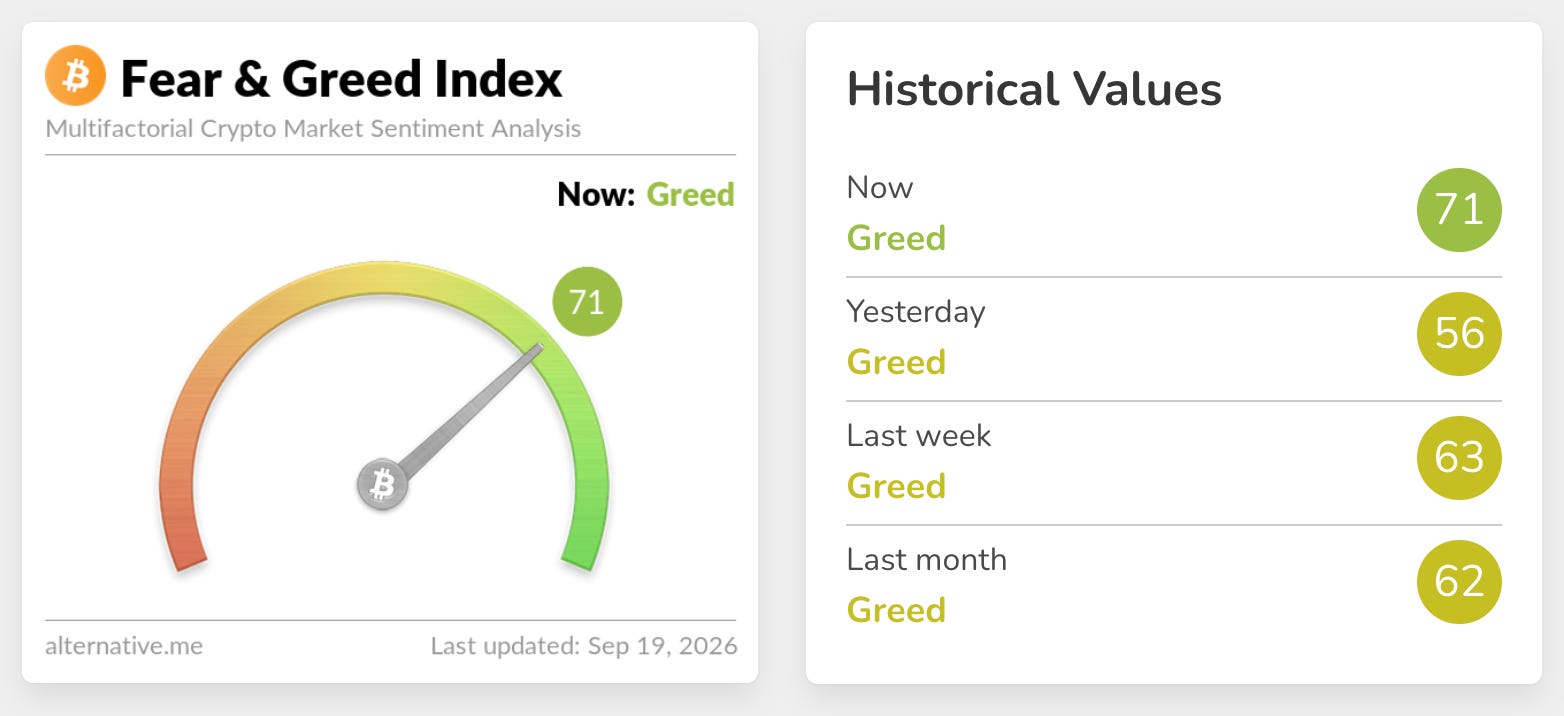
🎭 Crypto Fear and Greed Index is an insight into the underlying psychological forces that drive the market’s volatility. Sentiment reveals itself across various channels - from social media activity to Google search trends - and when analysed alongside market data, these signals provide meaningful insight into the prevailing investment climate. The Fear & Greed Index aggregates these inputs, assigning weighted value to each, and distils them into a single, unified score.

This section captures developments at the edge of digital systems. New interfaces, tools, and capabilities that feel early, unfinished, or slightly ahead of their moment. I’m less interested in what’s impressive today and more interested in what might quietly reshape how people work, coordinate, and interact over time.
Frontier Tech: Title-backed Tokens
Most property tokenisation starts one step removed from the property itself. A company or fund owns the building, and investors own tokens representing an interest in that company or fund. The blockchain may make the investment easier to administer or transfer, but underneath it is essentially a familiar investment structure with a new digital layer.
At Toroa, we have been exploring a different starting point: the property itself. The idea behind our title-backed token methodology is to connect digital ownership as directly as possible to an interest in a real property. Exactly how that connection is made will depend on the property and the laws of the country involved. That is part of what we are working through now.
One of the first projects we are exploring is a new hotel and spa development on a vineyard in Argentina. Rather than approaching the development only through conventional property finance, we are looking at whether part of the property could ultimately be divided into a fixed number of digital ownership interests.
In simple terms, imagine a hotel divided into a defined number of ownership pieces. Each piece has a digital token attached to it. Holding one could represent a corresponding interest in the underlying property, with the potential to receive a share of the income generated by the hotel and participate in the value of the property over time. The token provides a digital way of keeping track of who owns each piece and, potentially, making those interests easier to transfer between eligible owners.
That starts to address something property has always struggled with. A building can be extremely valuable, but it is difficult to divide and relatively slow to transact. Selling an entire hotel is a major event. Even selling a smaller interest can involve layers of paperwork, administration and intermediaries. Digital ownership could make smaller interests easier to keep track of, simplify distributions to owners and create a clearer path for those interests to change hands.
But putting something on a blockchain doesn’t make the real-world complexity disappear. A token might move between two digital wallets in seconds, while the vineyard and hotel remain very physical assets sitting in Argentina. The rights attached to them still have to work in the real world. That means working through what the digital interest actually represents, how ownership is recognised, what happens when an interest changes hands and how the digital record stays connected to the property behind it.
That is where much of our work on the Argentine vineyard project currently sits. We have a methodology and a proposed model, but we are deliberately leaving room for the final structure to emerge through the legal and practical work now underway. The technology can only be useful if someone holding the token can clearly understand what they own and those rights continue to mean something away from the blockchain.
This is why I find title-backed tokens more interesting than simply putting another investment product on-chain. The experiment isn’t really about whether we can create a token representing a hotel. We already know how to create tokens.
The harder question is whether we can make digital ownership and physical property behave as parts of the same system.

“Anything that is in the world when you’re born is normal and ordinary and is just a natural part of the way the world works.”
Douglas Adams
Adams wrote about the strange way humans absorb technological change. What initially feels unfamiliar eventually becomes infrastructure, and the generation that arrives afterwards often encounters it without remembering the transition at all.
There is something of that happening with tokenisation. Today we still make a distinction between a share, bond or property interest and its digital representation. We debate whether financial assets should move onto blockchain rails, which rules should apply and which institutions should be allowed to participate.
A decade from now, some of those distinctions may still matter. Others may sound strangely specific to this period.
For now, we’re still living through the part where the terminology hasn’t settled.