
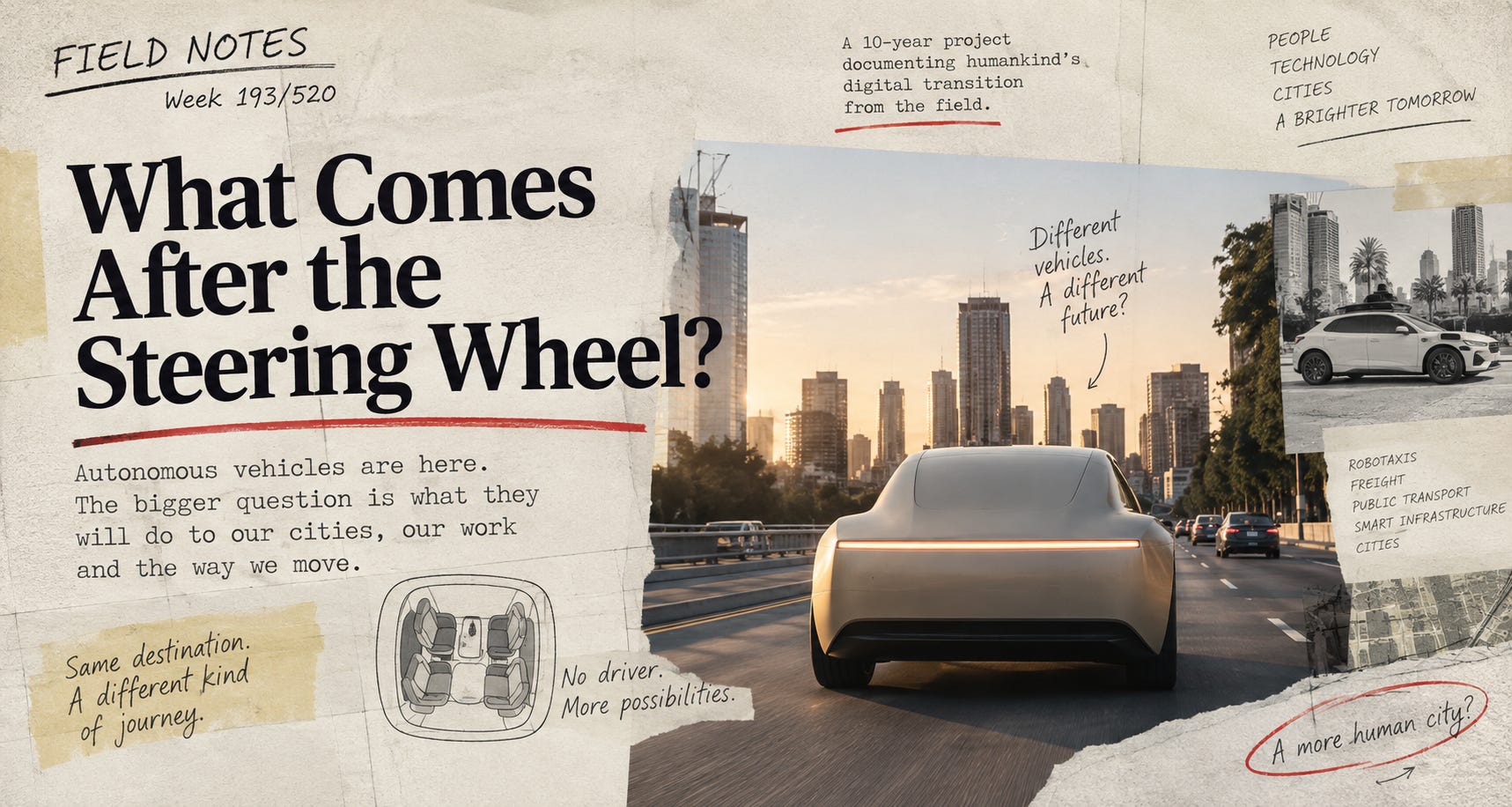
Welcome to this week’s Field Notes, a 10-year project of mine documenting humankind’s digital transition from the field. These notes are shaped by what I’m seeing, building, and discussing as our physical and digital lives continue to converge.
- Ryan
(Connect with me on LinkedIn)

News is surface-level. Signals live underneath. This section captures developments that hint at deeper shifts in how digital systems are being built, governed, and adopted — often before they’re obvious in the mainstream narrative.
The vehicle is starting to lose its driver
For most of the autonomous vehicle era, the basic approach has been to take a car designed for a human and teach a computer how to drive it. The steering wheel remained. So did the pedals, mirrors, dashboard and forward-facing seats. Autonomy changed who was controlling the vehicle, but not necessarily the vehicle itself.
That is beginning to change. Tesla started limited rides in its purpose-built Cybercab in Austin this week, moving beyond the modified Model Ys used in its earlier robotaxi service. The Cybercab has no steering wheel or pedals and dispenses with conventional side mirrors. It is designed around the assumption that a human driver will never need to take control. Reuters reported on the first rides this week, marking an interesting transition from making existing cars autonomous to designing vehicles specifically for autonomy.
That distinction is already creating some friction. US vehicle safety standards were largely developed around machines controlled by people, so removing the driver also removes some of the assumptions embedded in the regulatory system. The US National Highway Traffic Safety Administration has now opened an investigation into how Tesla certified the Cybercab against federal safety standards, including requirements covering equipment such as mirrors. Reuters reported on the investigation on Friday. The technology is beginning to encounter rules written for a different kind of machine.
Tesla isn’t alone in reaching this point. Amazon-owned Zoox and Alphabet’s Waymo both announced further US expansion this week, with their autonomous services and testing programmes spreading into additional cities. Reuters reported that Zoox is moving into Houston and San Diego, while Waymo is extending its footprint towards Denver, San Diego and Tampa. The important signal here isn’t another collection of dots appearing on a robotaxi map. It is that autonomous transport is beginning to encounter enough different streets, weather conditions and human behaviour that it increasingly has to operate as ordinary urban infrastructure rather than a contained technology demonstration.
Zoox also makes the changing design language particularly visible. Its purpose-built robotaxi has no conventional driver’s position and uses inward-facing seating, more like a small carriage than a car. Cybercab takes a somewhat more familiar form, but both start from the same premise. Once nobody needs to drive, there is less reason to organise the interior around someone sitting behind a steering wheel and looking through a windscreen.
The same transition may eventually matter even more in freight. Autonomous trucking company PlusAI announced plans this week to go public through a transaction valuing it at around US$800 million as it works towards commercial deployment of its autonomous driving system with truck manufacturers and fleet operators. Reuters covered the transaction here. Autonomous trucking has spent years in testing, but the interesting question now is what happens if driverless operation begins to affect the economics and physical design of freight itself.
A conventional long-haul truck is partly a machine for moving goods and partly a workplace for a person. It needs a cab, controls, visibility and often somewhere for the driver to sleep. Routes and schedules have also evolved around limits on how long people can safely remain behind the wheel. Remove the driver and some of those constraints begin to disappear. Trucks could eventually look different, operate for longer periods, use different kinds of depots and move through logistics networks designed around machines rather than shifts.
This feels like the more important stage of the autonomous transport story. Whether one company reaches full autonomy before another matters in the near term, but the longer transition may be what autonomy does to the machines themselves.
We spent the first phase teaching computers to drive vehicles built for humans. We may now be entering the phase where we start building vehicles for computers.

What it is
This video from Good Work looks at the rise of autonomous vehicles through San Francisco, where Waymo has moved from an experiment into an increasingly ordinary part of the transport system. The story begins with Sebastian Thrun, whose Stanford team won the 2005 DARPA Grand Challenge before he went on to lead Google’s self-driving car project, which eventually became Waymo. Today, the company is providing more than 500,000 autonomous rides a week and is expanding across the US, with plans for international markets including London and Tokyo.
The video is less interested in whether the technology works than in what happens once it does. It follows a Waymo ride through San Francisco, speaks with drivers, activists, transport researchers and local reporters, and looks at the growing political argument over how autonomous vehicles should fit into cities.
What stood out
The most interesting tension is between autonomous driving as a technology and autonomous vehicles as a transport system. Thrun makes a compelling case for the former. Machines don’t drink, text or get tired, and when one autonomous vehicle encounters a problem, what it learns can potentially be transferred across the fleet. His longer-term vision is a point where autonomous transport becomes cheaper than owning a car, eventually reducing the need for private vehicle ownership and all the urban space devoted to parking.
But the reporting from San Francisco complicates that picture. Critics aren’t necessarily arguing that Waymos are bad at driving. Their concerns are about what happens around them: whether robotaxis add rather than remove vehicles from congested streets, how they interact with emergency services and public transport, and what happens to the people whose livelihoods currently depend on driving. The video notes that New York alone has around 180,000 licensed taxi, Uber and Lyft drivers, which makes autonomy as much a labour and urban-planning question as a technical one.
There is also a useful connection to this week’s Frontier Tech section. Transport historian Peter Norton discusses V2X infrastructure, where roads, lampposts and other objects communicate with autonomous vehicles. His concern is that cities could end up spending public money adapting themselves to private autonomous-vehicle systems when simpler interventions, such as lower speeds, protected cycling infrastructure, better crossings and mass transit, may solve some of the same safety problems more cheaply.
Why it matters
Autonomous vehicles are reaching the point where the hardest questions are becoming less technological.
A robotaxi can navigate San Francisco. Purpose-built vehicles are beginning to lose their steering wheels and pedals. Fleets are expanding into new cities. The unresolved question is what we want the transport system around them to become.
There are several possible futures hiding inside the same technology. Autonomous vehicles could reduce private car ownership and make existing vehicles more productive. They could also make individual car journeys cheaper and easier, putting more vehicles onto already crowded streets. They could improve safety while displacing large categories of work. Cities could adapt their infrastructure around them, or decide that scarce public investment belongs elsewhere.
That is what makes this stage of autonomy more interesting than the long period of technical demonstrations that preceded it. The question is gradually moving from can a computer drive a car? to what happens to a city when it can?

Digital assets now sit less as an idea and more as infrastructure in progress. As physical and digital life continue to converge, money and digital asset infrastructure are doing the same. What was once framed as “crypto” is increasingly showing up as rails, balance sheets, and policy conversations.
🔥🗺️Heat map shows the 7 day change in price (red down, green up) and block size is market cap

🎭 Crypto Fear and Greed Index is an insight into the underlying psychological forces that drive the market’s volatility. Sentiment reveals itself across various channels - from social media activity to Google search trends - and when analysed alongside market data, these signals provide meaningful insight into the prevailing investment climate. The Fear & Greed Index aggregates these inputs, assigning weighted value to each, and distils them into a single, unified score.


This section captures developments at the edge of digital systems. New interfaces, tools, and capabilities that feel early, unfinished, or slightly ahead of their moment. I’m less interested in what’s impressive today and more interested in what might quietly reshape how people work, coordinate, and interact over time.
What happens when autonomous vehicles start talking to each other?
Most autonomous driving today is surprisingly individualistic. A vehicle uses cameras, radar, lidar and maps to understand the world around it, then makes its own decisions. It may be surrounded by other autonomous vehicles, but in most cases they behave much like human drivers do: observing one another from the outside and trying to anticipate what everyone else will do. The next stage could look quite different.
Researchers and transport authorities have been developing vehicle-to-everything communication, usually shortened to V2X, which allows vehicles to exchange information directly with other vehicles, traffic lights, road infrastructure and potentially pedestrians’ devices. A traffic light could tell an approaching vehicle exactly when it will change. A car braking suddenly could warn vehicles several hundred metres behind it before their sensors can even see the obstruction. Roadworks, accidents and slippery conditions could be communicated through the network rather than discovered individually by every vehicle that arrives.
The technology itself isn’t especially new. Standards for vehicle-to-vehicle and vehicle-to-infrastructure communication have been developing for years, and the US Department of Transportation published a national V2X deployment plan in 2024 intended to accelerate its use across American roads. The longer-term ambition is an interoperable system where vehicles and infrastructure can continuously exchange safety information regardless of manufacturer. The US Department of Transportation describes the deployment strategy here.
What makes this more interesting now is the growing number of vehicles capable of acting on that information without waiting for a human. A warning sent to a conventional car still requires someone to notice it and respond. An autonomous vehicle can incorporate the information directly into its decision-making, potentially adjusting speed, changing route or braking before its onboard sensors have identified the threat themselves.
Taken far enough, that begins to change how we think about autonomy. A road filled with independently intelligent vehicles is one model. A transport network in which vehicles, traffic signals and infrastructure coordinate continuously is another.
Intersections are a useful example. Traffic lights exist partly because humans need simple, visible rules for negotiating shared space. Autonomous vehicles communicating their position, speed and intended trajectory could theoretically coordinate an intersection much more dynamically, with each vehicle adjusting its movement to pass through available gaps. Researchers have been experimenting with versions of these systems for years, although deploying them on real streets filled with pedestrians, cyclists and human-driven cars remains a much harder problem.
The same logic becomes particularly interesting for freight. Autonomous trucks travelling along motorways could form tightly coordinated platoons, sharing braking and acceleration information while travelling closer together than would normally be safe for human drivers. The reduced aerodynamic drag can lower fuel or energy consumption, while coordinated vehicles could respond to changing road conditions as a group rather than individually. The European Commission has previously funded multi-brand truck platooning research specifically to explore how vehicles from different manufacturers could operate together. The EU’s ENSEMBLE project documented those trials here.
None of this means traffic lights are about to disappear or motorways will suddenly fill with perfectly synchronised robot convoys. Mixed traffic is likely to remain messy for a long time, and communication between vehicles introduces its own problems around cybersecurity, standards, reliability and deciding what happens when information from the network conflicts with what a vehicle’s sensors can see.
But it points towards a different end state for autonomous transport. The first challenge was teaching a machine to operate a vehicle. The next may be teaching millions of those machines to operate around one another.
At that point, the frontier is no longer the autonomous vehicle - it is the autonomous road.

“The city is a fact in nature, like a cave, a run of mackerel or an ant-heap.”
Lewis Mumford
Lewis Mumford was an American historian, writer and critic who spent much of the twentieth century studying the relationship between cities, technology and human life. He was particularly interested in what happens when technological systems begin determining the shape of the places we live, rather than remaining tools within them. His writing on transport was often critical of cities reorganising themselves around the automobile, especially when greater speed and mobility came at the expense of the wider urban environment.
That makes the line useful this week. Autonomous vehicles are becoming capable enough that the question is gradually shifting from whether they can operate in our cities to how our cities might change around them. Roads could communicate with vehicles, parking could become less important, freight networks could operate differently and cars themselves may no longer need to be designed around a driver. At the same time, many of the older questions remain: congestion, safety, public space, employment and who the transport system is ultimately designed to serve. The technology inside the vehicle may be new. The tension between adapting technology to the city, or adapting the city to technology, is much older.