
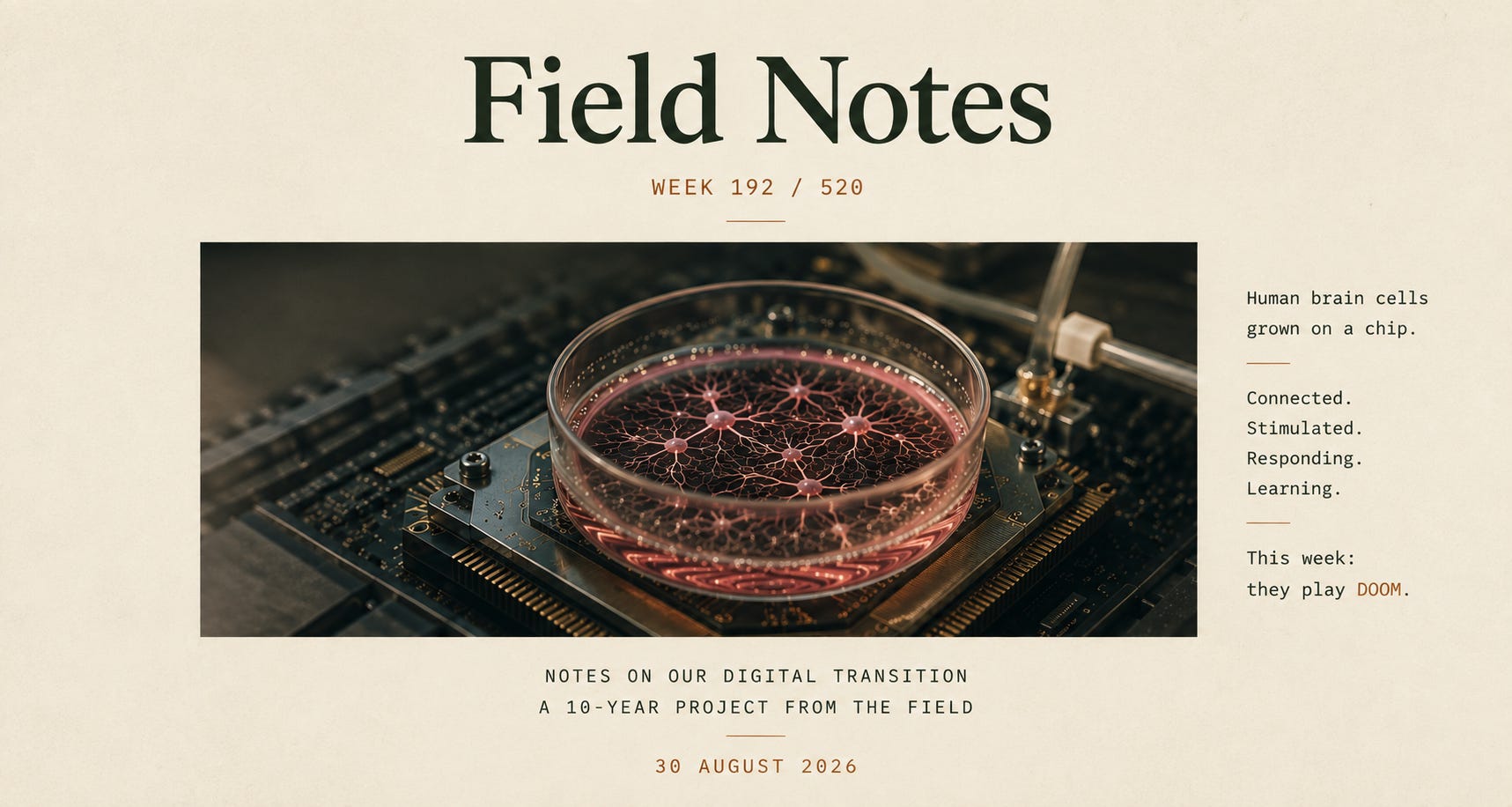
Welcome to this week’s Field Notes, a 10-year project of mine documenting humankind’s digital transition from the field. These notes are shaped by what I’m seeing, building, and discussing as our physical and digital lives continue to converge.
- Ryan
(Connect with me on LinkedIn)

News is surface-level. Signals live underneath. This section captures developments that hint at deeper shifts in how digital systems are being built, governed, and adopted — often before they’re obvious in the mainstream narrative.
The AI build-out is increasingly becoming a story about physical resources. Australian data centre operator NextDC reported this week that both the water and energy efficiency of its facilities deteriorated over the past year. Its power usage effectiveness rose from 1.44 to 1.49, while water usage increased from 2.25 to 2.40 litres per kilowatt-hour. Both measures have now been moving in the wrong direction for three years. (Reuters)
Some of that reflects the awkwardness of expansion. NextDC is commissioning new capacity and identified leaks and metering anomalies during the year. At the same time, revenue grew 16% and the company moved from a loss to an A$82.1 million profit. Demand for computing infrastructure continues to grow even as the resources required to support it become harder to ignore. (Reuters)
What stood out this week was an experiment underway 6,000 kilometres away in Singapore. NUS Medicine, data centre operator DayOne and Australian startup Cortical Labs have unveiled a prototype for what they call a Biological Data Centre. Instead of relying entirely on silicon processors, part of the system uses living human neurons grown from stem cells and connected to electronics. The initial installation contains 20 biological computing units arranged into a server rack at the NUS Life Sciences Institute. NUS Medicine described the prototype this month as the first independently operated biologically integrated server rack of its kind. (NUS Medicine)
The idea is still early. These aren’t miniature human brains sitting inside a data centre, and there is a long distance between an experimental rack and infrastructure capable of competing with conventional computing. But the motivation is worth noting. Brains are remarkably efficient computing systems. Cortical Labs is exploring whether some of that efficiency can be carried into computing by using living neural networks for tasks involving learning and adaptation. The Singapore project is explicitly being developed in response to the energy intensity of conventional AI infrastructure, with an eventual ambition to move the technology from the university environment into a commercial DayOne data centre. (NUS Medicine)
There is an interesting contrast between the two stories. Most of the response to rising compute demand has been additive. More data centres. More chips. More electricity generation. More cooling. More transmission infrastructure.
The Singapore experiment starts somewhere different. Instead of asking how much more infrastructure can be built around computation, it asks whether the underlying machinery of computation itself could change. For decades, computer science has borrowed language from biology. Neural networks. Learning. Memory. This feels like an early, slightly strange inversion of that relationship.

What it is
This is a demonstration from Cortical Labs of its CL1 biological computer running DOOM. Inside the machine are around 200,000 living human neurons grown on a multi-electrode array, a microchip capable of both stimulating the cells and recording their electrical activity.
The challenge is translating between two very different systems. Using the Cortical Labs API, an independent researcher mapped information from DOOM into patterns of electrical stimulation that the neurons can receive. If an enemy appears on one side of the screen, for example, particular electrodes stimulate a corresponding area of the neural culture. The resulting neural activity is then read back and translated into commands such as moving, turning or shooting.
What stood out
Cortical Labs previously demonstrated neurons learning to play Pong, but DOOM introduces a much less predictable environment. Pong could be reduced to a relatively direct relationship between the position of a ball and the movement of a paddle. DOOM requires the system to respond to a three-dimensional environment, encounter enemies and select between several possible actions.
The neurons aren’t particularly good at it. They die frequently and behave, as the researcher puts it, like “a beginner who’s never seen a computer”. More interesting is that they appear capable of responding to the environment, finding enemies and changing their behaviour through feedback.
The other detail that stood out was how quickly the experiment was assembled. The original Pong demonstration took Cortical Labs around 18 months using its earlier hardware and software. Once the CL1 and its programming interface were available, the researcher behind the DOOM experiment implemented the first version in less than a week with relatively minor tweaking. The progress here may therefore be as much about the interface as the neurons themselves. Researchers can now use ordinary Python commands to interact with living neural cultures in real time.
Why it matters
This makes the biological computing story elsewhere in this week’s notes a little easier to understand. The significance isn’t that 200,000 neurons can play a 33-year-old computer game badly. Conventional hardware can obviously do that without difficulty.
What matters is that a usable interface is beginning to form between software and living neural systems. Cortical Labs can encode digital information as electrical stimulation, allow neurons to respond to it, translate their activity back into software commands, and provide feedback that can influence subsequent behaviour.
There is still a large gap between this and useful biological computing at scale. Cortical Labs itself identifies better learning, information encoding, rewards and feedback as the next problems to solve. But making the platform accessible to outside researchers changes the nature of the experiment. Instead of asking only what Cortical Labs can teach neurons to do, developers can begin testing different answers themselves.
After decades of programming computers, we are beginning to develop tools for programming something rather different.

Digital assets now sit less as an idea and more as infrastructure in progress. As physical and digital life continue to converge, money and digital asset infrastructure are doing the same. What was once framed as “crypto” is increasingly showing up as rails, balance sheets, and policy conversations.
🔥🗺️Heat map shows the 7 day change in price (red down, green up) and block size is market cap

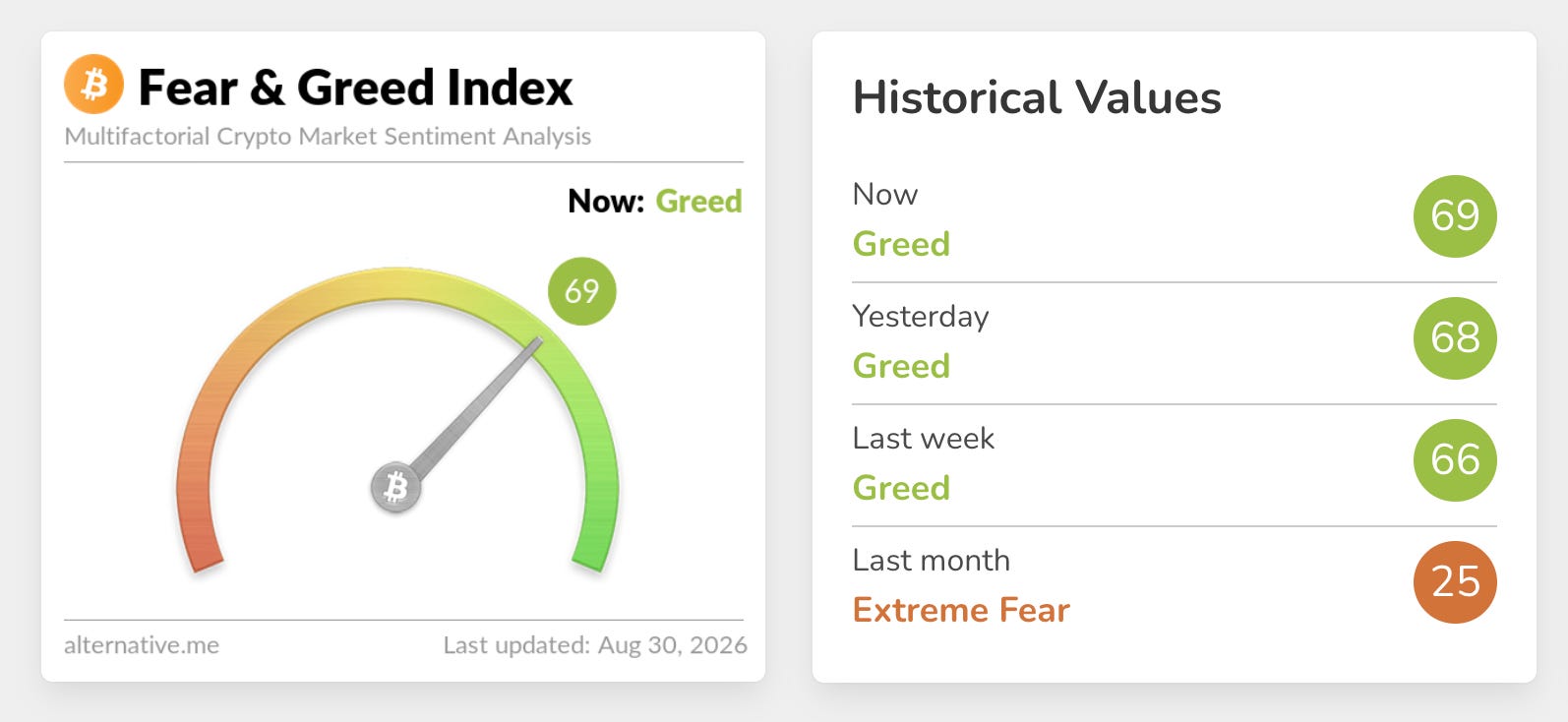
🎭 Crypto Fear and Greed Index is an insight into the underlying psychological forces that drive the market’s volatility. Sentiment reveals itself across various channels - from social media activity to Google search trends - and when analysed alongside market data, these signals provide meaningful insight into the prevailing investment climate. The Fear & Greed Index aggregates these inputs, assigning weighted value to each, and distils them into a single, unified score.

This section captures developments at the edge of digital systems. New interfaces, tools, and capabilities that feel early, unfinished, or slightly ahead of their moment. I’m less interested in what’s impressive today and more interested in what might quietly reshape how people work, coordinate, and interact over time.
Human brain cells are becoming computers
A story from Stuff this week led me down one of the stranger branches of computing I’ve come across for a while. Melbourne-based Cortical Labs is building computers that combine conventional silicon with living human neurons grown from stem cells. The neurons are cultivated directly over a silicon chip containing electrodes that can both stimulate the cells and record their responses, allowing software and living neural networks to interact in real time. Cortical Labs calls the approach Synthetic Biological Intelligence. More broadly, it sits within the emerging field of biological computing, or “wetware”. (docs.corticallabs.com)
The company has been working on this for several years. Its early experiments became known for connecting cultured neurons to a simplified version of Pong, feeding the cells information about the game through electrical signals and observing how their behaviour changed in response. That work has since been packaged into the CL1, a self-contained biological computer that keeps the neurons alive in a nutrient-rich environment while allowing researchers to stimulate them, record their activity and deploy code against them. Cortical Labs says the cells can currently be maintained inside the machine for up to six months, and researchers can now access the same biological computing systems remotely through its Cortical Cloud. (corticallabs.com)
What makes this particularly interesting now is the context in which it is developing. As conventional AI systems require increasingly large amounts of energy and infrastructure, biological computing is exploring whether some of the natural efficiency and adaptability of neurons can be incorporated into computation. Cortical Labs argues that biological neural networks can learn from much smaller datasets and with lower energy requirements than conventional AI systems. Those claims are still being explored, and the useful applications remain early, but the technology has moved far enough that developers can now write Python code that interacts directly with biological neural networks through the CL1’s programming interface. (docs.corticallabs.com)
That is also what makes the biological data centre prototype in Singapore, covered in this week’s News section, worth watching. NUS Medicine, DayOne and Cortical Labs have installed a rack containing 20 CL1 units at the NUS Life Sciences Institute. The initial research environment is intended to test whether biological computing can eventually move into a commercial DayOne data centre. The stated applications are not simply about replacing conventional processors. Cortical Labs is looking for areas where biological systems’ ability to learn from sparse information and adapt as conditions change might be useful, including drug discovery, robotics, cybersecurity and fraud detection. (NUS Medicine)
There are obvious limits to how far to take this. These are cultures of neurons, not miniature human brains, and nothing demonstrated so far suggests biological computers are about to replace the silicon infrastructure underpinning AI. Keeping living cells healthy is itself an engineering constraint, and it remains unclear which computational problems will ultimately justify the added complexity. The Singapore prototype is perhaps best understood as an experiment in a different computing substrate rather than an early replacement for today’s data centres. (NUS Medicine)
Still, the direction is unusual. For decades, computing has borrowed concepts from biology. Neural networks, learning and memory became abstractions that engineers attempted to reproduce in silicon. Biological computing reverses that relationship by putting the neuron itself inside the computing architecture.
That introduces a set of questions computer engineers have rarely had to deal with. Cortical Labs already publishes research examining agency, intelligence and even sentience in cultured neural systems. As these systems become more capable, the boundary between biological experiment and computing infrastructure may become increasingly difficult to define. (corticallabs.com)
For now, the systems are small, awkward and experimental. But after decades spent trying to make machines behave more like brains, researchers are beginning to explore what happens when part of the machine is biological.

“What I cannot create, I do not understand.”
Richard Feynman
Feynman famously left these words on his blackboard at Caltech. They fit biological computing particularly well because researchers aren’t simply observing neurons anymore. They are building interfaces around them, feeding them information and trying to understand learning by creating environments in which learning can occur.
There is a subtle inversion here. We spent decades trying to understand intelligence well enough to reproduce aspects of it in silicon. Now researchers are using living neurons to understand what the silicon models were attempting to approximate in the first place.