
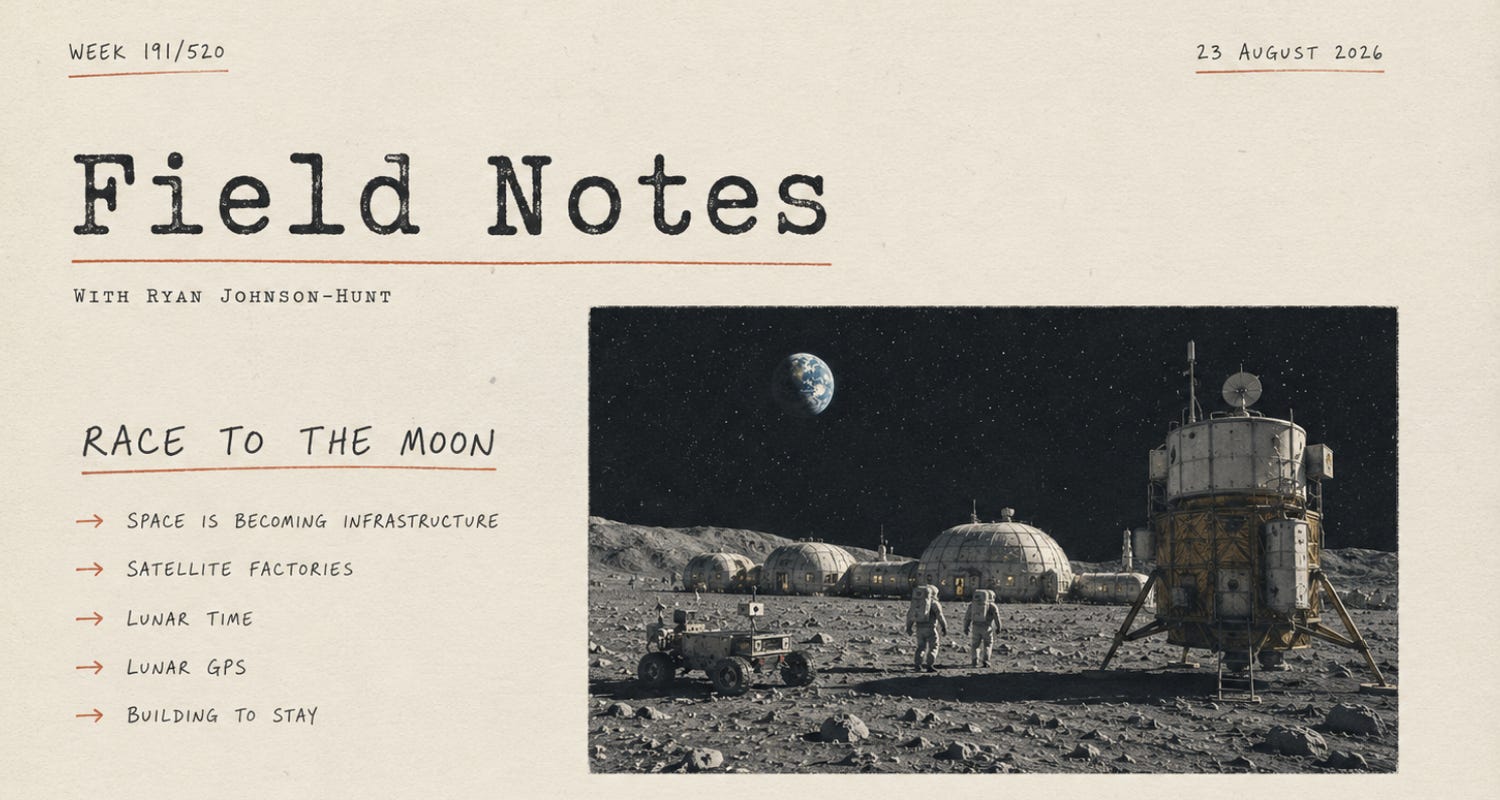
Welcome to this week’s Field Notes, a 10-year project of mine documenting humankind’s digital transition from the field. These notes are shaped by what I’m seeing, building, and discussing as our physical and digital lives continue to converge.
- Ryan
(Connect with me on LinkedIn)

News is surface-level. Signals live underneath. This section captures developments that hint at deeper shifts in how digital systems are being built, governed, and adopted — often before they’re obvious in the mainstream narrative.
Lunar infrastructure
For most of the space age, the basic unit of progress was the mission. A rocket launched. A satellite entered orbit. A spacecraft reached another world. Each event was sufficiently difficult and expensive that it could be treated as an achievement in itself. That framing is beginning to feel outdated.
This week, the United States set a target of reaching at least 1,000 launches and re-entries a year by 2030, part of a new national space transportation policy intended to dramatically increase the country’s capacity to move things between Earth and orbit. The plan calls for more launch sites, faster approvals, additional spectrum and greater reliance on commercial providers. (Reuters)
For context, the US recorded 178 launches last year. Getting to 1,000 would mean moving from roughly one launch every two days to nearly three every day. That changes the nature of the system. Rockets begin to look less like exceptional machines and more like transportation infrastructure. Something similar is happening on the other side of the journey.
Satellite manufacturer Muon Space raised US$250 million this week at a reported valuation of US$1.5 billion. The company isn’t simply building individual satellites. It is developing the capability to design, manufacture and operate entire constellations for customers across communications, Earth observation and other applications. Its expanding manufacturing footprint is intended to support production of as many as 500 satellites a year by 2027. (Reuters)
The comparison Muon’s chief executive makes is with cloud computing. Before the cloud, organisations bought and operated their own servers. Eventually, computing became infrastructure that could be accessed continuously and expanded as required. Muon’s thesis is that space may be heading through a similar transition, with satellite capability becoming something organisations consume rather than something they need to build themselves.
And then there is the Moon. As governments and companies prepare for more sustained activity there, an unexpectedly basic problem has emerged: what time is it? Clocks on the Moon run slightly faster than clocks on Earth because of the difference in gravity, accumulating a difference of roughly 57 microseconds per Earth day. That is irrelevant to a person looking at a watch, but potentially significant for precision navigation, communications and spacecraft coordinating across a future lunar network.
Scientists are now working towards common lunar time standards, with proposals moving through international standards bodies as activity around the Moon increases. (Financial Times). There is a nice historical echo here. Standardised time on Earth became increasingly important during the nineteenth century partly because railways connected places that had previously kept their own local time. Infrastructure created a coordination problem, and eventually we built another layer of infrastructure to solve it.
Something similar may now be beginning on the Moon. Launch cadence. Satellite factories. Communications networks. Power systems. Navigation. Time standards. None is particularly dramatic in isolation. Together, they suggest that space is gradually moving beyond exploration and towards something more ordinary. Infrastructure.

What it is
This NASA news conference lays out the agency’s emerging plans for establishing a sustained human presence at the lunar south pole. The distinction NASA Administrator Jared Isaacman makes is important. This isn’t being framed as another series of missions to visit the Moon and return home. The intention is to build towards staying there.
That requires a different kind of programme. NASA outlined a phased approach to Moonbase development and announced several pieces of infrastructure intended to support it. Blue Origin has been selected to deliver lunar terrain vehicles to the surface using its Mark 1 lander, while Astrolab and Lunar Outpost will provide vehicles capable of operating both autonomously and with astronauts aboard. Firefly will also carry a series of lunar drones designed to explore terrain beyond the immediate reach of crews.
Later phases contemplate permanent habitation modules and exploration of features such as lunar lava tubes.
What stood out
The most interesting part was how quickly the conversation moved beyond rockets. Once the objective changes from getting to the Moon to staying on the Moon, an entirely different set of problems appears.
Transport across the surface. Autonomous vehicles. Communications. Navigation. Power. Habitats. Logistics. Exploration equipment. Eventually, somewhere for people to live. NASA isn’t proposing to build all of this itself. Instead, the architecture increasingly resembles an ecosystem of specialised commercial providers, with different companies responsible for individual layers of lunar infrastructure.
There is something almost mundane about it. The Moon is slowly becoming a logistics problem.
Why it matters
For most of the space age, success was measured by reaching somewhere humans hadn’t been before. A permanent lunar presence changes the measure.
The challenge becomes reliability, redundancy and the ability to keep systems operating when nobody from Earth can easily come and fix them. Technologies that seem ordinary here, vehicles, electricity, communications and navigation, become frontier infrastructure when recreated 384,000 kilometres away.
It connects with a broader pattern running through this week’s notes. Launch is becoming transportation. Satellites are becoming shared infrastructure. The Moon is getting navigation and common time standards. Now NASA is beginning to assemble the physical systems required for people to remain there.
Perhaps the next phase of the space age will be defined less by how far we can travel and more by where we learn to stay.

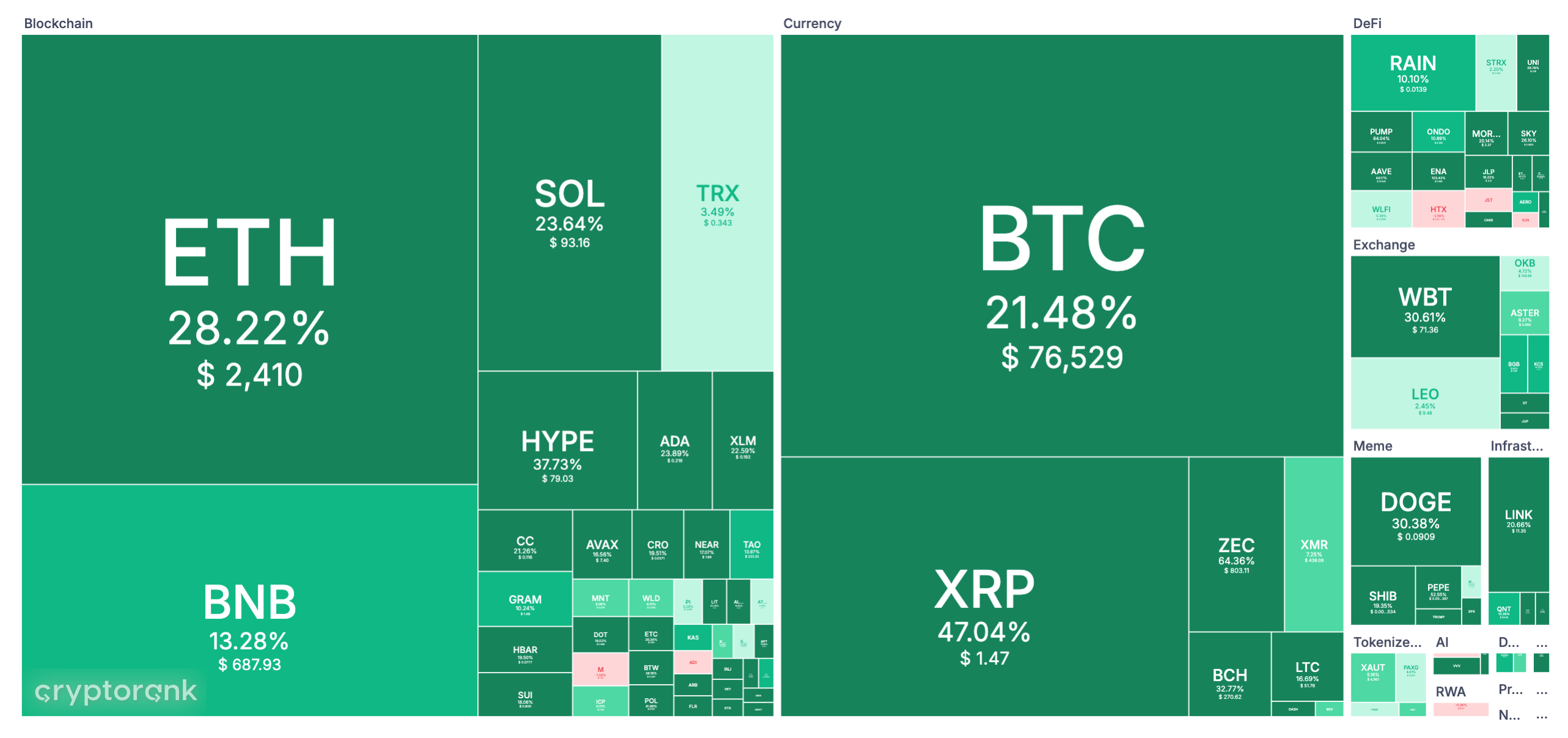
Digital assets now sit less as an idea and more as infrastructure in progress. As physical and digital life continue to converge, money and digital asset infrastructure are doing the same. What was once framed as “crypto” is increasingly showing up as rails, balance sheets, and policy conversations.
🔥🗺️Heat map shows the 7 day change in price (red down, green up) and block size is market cap
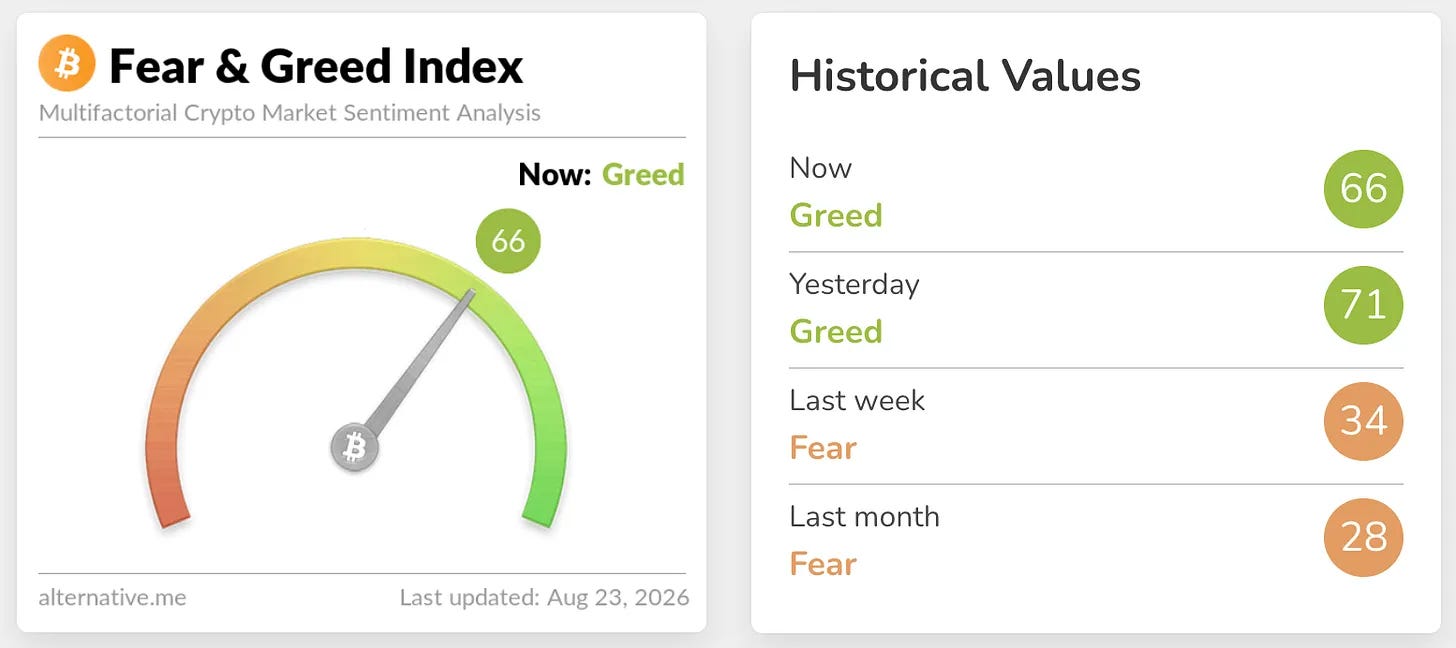
🎭 Crypto Fear and Greed Index is an insight into the underlying psychological forces that drive the market’s volatility. Sentiment reveals itself across various channels - from social media activity to Google search trends - and when analysed alongside market data, these signals provide meaningful insight into the prevailing investment climate. The Fear & Greed Index aggregates these inputs, assigning weighted value to each, and distils them into a single, unified score.

This section captures developments at the edge of digital systems. New interfaces, tools, and capabilities that feel early, unfinished, or slightly ahead of their moment. I’m less interested in what’s impressive today and more interested in what might quietly reshape how people work, coordinate, and interact over time.
The Moon is getting its own GPS
Getting to the Moon is difficult. Knowing exactly where you are once you arrive is becoming a different kind of problem. On Earth, GPS has become so ordinary that its underlying infrastructure is almost invisible. A constellation of satellites and shared timing standards allows phones, cars, ships and aircraft to continuously calculate where they are. Around the Moon, no equivalent system yet exists.
That is starting to change. NASA, the European Space Agency and Japan’s space agency are developing LunaNet, a common set of standards intended to allow different lunar communications and navigation networks to work together. The ambition is eventually to give astronauts, spacecraft and rovers access to GPS-like positioning, navigation and timing services around the Moon. (NASA)
Europe is already building part of the physical infrastructure. ESA’s Moonlight programme plans a constellation of five satellites around the Moon, four dedicated to navigation and one to communications. Initial services are planned for 2028, with full operations targeted for 2030. The system will concentrate initially on the lunar south pole, where many future missions are expected to operate, and aims to provide surface positioning accurate to around three metres. (European Space Agency)
There has also been a useful intermediate step. Last year, NASA and the Italian Space Agency successfully picked up signals from Earth’s existing GPS and Galileo satellites on the lunar surface for the first time. NASA is now developing receivers that can use those extremely faint signals as a bridge until dedicated lunar navigation infrastructure is available. (NASA)
And earlier this month, NASA delivered a new navigation payload to Intuitive Machines for integration into Altus-1, the company’s first lunar relay satellite. It is another small piece of the network beginning to take physical form. (NASA)
There is something interesting about what this says about the maturity of space activity. Explorers navigate themselves. Infrastructure allows everyone else to follow. If hundreds of spacecraft, rovers, scientific instruments and eventually people are going to operate around the Moon, each mission cannot reasonably build its own communications and navigation system from scratch. Shared infrastructure starts to become necessary.
It is a similar transition to the one playing out elsewhere in this week’s notes. Launch is becoming transportation. Satellites are becoming shared services. Even time itself is beginning to require common lunar standards. Now the Moon is getting something we barely think about on Earth anymore. Directions.

“Earth is the cradle of humanity, but one cannot live in a cradle forever.”
Konstantin Tsiolkovsky
Tsiolkovsky was a Russian scientist and one of the earliest serious theorists of spaceflight. Decades before rockets could reach orbit, he worked through many of the principles that would eventually make them possible, including multistage rockets and the mathematics of propulsion. The line fits this week because space is beginning, very slowly, to move beyond exploration. Launch networks, lunar navigation, communications and common time standards are the less spectacular systems required if activity beyond Earth is ever going to become persistent.