
Welcome to this week’s Field Notes, a 10-year project of mine documenting humankind’s digital transition from the field. These notes are shaped by what I’m seeing, building, and discussing as our physical and digital lives continue to converge.
- Ryan
(Connect with me on LinkedIn)

News is surface-level. Signals live underneath. This section captures developments that hint at deeper shifts in how digital systems are being built, governed, and adopted — often before they’re obvious in the mainstream narrative.
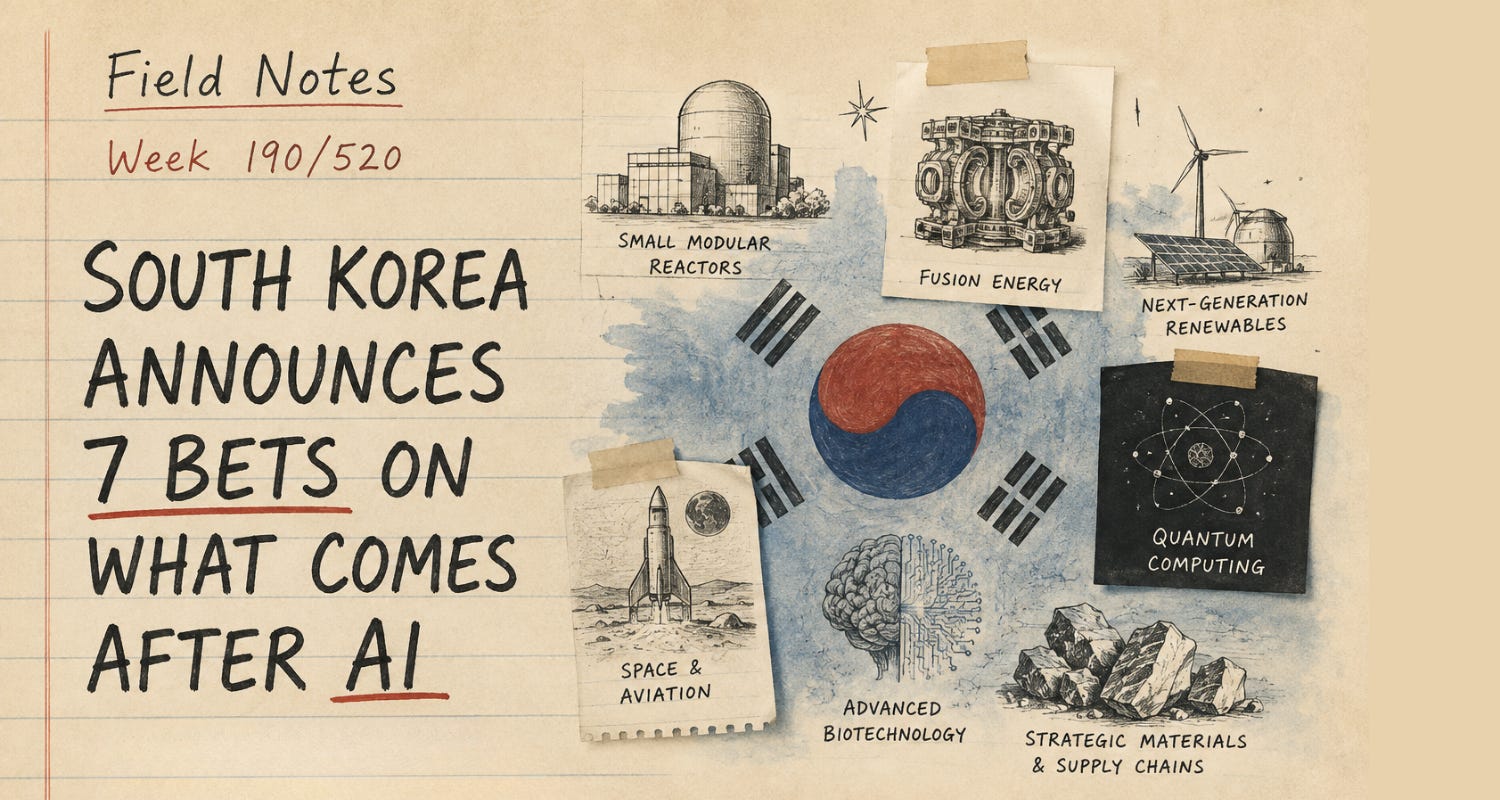
South Korea is placing seven bets on what comes after AI
South Korea has spent decades building industrial advantage around a handful of technologies, most notably semiconductors, displays and batteries. This week, its government offered an unusually clear view of where it thinks the next generation of that advantage might come from.
The government unveiled its Seven Major SEED initiative, a national technology programme intended to create new sources of economic growth beyond today’s semiconductor and AI industries. Rather than picking a single successor, South Korea is spreading its bets across seven areas, with some surprisingly specific milestones attached. (Reuters)
Small modular reactors. South Korea wants to deploy advanced SMRs by 2035, building on an existing nuclear industry while developing smaller reactors that could eventually provide more flexible sources of power.
Fusion energy. The country is targeting progress towards fusion power generation in the late 2030s, alongside continued investment in the underlying research and demonstration infrastructure.
Next-generation renewables. Solar, wind and hydrogen form another part of the energy strategy, suggesting South Korea isn’t making a single bet on how future electricity demand will be met.
Quantum computing. The target here is unusually concrete: develop a domestic 100-qubit quantum processor by 2029. South Korea is also investing in quantum communications and the wider infrastructure needed to turn research capability into an industry.
Space and aviation. South Korea wants to land a small spacecraft on the Moon by 2030, followed by another lunar mission in 2032. By 2035, it plans to have its own low-Earth-orbit satellite communications network, while increasing its participation in commercial aircraft development.
Advanced biotechnology. This includes AI-assisted biology, autonomous laboratories, advanced therapies and brain-computer interfaces. The government has set a goal of commercialising BCI products by 2035, moving an area still largely associated with experimental medicine towards practical applications.
Strategic materials and supply chains. Perhaps the least glamorous of the seven, but potentially one of the most important. South Korea plans to invest around 10 trillion won in materials and equipment while increasing strategic stockpiles, recognising that technological sovereignty ultimately depends on access to the physical materials underneath it all. (Reuters)
What stood out wasn’t any one of these technologies. It was the time horizon. A 100-qubit processor in 2029. A Moon landing in 2030. Fusion development stretching into the late 2030s. New nuclear infrastructure, autonomous laboratories and entirely new supply chains.
There is something distinctly industrial about the approach. South Korea isn’t simply funding research and waiting to see what emerges. It is attempting to connect science, infrastructure, manufacturing, capital and government policy around a small number of technologies it believes could matter a decade from now. Some of those bets will almost certainly age better than others. But perhaps that is the point.

What it is
South Korea is already heavily invested in AI and semiconductors. Now it is asking a longer-term question: what comes next?
The “What Comes After AI? Korea Bets on Seven Technologies for the Future | Arirang News” short report looks at the government’s new SEED initiative, or Strategic Emerging Engines for Disruptive Innovation, which identifies seven technologies that South Korea believes could become important economic engines over the coming decades.
The programme spans three broad areas: clean energy, frontier technology and supply-chain resilience. Some of the targets are unusually specific. South Korea wants to commercialise its light-water small modular reactor technology by 2035, land a domestically developed spacecraft on the Moon by 2030, and build a homegrown quantum computer by 2029.
What stood out
The most interesting part wasn’t really the seven technologies. It was what sits underneath them. South Korea is already a manufacturing powerhouse in semiconductors, electric vehicles and other advanced industries, yet many of the materials, components and machines required to produce them still come from overseas.
The report says Korea accounts for only 2.3% of the semiconductor equipment market and 3% of the anode-materials market for secondary batteries. More strikingly, 99% of the heavy rare earths used in permanent magnets are imported. These magnets are increasingly important for technologies such as robotics.
That exposes an awkward distinction between being good at manufacturing advanced technology and controlling the systems required to manufacture it.
Why it matters
South Korea appears to be thinking about technological sovereignty as a stack. Energy matters. Quantum computing, space and other frontier technologies matter. But so do the materials, components, equipment and supply chains underneath them.
That feels directionally important. For much of the past decade, technological leadership has been discussed through individual breakthroughs: the best AI model, the fastest chip, the most capable robot. Increasingly, governments seem to be looking further down the stack and asking what dependencies sit beneath those capabilities. South Korea’s answer is deliberately long term. A quantum computer in 2029. A Moon landing in 2030. Commercial SMRs in 2035. Other ambitions stretch further still.
Not all seven bets will work. But there is something interesting about a country explicitly asking what comes after its current engines of growth, then beginning to build for it before the answer is clear.

Digital assets now sit less as an idea and more as infrastructure in progress. As physical and digital life continue to converge, money and digital asset infrastructure are doing the same. What was once framed as “crypto” is increasingly showing up as rails, balance sheets, and policy conversations.
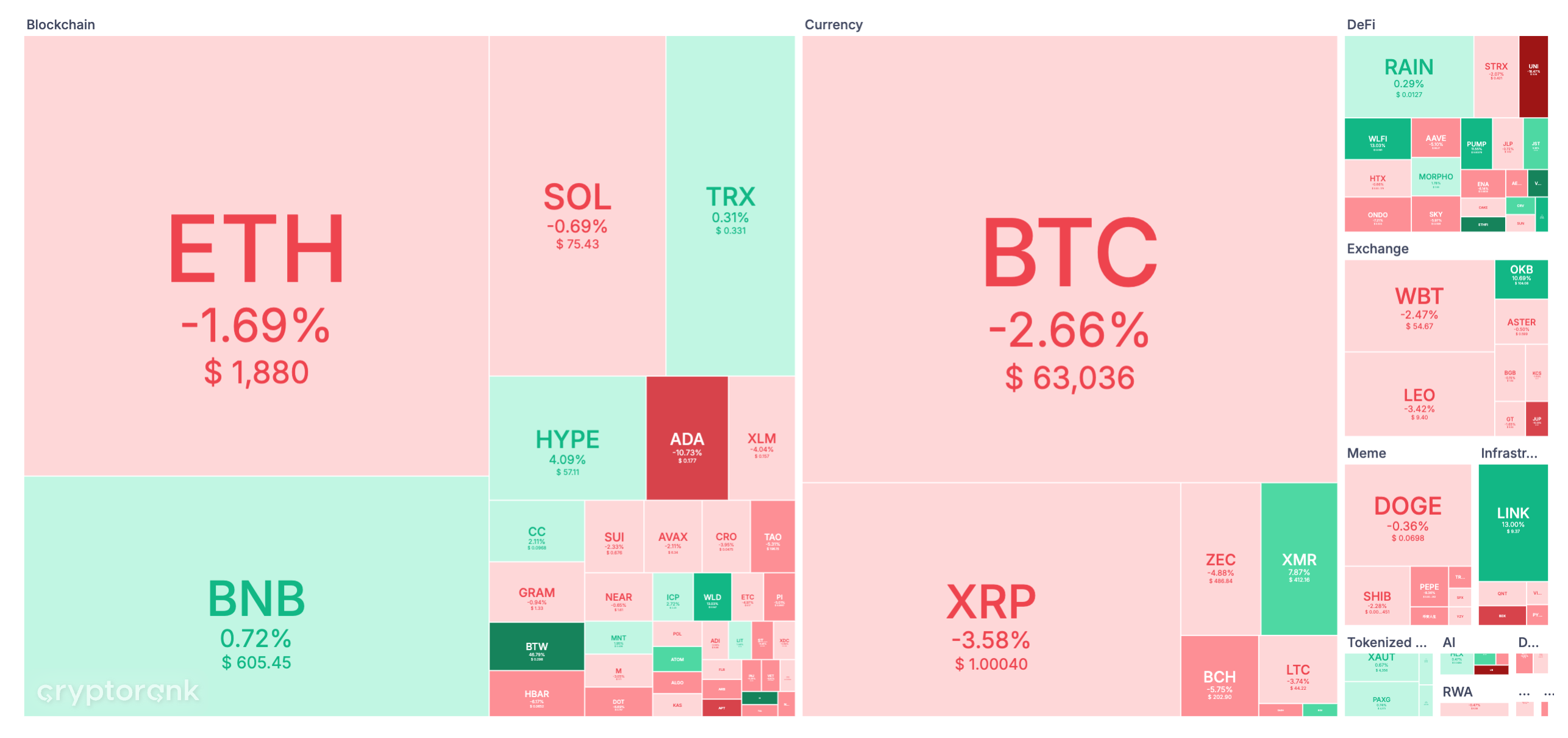
🔥🗺️Heat map shows the 7 day change in price (red down, green up) and block size is market cap
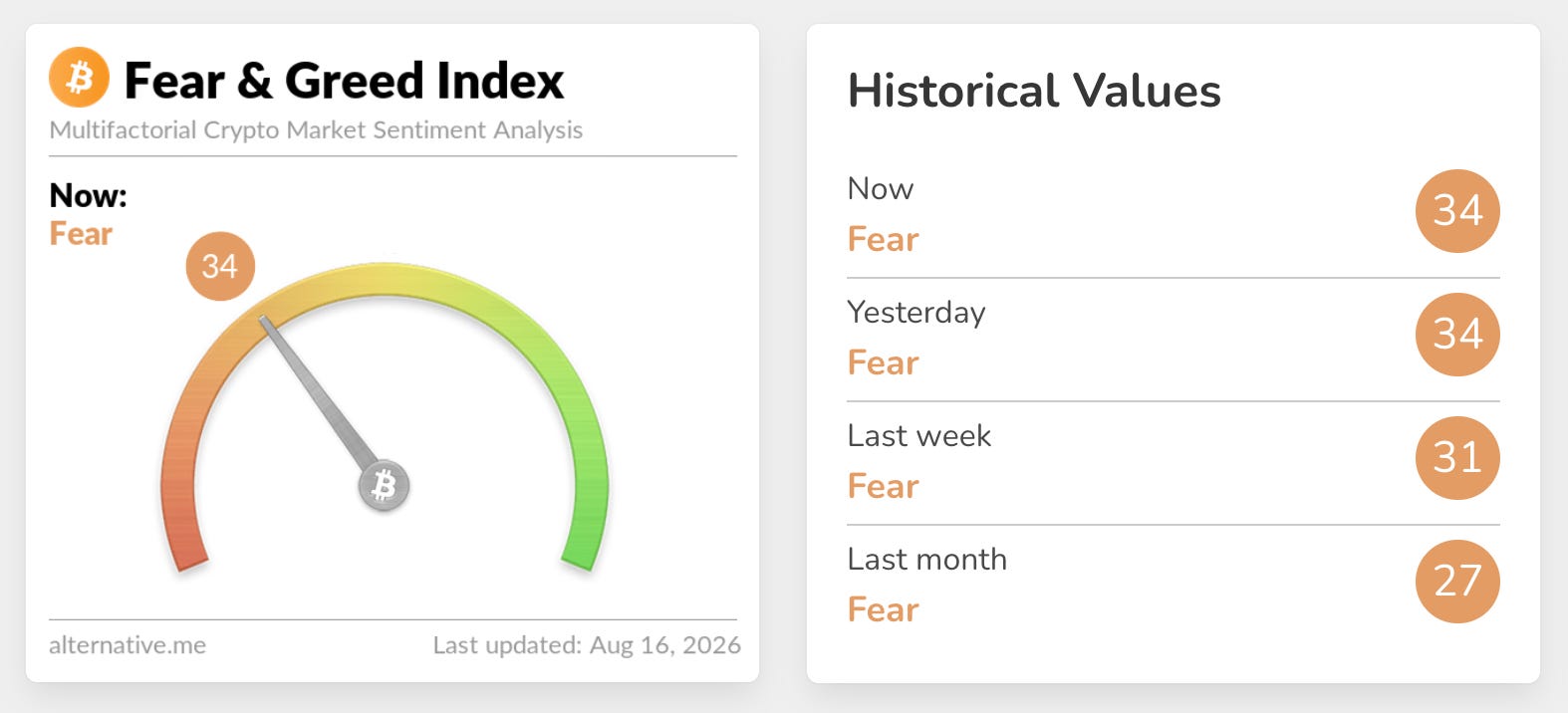
🎭 Crypto Fear and Greed Index is an insight into the underlying psychological forces that drive the market’s volatility. Sentiment reveals itself across various channels - from social media activity to Google search trends - and when analysed alongside market data, these signals provide meaningful insight into the prevailing investment climate. The Fear & Greed Index aggregates these inputs, assigning weighted value to each, and distils them into a single, unified score.

This section captures developments at the edge of digital systems. New interfaces, tools, and capabilities that feel early, unfinished, or slightly ahead of their moment. I’m less interested in what’s impressive today and more interested in what might quietly reshape how people work, coordinate, and interact over time.
Gene editing is coming for pet allergies
Scientists at US biotech company Kindred Companion Sciences have used CRISPR gene editing to create two beagles that do not produce Can f 1, one of the major proteins responsible for human allergic reactions to dogs.
The researchers edited the relevant gene in dog cells and then used cloning techniques to produce two genetically identical beagles, Bailey and Alfie. Tests found no detectable Can f 1 protein, and one of the scientists involved, who has a severe dog allergy, has reportedly lived with Bailey for around 18 months without experiencing his usual symptoms. (Associated Press)
The application feels surprisingly ordinary. CRISPR is usually discussed in the context of rare genetic diseases, cancer treatments or ambitious attempts to engineer organs. Here, the same underlying technology is being applied to a much more familiar problem: people who love dogs but are allergic to them.
That makes the experiment more interesting, not less. The claim also needs to remain fairly narrow. Can f 1 is an important dog allergen, but it isn’t the only one, and people can be sensitive to several different proteins. Removing it therefore doesn’t necessarily create a universally “hypoallergenic dog”. Researchers still need to understand how effective the approach is across different people and breeds, as well as whether the genetic change has any long-term consequences for the animals. (Associated Press)
Frontier technologies often begin with problems important enough to justify enormous cost and complexity. Over time, the technology improves, becomes cheaper and gradually finds its way into more ordinary parts of life. Gene editing may be approaching that transition. The interesting question is no longer simply whether we can edit animals. Humans have already crossed that technical threshold. It is what we decide is important enough to edit them for.
Preventing disease is relatively easy to understand. Removing an allergen from a family pet sits somewhere different. Beyond that are questions about lifespan, physical characteristics, temperament and eventually traits that have little to do with health at all. Two beagles without a particular protein may seem like a small experiment. But they hint at a much larger transition, where genetic engineering moves beyond treating disease and begins altering the everyday biological world around us.

“You never change things by fighting the existing reality. To change something, build a new model that makes the existing model obsolete.”
Buckminster Fuller
Fuller was an American architect, inventor and systems thinker who spent much of his life exploring how technology and design could change the structures people live within. It works nicely with South Korea’s approach because the strategy isn’t simply about defending existing industries. It is about deliberately building the capabilities that might eventually replace them.