
Welcome to this week’s Field Notes, a 10-year project of mine documenting humankind’s digital transition from the field. These notes are shaped by what I’m seeing, building, and discussing as our physical and digital lives continue to converge.
- Ryan
(Connect with me on LinkedIn)

News is surface-level. Signals live underneath. This section captures developments that hint at deeper shifts in how digital systems are being built, governed, and adopted — often before they’re obvious in the mainstream narrative.
Microsoft may have changed the AI conversation
For much of the past year, the dominant question around AI has been whether the enormous investment in infrastructure would ever generate meaningful returns.
This week, that conversation appeared to shift. Microsoft reported that Azure had surpassed US$100 billion in annual revenue, with AI services playing a significant role in that growth. The results were well ahead of expectations, pushing Microsoft’s market value beyond US$5 trillion and marking one of its strongest single-day share price gains in nearly two decades.
The numbers matter, but the reaction may matter more. Markets no longer seem focused solely on how much technology companies are spending on AI. Increasingly, they are asking which companies can convert that investment into durable revenue and long-term cash flow.
It feels like a subtle transition. The first phase of the AI boom rewarded ambition. The next may reward execution.
AI’s invisible winners are beginning to emerge
Nvidia has become the public face of the AI boom, but this week’s results from Samsung highlighted a quieter part of the supply chain.
The company reported record semiconductor profits driven by demand for high-bandwidth memory (HBM), while warning that shortages could extend through 2028. Samsung says it has already committed around two-thirds of its memory production through long-term agreements with major data centre operators. Reuters
It’s a useful reminder that technological transitions rarely benefit only the companies in the spotlight. Railways created fortunes for steel producers. The smartphone era rewarded semiconductor manufacturers. AI appears to be creating a similar layer of less visible beneficiaries. As models grow larger and more capable, memory is becoming just as strategically important as processing power.
Sometimes the most important companies in a technology transition are not the ones building the applications. They are the ones quietly supplying everyone else.

What it is
This Bloomberg Primer “The Business of Adapting to Flood Risk” explores the growing business of climate adaptation. Rather than asking how the world can prevent climate change, it examines how governments, businesses and communities are responding to its consequences. From mega seawalls in Jakarta and flood tunnels in Tokyo to nature-based solutions in Kenya, the documentary shows how adaptation is becoming an increasingly important part of the global economy.
What stood out
The documentary spans projects costing billions of dollars, but one of its final examples is surprisingly modest. In Kenya, black soldier flies are being used to process organic waste in flood-prone informal settlements. The insects convert waste into protein for animal feed, reducing pollution while creating a local circular economy. It is a simple intervention, yet one that improves resilience for communities facing increasingly frequent flooding.
That contrast is what lingered. Climate adaptation is often associated with massive engineering projects, but resilience can also emerge from smaller, local solutions. The scale of the response depends on the scale of the problem being solved.
Why it matters
The conversation around climate change has traditionally focused on mitigation, reducing emissions and slowing future warming. This documentary suggests another transition is already underway.
Adaptation is becoming an industry in its own right. As climate risks become more visible, investment is flowing into flood defences, resilient infrastructure, insurance, water management and local adaptation projects. These are no longer simply environmental initiatives. They are becoming long-term economic and infrastructure decisions.
Perhaps the most useful reminder is that resilience is rarely built through a single solution. It emerges through layers of adaptation, from national infrastructure projects to small community interventions, each responding to local conditions in different ways.


Digital assets now sit less as an idea and more as infrastructure in progress. As physical and digital life continue to converge, money and digital asset infrastructure are doing the same. What was once framed as “crypto” is increasingly showing up as rails, balance sheets, and policy conversations.
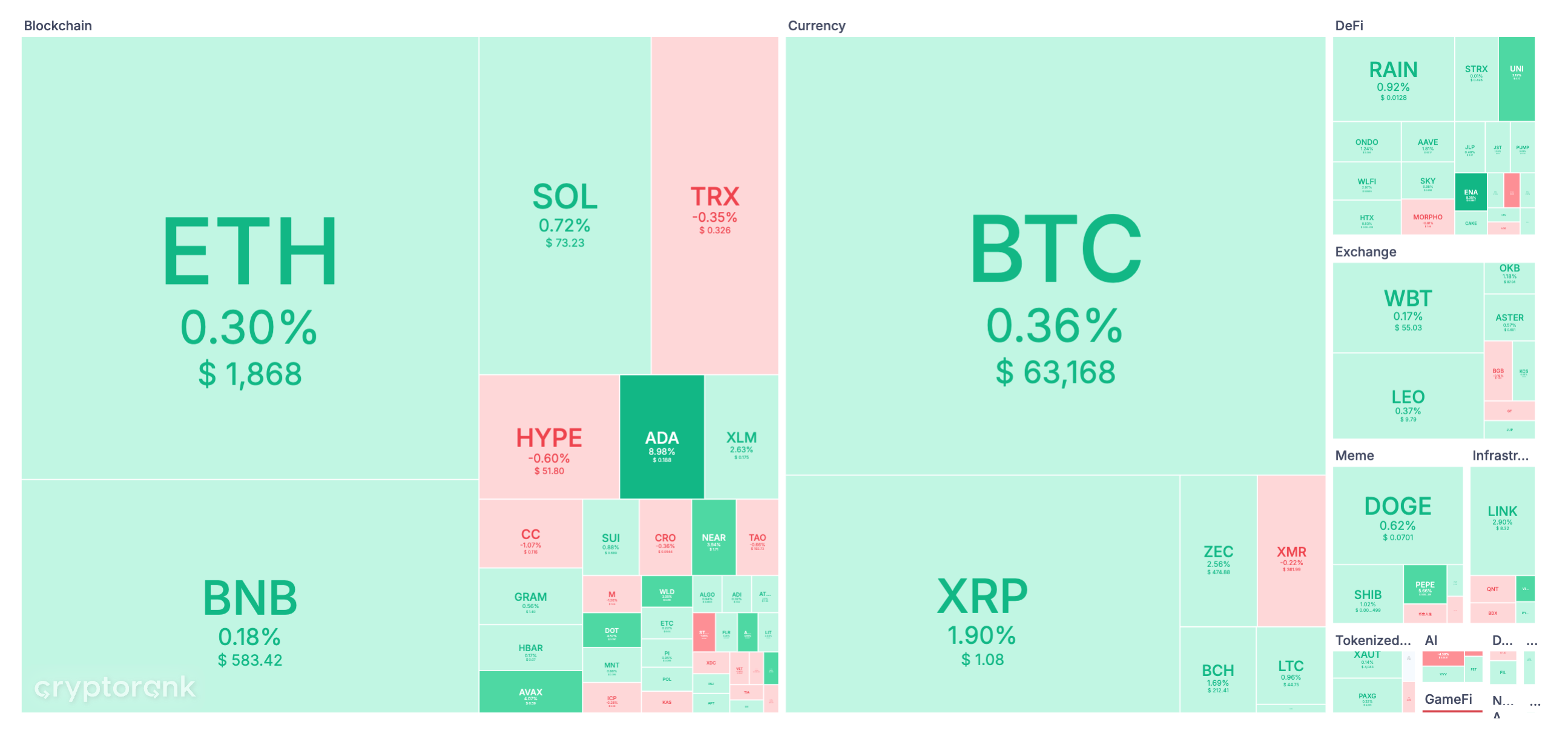
🔥🗺️Heat map shows the 7 day change in price (red down, green up) and block size is market cap.
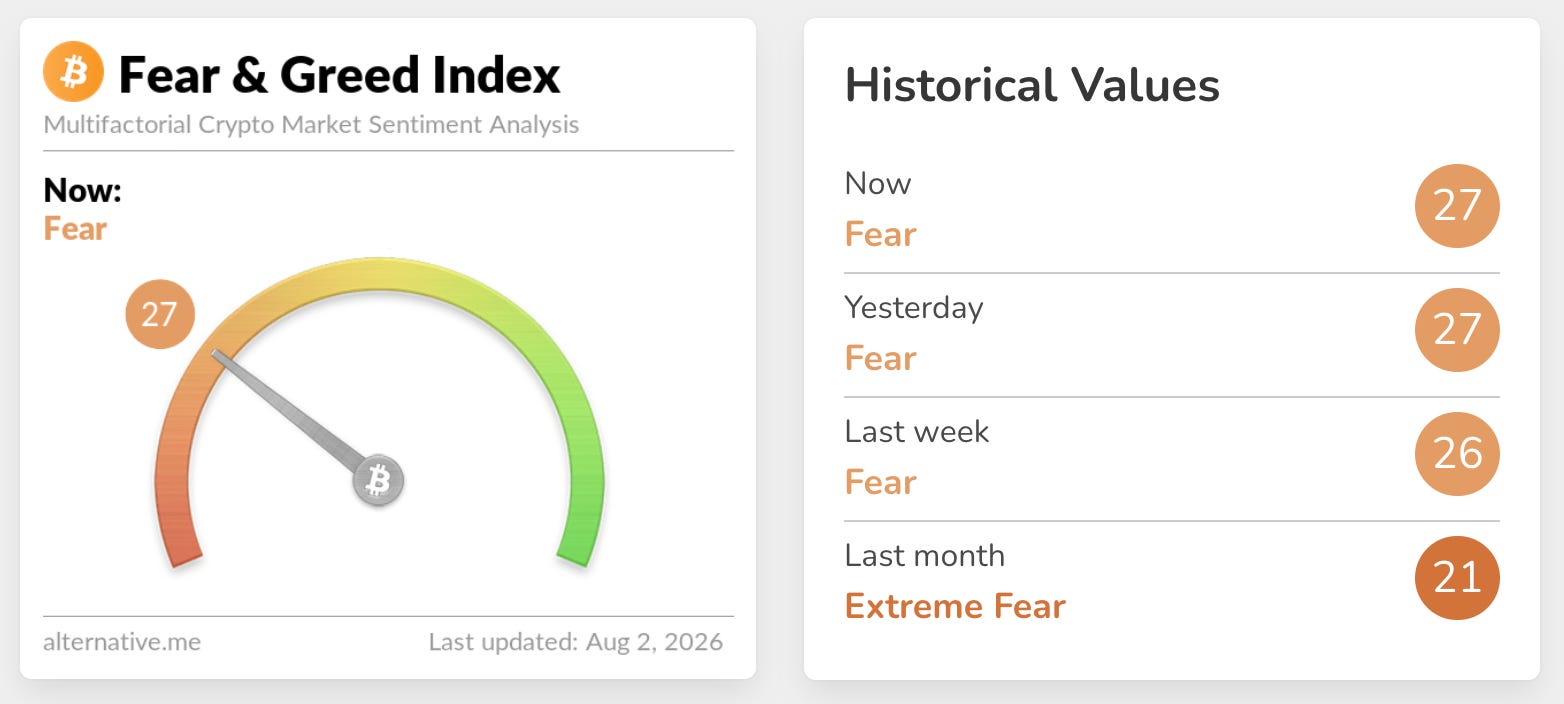
🎭 Crypto Fear and Greed Index is an insight into the underlying psychological forces that drive the market’s volatility. Sentiment reveals itself across various channels - from social media activity to Google search trends - and when analysed alongside market data, these signals provide meaningful insight into the prevailing investment climate. The Fear & Greed Index aggregates these inputs, assigning weighted value to each, and distils them into a single, unified score.

This section captures developments at the edge of digital systems. New interfaces, tools, and capabilities that feel early, unfinished, or slightly ahead of their moment. I’m less interested in what’s impressive today and more interested in what might quietly reshape how people work, coordinate, and interact over time.
AI is becoming a scientific instrument
For much of the past three years, AI has been judged by its ability to generate content. The benchmarks measured how well models could write, reason, translate, code or create images. Success was defined by how closely machines could imitate human capabilities.
That still matters, but a quieter transition appears to be underway. Increasingly, frontier AI companies are positioning their models not as conversational assistants, but as tools for scientific discovery. Anthropic recently introduced Claude for Science, designed to support researchers working across biology, chemistry and medicine, while OpenAI continues to deepen its investment in scientific research and life sciences. (anthropic.com, nature.com)
The distinction is subtle, but important. Writing an essay or generating an image is ultimately about producing content. Scientific research is about producing knowledge. The objective is no longer simply to answer a question, but to identify patterns, generate hypotheses and help researchers navigate problems that would otherwise take months or years to explore.
That changes the role AI begins to play. Rather than replacing expertise, it becomes another instrument alongside microscopes, particle accelerators and DNA sequencers. Its value comes not from making decisions on behalf of scientists, but from helping them search larger spaces, test more possibilities and uncover relationships that may have remained hidden.
Whether these systems deliver on that ambition remains to be seen. Scientific progress has always depended on careful validation, repeatability and human judgement, none of which can be shortcut by better models alone.
What feels directionally important is the shift in intent. The first wave of AI focused on generating information. The next may be focused on generating discovery. If that proves true, AI will be remembered less as a better way to write documents, and more as a new class of scientific instrument.

“Nothing is less predictable than the development of an active scientific field.”
Murray Gell-Mann
Murray Gell-Mann was one of the twentieth century’s most influential physicists, best known for developing the theory of quarks, the fundamental building blocks of protons and neutrons. He was awarded the Nobel Prize in Physics in 1969 and later became a founding figure at the Santa Fe Institute, where his work expanded into complexity science and the study of how large, interconnected systems evolve. His writing often explored the idea that progress rarely unfolds in a simple or predictable way. Instead, it emerges through countless interactions, feedback loops and discoveries that only become obvious in retrospect. That perspective feels particularly relevant as AI moves beyond software and into the physical world, where each breakthrough seems to uncover a new set of challenges rather than bringing the journey to an end.
The trajectory of AI often feels obvious in hindsight, but far less certain from inside the transition. Each breakthrough tends to reveal a new constraint, whether it is data, energy, manufacturing or deployment. Progress rarely follows a straight line. It accumulates through thousands of small advances, unexpected detours and problems that only become visible once the previous ones have been solved.