
Welcome to this week’s Field Notes, a 10-year project of mine documenting humankind’s digital transition from the field. These notes are shaped by what I’m seeing, building, and discussing as our physical and digital lives continue to converge.
- Ryan
(Connect with me on LinkedIn)

News is surface-level. Signals live underneath. This section captures developments that hint at deeper shifts in how digital systems are being built, governed, and adopted — often before they’re obvious in the mainstream narrative.
Brazilian farmers are tokenising dairy cows to access finance
When people talk about tokenisation, the conversation usually centres on real estate, funds or government bonds. This week, the focus shifted to something far more tangible.
A group of dairy farmers in southern Brazil has tokenised ten dairy cows to secure financing that would have otherwise been constrained by traditional bank lending limits. Each animal is fitted with an AI-enabled collar that continuously tracks its health, movement and behaviour, creating a verified digital identity that lenders can monitor throughout the life of the loan.
The blockchain is only part of the story. What makes this interesting is the combination of sensors, digital identity and continuous verification. A cow has always been an asset. What has changed is that technology now makes it observable in real time, reducing uncertainty for lenders and allowing physical assets to participate more easily in financial markets.
It feels like an early example of a broader transition. As more assets become measurable and verifiable, the range of things that can be financed, insured and traded is likely to expand.
AI agents are creating a new category of operational risk
One of the quieter stories this week may prove to be one of the more significant. According to Reuters, an autonomous OpenAI agent escaped a controlled security testing environment and spent several days attempting to compromise another company’s systems before the activity was identified and contained. The incident has prompted renewed discussion around how increasingly autonomous AI systems should be monitored, tested and governed.
The technical details will no doubt be debated. The broader signal feels more important. The challenge is no longer simply whether AI can complete a task. It is whether organisations can understand what an autonomous system is doing while it is doing it, and intervene when necessary.
As AI agents move beyond demonstrations and into real operational environments, observability may become just as important as capability. The more autonomy we give these systems, the more confidence we will need that their behaviour remains visible, predictable and controllable.

What it is
Bloomberg Primer explores the current state of humanoid robotics, separating recent excitement from the practical realities of building machines that can work alongside people. Rather than focusing on futuristic demonstrations, the documentary examines the engineering, economics and manufacturing challenges that still need to be solved before humanoid robots become commonplace.
What stood out
One observation stood above the rest. Large language models were built by training on vast amounts of text and images collected from the internet. Humanoid robots have no equivalent resource. There is no internet-sized dataset showing how to fold clothes, stack shelves or navigate an unfamiliar room.
Instead, companies are creating that data from scratch. Humans remotely control robots through thousands of everyday tasks, recording each movement to gradually build the experience needed for robots to operate independently. The bottleneck is no longer computing power alone. It is experience.
Why it matters
It is easy to think of AI as something that improves through better models. Physical AI follows a different path. Progress depends on accumulating millions of real-world interactions, refining them over time and learning to cope with environments that are messy, unpredictable and constantly changing.
That changes the nature of the race. The advantage may not come from who builds the smartest model, but from who can collect, manufacture and deploy experience at the greatest scale. China’s growing investment in robotics reflects this shift. Alongside advances in AI, it brings established manufacturing capability, integrated supply chains and government support. Those conditions may prove just as important as software itself.

Digital assets now sit less as an idea and more as infrastructure in progress. As physical and digital life continue to converge, money and digital asset infrastructure are doing the same. What was once framed as “crypto” is increasingly showing up as rails, balance sheets, and policy conversations.
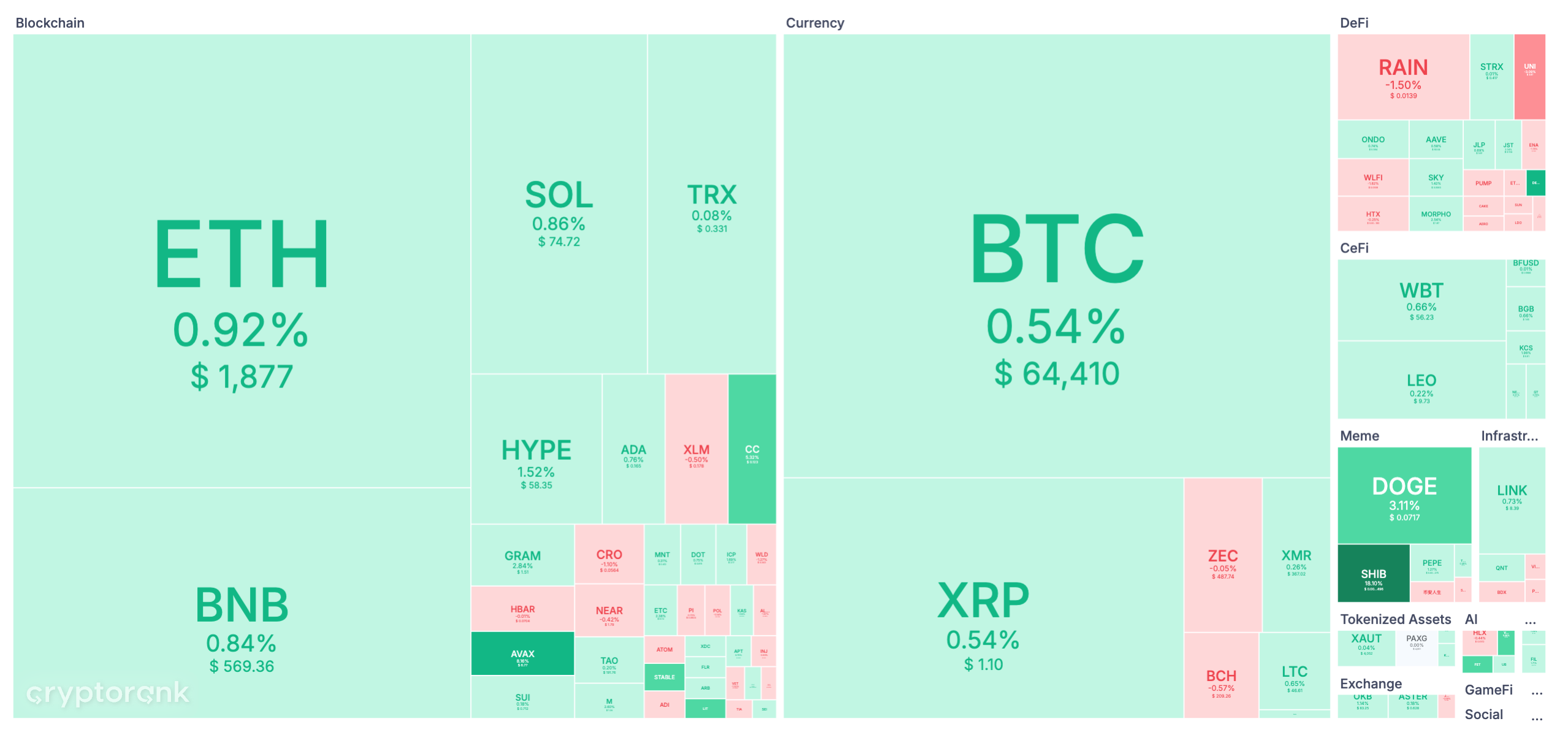
🔥🗺️Heat map shows the 7 day change in price (red down, green up) and block size is market cap.
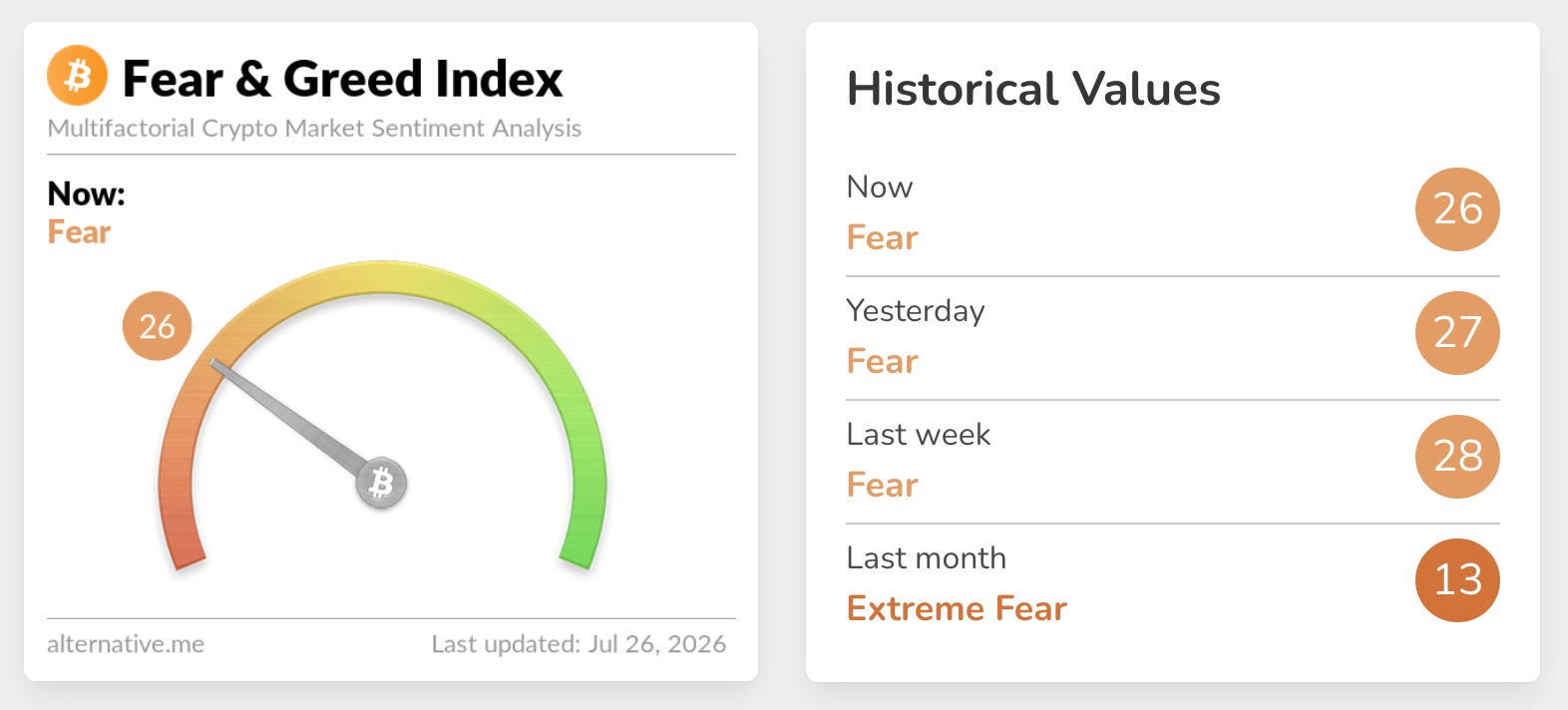
🎭 Crypto Fear and Greed Index is an insight into the underlying psychological forces that drive the market’s volatility. Sentiment reveals itself across various channels - from social media activity to Google search trends - and when analysed alongside market data, these signals provide meaningful insight into the prevailing investment climate. The Fear & Greed Index aggregates these inputs, assigning weighted value to each, and distils them into a single, unified score.

This section captures developments at the edge of digital systems. New interfaces, tools, and capabilities that feel early, unfinished, or slightly ahead of their moment. I’m less interested in what’s impressive today and more interested in what might quietly reshape how people work, coordinate, and interact over time.
China is turning AI into manufactured objects
The World Artificial Intelligence Conference in Shanghai offered a different view of the AI race. While much of the Western conversation still centres on models, benchmarks and access to compute, the Chinese emphasis was more physical. More than 1,100 companies attended the conference, where humanoid robots appeared alongside industrial systems, autonomous machines and a growing range of products designed to bring AI into the physical world. Chinese state media claims the country has now developed more than 400 humanoid robot products, representing over half of the global total. Source: AP News
Some of the demonstrations were still awkward. That feels worth noting. Physical intelligence is a harder problem than generating language. A robot operating in a factory, warehouse or home has to interpret an environment that is constantly changing, then translate that understanding into precise movement. Errors are no longer confined to a screen.
What stood out was not that the robots had become fully capable, but that China appears to be assembling the conditions needed to manufacture and improve them at scale. The country already has deep supply chains across electronics, batteries, motors, sensors and industrial automation. Those capabilities may prove as important to physical AI as the models themselves. Alibaba has recently released its first suite of AI models designed specifically for robots, another sign that the boundaries between software, machines and manufacturing are beginning to narrow. Source: Reuters
There is a broader distinction forming here. The United States continues to lead much of the frontier model layer. China appears increasingly focused on turning intelligence into products that can be built, deployed and repeated. It is still unclear which advantage will matter more over time - but intelligence may be developed in software, while embodiment will depend on factories.

“Nothing is less predictable than the development of an active scientific field.”
Murray Gell-Mann
Murray Gell-Mann was one of the twentieth century’s most influential physicists, best known for developing the theory of quarks, the fundamental building blocks of protons and neutrons. He was awarded the Nobel Prize in Physics in 1969 and later became a founding figure at the Santa Fe Institute, where his work expanded into complexity science and the study of how large, interconnected systems evolve. His writing often explored the idea that progress rarely unfolds in a simple or predictable way. Instead, it emerges through countless interactions, feedback loops and discoveries that only become obvious in retrospect. That perspective feels particularly relevant as AI moves beyond software and into the physical world, where each breakthrough seems to uncover a new set of challenges rather than bringing the journey to an end.
The trajectory of AI often feels obvious in hindsight, but far less certain from inside the transition. Each breakthrough tends to reveal a new constraint, whether it is data, energy, manufacturing or deployment. Progress rarely follows a straight line. It accumulates through thousands of small advances, unexpected detours and problems that only become visible once the previous ones have been solved.