
Welcome to this week’s Field Notes, a 10-year project of mine documenting humankind’s digital transition from the field. These notes are shaped by what I’m seeing, building, and discussing as our physical and digital lives continue to converge.
- Ryan
(Connect with me on LinkedIn)

News is surface-level. Signals live underneath. This section captures developments that hint at deeper shifts in how digital systems are being built, governed, and adopted — often before they’re obvious in the mainstream narrative.
Physical AI is moving from concept to competition
For the past few years, the AI race has largely been fought through language. Companies competed to build models that could write, reason and generate increasingly convincing text and images.
That race is beginning to expand into the physical world. Over the past month, several of the largest technology companies have accelerated their investment in robotics, with Nvidia, OpenAI, Meta and Tesla all positioning themselves for what many are now calling “physical AI”. Venture funding has followed, growing rapidly as investors look beyond software towards machines that can navigate, manipulate and operate in real-world environments (source)
The technical challenge is considerably harder. Understanding language is one thing. Folding laundry, carrying boxes or plugging in a charging cable requires perception, dexterity and decision-making under constantly changing conditions.
What stood out wasn’t another robot demonstration. It was the sense that the industry’s centre of gravity is shifting. If the first phase of AI changed how we interact with computers, the next may change how computers interact with the physical world.
Frontier AI is becoming a matter of national security
For decades, software has largely been treated as a commercial product. Companies developed it, tested it and released it when they believed it was ready.
Frontier AI appears to be entering a different category. Last week, OpenAI broadly released GPT-5.6 after a delayed rollout that followed additional testing and discussions with US government officials over national security concerns. While the White House later clarified that formal government approval was not legally required for the release, the episode highlighted the increasingly close relationship between frontier AI developers and government agencies (source).
Whether this becomes the norm remains unclear. What feels more significant is the direction of travel. As AI systems become more capable, governments are treating them less like ordinary software and more like strategically important technologies. Questions of security, resilience and geopolitical advantage are becoming part of the release process.
It’s a subtle change, but one worth watching. The conversation around frontier AI is no longer confined to engineering teams and product roadmaps. It is increasingly becoming part of industrial policy and national strategy.

What it is
This conversation “Why Half of AI’s Data Centers May Never Get Built” explores the less visible side of the AI boom. Rather than discussing models or applications, it focuses on the layers beneath them: electricity, transmission infrastructure, substations, transformers and the engineering required to bring new data centres online. One idea stood out - new AI projects are increasingly expected to “bring their own electrons”, securing access to power before construction can even begin.
What stood out
Most discussion around AI assumes that demand naturally becomes supply. More models lead to more data centres, which lead to more compute. This video suggests the opposite, that the limiting factor is no longer ambition - it’s infrastructure.
A comparison is drawn to the power boom between 1995 and 2005, when far more generation projects were announced than were ultimately built. Today’s AI infrastructure pipeline may follow a similar pattern. Land can be purchased, capital can be raised and announcements can be made. None of that guarantees transformers, transmission capacity or grid connections will arrive on time.
The AI stack is often presented as chips, models and applications. This conversation starts one layer lower. Energy comes first.
Why it lingers
It feels increasingly misleading to describe AI as a software industry. Software may be what we interact with, but the competition is shifting towards physical infrastructure. Power generation, transmission lines, cooling systems and specialised equipment are becoming strategic assets in their own right.
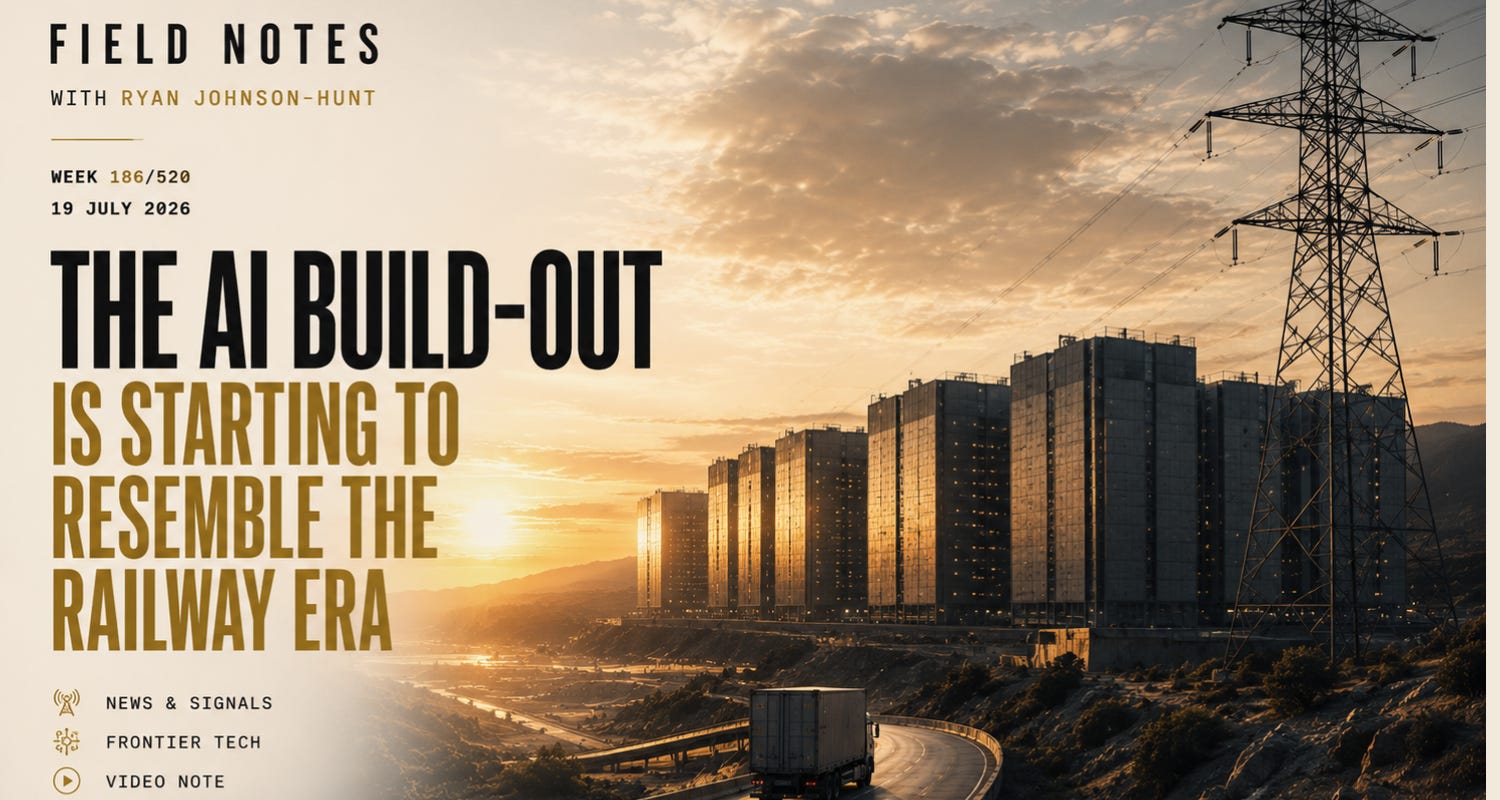
The railway era wasn’t defined by the trains. It was defined by the tracks that connected them. This build-out may be remembered in much the same way. Not by the models that captured today’s attention, but by the infrastructure that quietly determined which ones could scale.

Digital assets now sit less as an idea and more as infrastructure in progress. As physical and digital life continue to converge, money and digital asset infrastructure are doing the same. What was once framed as “crypto” is increasingly showing up as rails, balance sheets, and policy conversations.
🔥🗺️Heat map shows the 7 day change in price (red down, green up) and block size is market cap.

🎭 Crypto Fear and Greed Index is an insight into the underlying psychological forces that drive the market’s volatility. Sentiment reveals itself across various channels - from social media activity to Google search trends - and when analysed alongside market data, these signals provide meaningful insight into the prevailing investment climate. The Fear & Greed Index aggregates these inputs, assigning weighted value to each, and distils them into a single, unified score.


This section captures developments at the edge of digital systems. New interfaces, tools, and capabilities that feel early, unfinished, or slightly ahead of their moment. I’m less interested in what’s impressive today and more interested in what might quietly reshape how people work, coordinate, and interact over time.
Reliability is replacing capability as the frontier
For the past three years, progress in AI has largely been measured through capability. Each new model has been compared on its ability to write, reason, code or generate increasingly convincing images. The conversation has centred on benchmarks, leaderboards and which model sits at the top.
That still matters, but it feels like the conversation is beginning to shift. This week, OpenAI launched ChatGPT Work, extending agent-like capabilities into more everyday office tasks such as creating documents, presentations and websites. It’s another step towards AI systems that don’t just respond to prompts, but carry out pieces of work on a user’s behalf.
As those systems become more autonomous, the challenge changes. A model that occasionally makes a mistake can still be an impressive demonstration. An AI agent embedded in a business workflow has a much higher standard to meet. It needs to be predictable, recover gracefully when something goes wrong, understand the limits of its own confidence, and behave consistently over hundreds or thousands of interactions.
That makes reliability a very different engineering problem from capability. It also changes how progress is measured. The next generation of AI products may not be judged by another benchmark result or a marginal improvement in reasoning. Instead, they’ll be judged by whether organisations are comfortable trusting them with real work.
This feels like a familiar stage in the adoption of new technologies. Early excitement often comes from what becomes possible. Long-term value comes from making those new capabilities dependable enough to disappear into the background. The most interesting frontier may no longer be building smarter models. It may be building systems that people stop thinking about because they simply work.

“Civilisation advances by extending the number of important operations which we can perform without thinking about them.”
Alfred North Whitehead
Alfred North Whitehead was an English mathematician and philosopher whose work explored science, systems and the nature of progress. Although written nearly a century ago, this observation feels particularly relevant today. Technologies rarely change society at the moment they are invented. They change society when they become dependable enough to disappear into the background. Electricity, clean water and the internet all followed that path. AI may be entering the same phase. This week’s stories, from data centre construction to autonomous agents, were less about what AI can do than whether the infrastructure and reliability exist for it to become part of everyday life. The most important technologies are often the ones we stop noticing.