
Welcome to this week’s Field Notes, a 10-year project of mine documenting humankind’s digital transition from the field. These notes are shaped by what I’m seeing, building, and discussing as our physical and digital lives continue to converge.
- Ryan
(Connect with me on LinkedIn)

News is surface-level. Signals live underneath. This section captures developments that hint at deeper shifts in how digital systems are being built, governed, and adopted — often before they’re obvious in the mainstream narrative.
Two stories this week point to the same underlying shift. Infrastructure that once looked settled is being reclassified. In Italy, the national postal network is being recast as part of the AI stack. In the United States, the Federal Reserve is now naming AI buildout as one of the forces shaping the inflation picture alongside tariffs and war. Different institutions, different lenses, same direction: AI is moving further out of the software story and deeper into the physical and macroeconomic one.
Italy’s post offices are being repurposed for the AI age
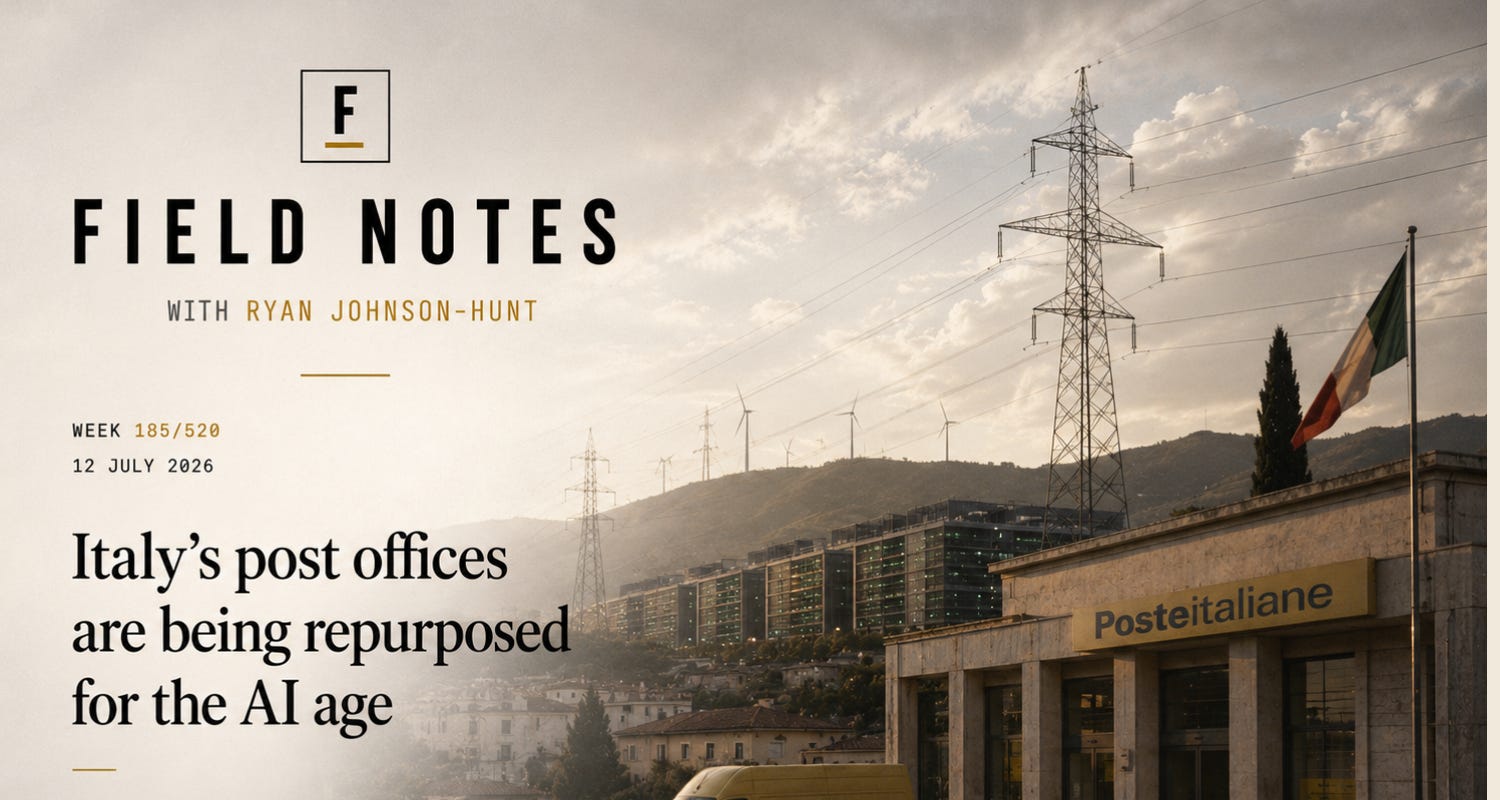
Reuters reported on 10 July that Poste Italiane is trying to turn its sprawling physical footprint into part of Italy’s digital and AI infrastructure. Its proposed €13.5 billion bid for Telecom Italia would combine Poste’s network of 12,600 post offices with TIM’s telecom assets, 125 megawatts of data-centre capacity, and older sorting centres that could be converted into edge-computing hubs. Reuters said the effort is being framed as part of a broader push to strengthen Italy’s technological capability and digital sovereignty.
What stood out is that this is not really a telecom merger story. It is a reclassification story. A legacy national institution, built to move letters, parcels, payments, and pensions, is being read again as infrastructure for a different era. That feels directionally important because it suggests AI buildout may not always arrive through entirely new systems. Sometimes it arrives by reinterpreting old ones.
There is also something distinctly European about the logic. Reuters notes that the proposed acquisition sits alongside wider sovereign cloud ambitions and would help create nationally controlled infrastructure for sensitive communications. In that frame, the point is not only scale or efficiency. It is who owns the physical layer once cloud, telecoms, and public-service delivery begin to converge.
The Fed is now naming AI buildout as part of the inflation picture
Reuters reported on 10 July that the Federal Reserve’s monetary policy report to Congress cited stepped-up inflation pressure linked to tariffs, the U.S.-Israeli war with Iran, and rapid AI-related investment. Reuters said inflation is running at about double the Fed’s 2% target, while the economy grew at a 2.1% annual rate in early 2026, helped in part by AI investment even as housing and household consumption remained softer.
What stood out is not only that AI is boosting investment. It is that the buildout has moved far enough down the stack to register in monetary language. Once the central bank starts treating AI-related spending as part of the inflation story, the category changes. It is no longer only a productivity promise or equity-market narrative. It becomes part of the same macro conversation as energy shocks, trade policy, and war.
That matters because it suggests AI infrastructure is starting to have a real economic footprint beyond the companies building it. Demand for power, land, equipment, construction, and financing does not stay contained within the technology sector for long. The Fed report makes that visible in a colder way than most market commentary does. AI is no longer just expected to change the economy later. It is already influencing how the current one is being read.
What stood out
Taken together, these stories suggest that AI is becoming harder to keep abstract. In Italy, it turns a postal network into strategic infrastructure. In the United States, it enters the inflation conversation alongside tariffs and conflict. One story is about legacy systems being repurposed. The other is about new systems becoming economically material. Both point to the same thing: the AI era is moving out of the lab and into the institutions that organise everyday capacity.

What it is
This week’s watch is “How the Electrical Grid Is Being Rebuilt for AI” from Bloomberg Primer.
The video starts with the obvious pressure point: electricity demand is rising again, pushed by AI, data centres, and electrification. But it quickly widens into something more useful. This is not just a story about extra demand. It is a story about how grids actually work, where they break, and why the next phase of digital infrastructure may depend less on software than on transmission, stability, and physical redesign. What makes the piece work is that it moves between scales. From China’s transmission buildout to superconducting cables, from Spain’s blackout to mini-grids in Nigeria. The grid stops looking like background utility and starts looking like the central coordination problem.
What stood out
What stood out is that the AI story keeps collapsing downward into infrastructure. The common public framing is that AI needs more chips and more data centres. The video makes clear that this is too narrow. AI also needs transmission capacity, faster grid upgrades, better balancing, and new ways of moving power without losing too much of it along the way. In that sense, the bottleneck is not only computation. It is electricity as a system.
The China section is useful for that reason. It suggests that one of China’s real advantages is not just manufacturing scale, but the ability to build grid infrastructure quickly enough to support new industrial demand. That sits in contrast to slower, more fragmented systems where generation, transmission, and local permitting do not move at the same pace.
The Spain blackout section also lingers. The explanation of inertia makes the whole system feel more fragile and more physical than the usual clean-energy narrative allows. A grid is not just power in and power out. It is a stability machine. Once that becomes visible, a lot of the current buildout starts to look more complicated than simply adding more generation.
Why it lingers
It lingers because it gives a cleaner language for what the AI buildout is really doing. The digital economy often presents itself as weightless. Cloud, agents, models, software. This video is a reminder that none of that escapes the grid. If anything, it drives us back into it. The more ambitious the digital layer becomes, the more the physical layer reasserts itself underneath.
That feels especially relevant now because so many of this week’s stories are really about reclassification. Old institutions becoming infrastructure again. New systems becoming economically material. The Bloomberg piece fits that pattern well. It suggests the next technology race may be won less by whoever has the best model than by whoever can align power, transmission, and reliability fast enough to support the model in the first place.
The useful signal is not just that the grid needs upgrading. It is that the grid is becoming one of the main arenas in which the next decade of technological competition will actually be decided.

Digital assets now sit less as an idea and more as infrastructure in progress. As physical and digital life continue to converge, money and digital asset infrastructure are doing the same. What was once framed as “crypto” is increasingly showing up as rails, balance sheets, and policy conversations.
🔥🗺️Heat map shows the 7 day change in price (red down, green up) and block size is market cap.

🎭 Crypto Fear and Greed Index is an insight into the underlying psychological forces that drive the market’s volatility. Sentiment reveals itself across various channels - from social media activity to Google search trends - and when analysed alongside market data, these signals provide meaningful insight into the prevailing investment climate. The Fear & Greed Index aggregates these inputs, assigning weighted value to each, and distils them into a single, unified score.


This section captures developments at the edge of digital systems. New interfaces, tools, and capabilities that feel early, unfinished, or slightly ahead of their moment. I’m less interested in what’s impressive today and more interested in what might quietly reshape how people work, coordinate, and interact over time.
The next layer of AI may not be the agent itself, but the trust architecture built around it.
A lot of the discussion around AI agents still sits at the level of capability. What can they book, buy, schedule, negotiate, monitor, optimise. That matters. But it may not be the real frontier. Reuters reported on 9 July that the International Telecommunication Union, the UN’s digital technology agency, has launched an initiative to improve trust in AI agents, autonomous systems that can perform tasks such as decision-making, scheduling, and financial transactions. The effort was announced at the AI for Good Summit in Geneva and will be carried forward through a new focus group of technical, legal, and policy experts.
What stood out is the framing. The concern is not only whether agents become more capable. It is whether they remain identifiable, trustworthy, and under meaningful human control, especially in areas such as finance and critical infrastructure. Reuters says the group’s mandate is to build international frameworks around exactly those questions. That is a useful signal because it suggests the next bottleneck may not be what agents can do, but what kinds of social and institutional trust can form around them before they become ambient.
That feels directionally important because software has usually been allowed to spread first and earn trust later. With agents, that sequence may be harder to tolerate. Once a system can act on behalf of a person or organisation, make transactions, impersonate authority, or move across multiple services without constant human supervision, the old assumptions break down more quickly. Reuters notes that the ITU initiative is responding in part to the risks of impersonation and unauthorised actions. The problem is no longer only model output. It is agency itself.
This is where the frontier starts to look less technical and more constitutional. Who authorised the action. How is an agent authenticated. What is the boundary between delegation and autonomy. When something goes wrong, who is accountable, the user, the developer, the platform, the firm that deployed it, or the system itself. Those are not side questions. They are the category. And the fact that the ITU is moving early on them is telling. It suggests the institutions closest to global digital coordination do not think trust can be left to emerge on its own.
There is also something quietly practical in the format. The ITU is starting with a focus group, not a treaty or a grand legal settlement. Reuters says the first meeting will take place in Paris in November, followed by another in Geneva in January. That is how new infrastructure categories often begin: not with a finished rulebook, but with a working attempt to define the problem before the market hardens around one default.
If the last generation of digital systems forced institutions to ask what happens when information scales too quickly, the next may force a different question: what happens when action does.

“Energy is the only universal currency.”
Vaclav Smil
Vaclav Smil is a Czech-Canadian scientist and policy analyst best known for his work on energy, materials, food systems, and the physical foundations of modern civilisation. He spent decades at the University of Manitoba and has written repeatedly about the long arc of how energy shapes economies, infrastructure, and everyday life. That is what makes the line so useful. It reduces a complicated week back to a basic condition. Beneath AI buildout, data centres, postal networks, and digital systems sits the same underlying question: how energy is produced, moved, stabilised, and allocated. The digital layer may change quickly. The physical logic underneath it still keeps score.