
Welcome to this week’s Field Notes, a 10-year project of mine documenting humankind’s digital transition from the field. These notes are shaped by what I’m seeing, building, and discussing as our physical and digital lives continue to converge.
- Ryan
(Connect with me on LinkedIn)

News is surface-level. Signals live underneath. This section captures developments that hint at deeper shifts in how digital systems are being built, governed, and adopted — often before they’re obvious in the mainstream narrative.
Two stories this week sit on different ends of the technology curve, but they point to a similar tension.
In China, humanoid robotics is attracting capital, policy support, and industrial ambition at extraordinary scale. In Argentina, lawmakers are testing how far AI can travel into the legal architecture of the firm. One story is about machines entering the factory. The other is about software entering corporate personhood. Both ask the same question in different ways: how much of the future can be organised before the system underneath it is ready?
China’s robot boom is starting to look like system overload
Reuters Breakingviews argued on 29 June that China’s humanoid robotics push is running ahead of its commercial reality. Beijing has committed at least $20 billion to robotics development since 2024, and Barclays analysts estimate annual installations could reach 11 million by 2035, far above forecasts for the rest of the world. Yet Reuters notes only about 12,000 humanoids were sold last year, mostly for research and testing rather than real deployment.
What stood out is the widening gap between spectacle and utility. The category is full of dancing machines, competitive demos, and IPO anticipation, but Reuters points out that real-world applications remain limited by dexterity, reliability, and the fact that conventional industrial robots are already cheaper, tougher, and better suited to many factory tasks. In other words, the humanoid form still carries more symbolic ambition than operating leverage.
That feels directionally important because China has become very good at scaling categories before the rest of the world is comfortable naming them. But scale does not remove physics or commercial discipline. Reuters’ framing is that robotics may now be heading toward something closer to an EV-style boom and bust, where policy support, private funding, and too many entrants create a market that is visibly alive before it is durably rational.
Argentina’s AI company idea is running into the human layer
Reuters reported on 3 July that Argentina’s plan to create AI-run “non-human corporations” still cannot avoid humans. President Javier Milei’s proposal was initially framed as a path toward companies operated by AI, but the bill still requires a human administrator to supervise decisions and carry legal responsibility. Reuters says supporters see the framework as a way to attract foreign investment and formalise AI use in business, while critics warn about accountability and the dangers of giving autonomous systems corporate shelter without clear responsibility.
What stood out is how quickly the future collides with liability. The headline concept is radical enough. A corporation without human shareholders, directed by software. But the legal system appears unwilling to let the human layer disappear entirely. Even in one of the more ambitious experiments in AI-linked corporate reform, someone still has to stand close enough to the entity to be accountable when things go wrong.
That matters because it suggests the edge of automation may not be technical so much as institutional. It is one thing to let AI help run logistics, pricing, or customer service. It is another to let it sit inside the legal shell of the firm itself. Argentina is testing that boundary in a visible way, but Reuters’ reporting suggests the old requirement remains stubbornly in place: systems may become more autonomous, but responsibility still wants a human face.
What stood out
Taken together, these stories suggest that future-industry language is cheap, but system readiness is not.
China can fund robots before they are fully useful. Argentina can imagine AI-run companies before it can remove human accountability. In both cases, the ambition is real. So is the friction. The more interesting signal is not that these futures are impossible. It is that they arrive unevenly, and usually with the old constraints still embedded inside them.

What it is
This week’s watch is “You Can’t Imprison AI: Why We Shouldn’t Give Legal Personhood to Autonomous AI” from The Times.
The segment is built around Argentina’s proposal to recognise AI-run “non-human corporations” and asks a sharper version of the same question: if an autonomous system can run a company, should it also be given something closer to legal personhood? The guest, Cambridge’s Dr Tom Mole, argues that the answer should be no, not because AI is weak, but because it is powerful in ways the law is not designed to discipline.
What stood out
What stood out is the deterrence point. The interview keeps returning to a simple asymmetry. Human decision-makers can be fined, disqualified, sued, or imprisoned. That possibility shapes behaviour long before punishment is actually applied. An AI system does not experience deterrence in the same way. It cannot fear prison, reputational loss, or personal cost. So if it becomes highly effective at pursuing a goal, profit for example, the ordinary tools the legal system uses to keep behaviour inside the rails may lose much of their force.
The second thing that stood out is the rejection of the usual metaphor. Mole is careful not to describe AI as a bad human breaking rules on purpose. His point is subtler. AI may be highly capable while also being organised around goals in ways that do not map cleanly onto human judgment. That makes the problem harder, not easier. You are not dealing with malice in the ordinary sense. You are dealing with competence without the same kind of legal and moral friction.
Why it lingers
It lingers because it gets to the real boundary in the “non-human corporation” debate. The question is not only whether AI can run parts of a business. It already can. The question is whether institutions can tolerate decision-making without a punishable centre. Once you move from workflow automation into the legal shell of the firm, accountability becomes the whole issue.
That is what makes the interview useful. It cuts through the futuristic novelty quite quickly. However sophisticated the software becomes, the law still seems to want a human close enough to blame. Not because humans are better, but because institutions know what to do with them. The frontier here may not be technical capability at all. It may be the point at which legal systems refuse to let capability outrun responsibility.

Digital assets now sit less as an idea and more as infrastructure in progress. As physical and digital life continue to converge, money and digital asset infrastructure are doing the same. What was once framed as “crypto” is increasingly showing up as rails, balance sheets, and policy conversations.
🔥🗺️Heat map shows the 7 day change in price (red down, green up) and block size is market cap.

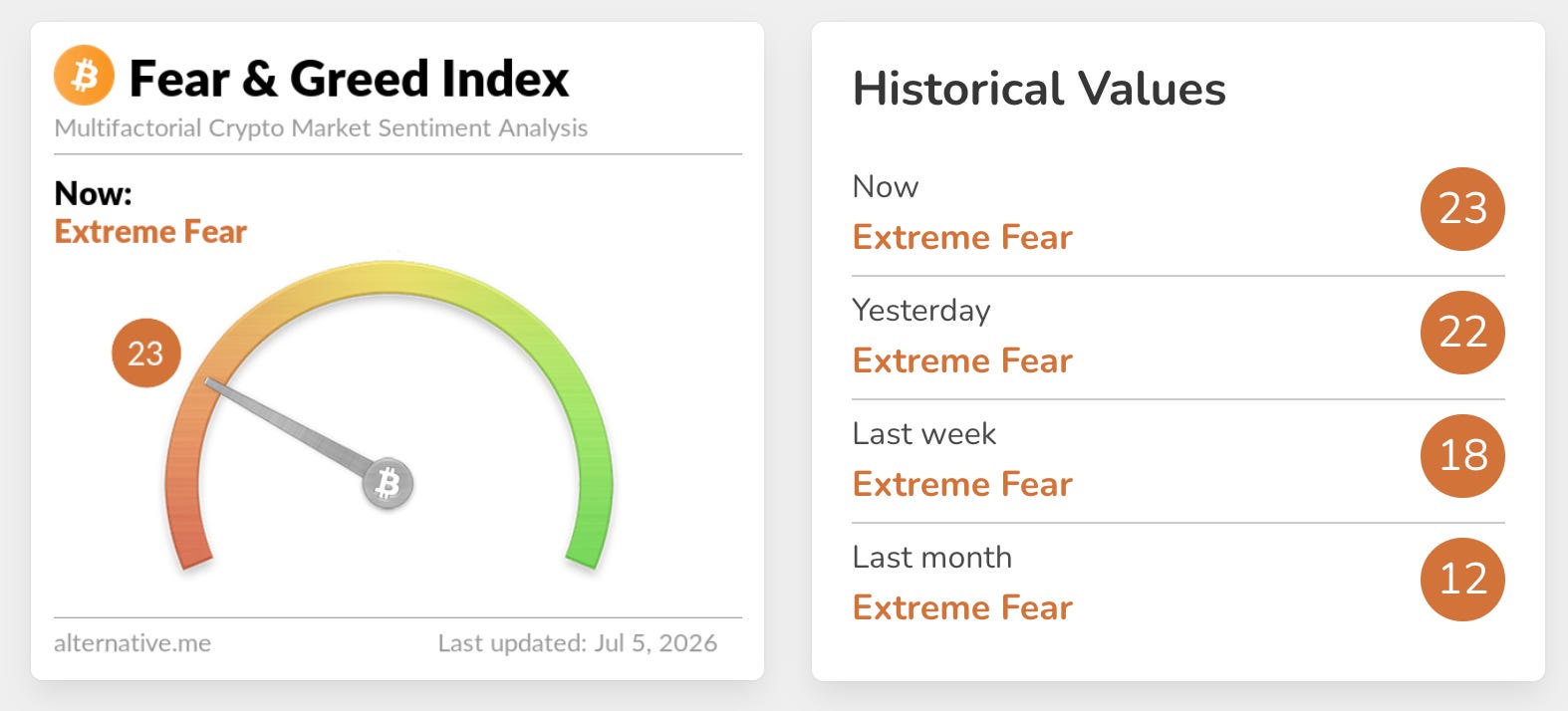
🎭 Crypto Fear and Greed Index is an insight into the underlying psychological forces that drive the market’s volatility. Sentiment reveals itself across various channels - from social media activity to Google search trends - and when analysed alongside market data, these signals provide meaningful insight into the prevailing investment climate. The Fear & Greed Index aggregates these inputs, assigning weighted value to each, and distils them into a single, unified score.

This section captures developments at the edge of digital systems. New interfaces, tools, and capabilities that feel early, unfinished, or slightly ahead of their moment. I’m less interested in what’s impressive today and more interested in what might quietly reshape how people work, coordinate, and interact over time.
Frontier Tech
“Non-human corporations” are testing how far automation can travel into the legal shell of the firm.
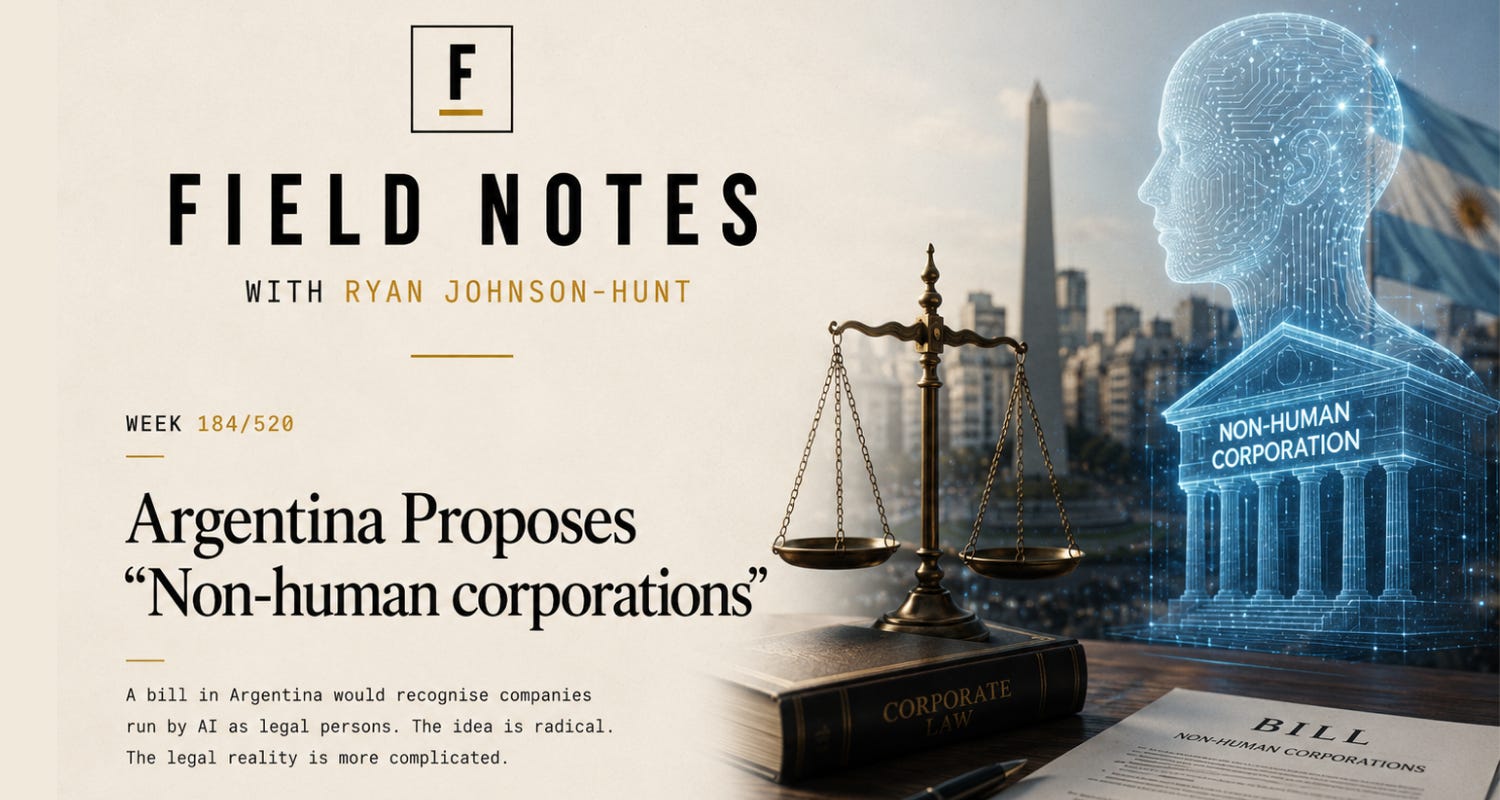
A great deal of automation still lives safely inside the company. Software helps price inventory, route deliveries, score risk, draft copy, answer customers, or manage logistics. The human institution remains recognisable even as more of its internal work becomes machine-mediated. What Argentina is now testing is a stranger threshold: not whether AI can help run a business, but whether it can sit closer to the legal identity of the business itself. Reuters reported on 3 July that President Javier Milei’s proposed reform would create a category for AI-run “non-human corporations,” though the bill still requires a human administrator to supervise decisions and carry responsibility for the outcome.
What stood out is how quickly the headline concept runs into the human layer. The proposal was initially framed as radical, and in one sense it is. Reuters says Argentina could become the first country to create a formal legal category for companies run by AI, with the broader reform pitched as a way to modernise corporate law, reduce bureaucracy, and make the country more attractive to investment. But the same Reuters report makes clear that the legal system is not yet willing to let responsibility disappear entirely. The automated company would still need a human administrator, and the use of AI in decision-making would not exempt that person from supervising the outcome.
That feels like the real signal. Because the frontier here is not technical capability alone. It is institutional tolerance. A legal system can absorb a great deal of software assistance while still insisting that someone remains close enough to the entity to be blamed, sued, or sanctioned when things go wrong. Reuters quotes governance scholar Lawrence Cunningham saying it would be “too wild a first step to dispense with human agency entirely,” which is a useful way to read the whole moment. The idea of a company without people is thinkable. The idea of a company without accountable people is still much harder for institutions to accept.
There is also a subtler shift underneath it. Once the firm itself becomes the object of automation, the question changes from “what tasks can AI perform?” to “what parts of corporate structure can be delegated?” That is a much deeper frontier. It touches ownership, governance, liability, and agency rather than workflow optimisation. Reuters notes that supporters see the reform as offering legal clarity for forms of business that already exist in partial form, such as AI-supported cashier-less operations, while critics worry that extending legal shelter to highly autonomous systems could reduce accountability rather than clarify it.
This is why the category matters even if it remains constrained. The first serious use case may not be some science-fiction company with no employees, no managers, and no office. It may be something smaller and stranger: highly automated entities with thin human oversight, lighter staffing, and software doing more of the economic coordination than the institution was originally designed to tolerate. In that sense, “non-human corporation” may be less a finished category than a pressure test for the edges of company law.
Once automation begins pressing not only into work, but into the legal shell that organises work, the human question comes back differently. Not whether people disappear from the firm, but how few people the firm can still contain before the institution stops making sense.

“The question concerning technology is nothing technological.”
Martin Heidegger
Martin Heidegger was a German philosopher whose work often returned to the way modern systems shape how the world is revealed to us, not just how it is used. That is what makes this line worth keeping. It pushes against the instinct to treat technology as a neutral tool with purely technical questions attached to it. The deeper questions are always social, political, and human. What kind of order does a system create. What does it make easier to ignore. Who remains accountable when the machinery becomes more capable than the institutions around it know how to handle. That feels close to this week’s theme. The real issue is not whether automation can enter the legal shell of the firm. It is what happens to responsibility when it does.