

Welcome to this week’s Field Notes, a 10-year project of mine documenting humankind’s digital transition from the field. These notes are shaped by what I’m seeing, building, and discussing as our physical and digital lives continue to converge.
- Ryan
(Connect with me on LinkedIn)

News is surface-level. Signals live underneath. This section captures developments that hint at deeper shifts in how digital systems are being built, governed, and adopted — often before they’re obvious in the mainstream narrative.
This week’s signal is not only that Europe is hot. It is that the heat is beginning to expose which parts of ordinary life were never really built for this temperature regime.
Reuters reported this week that the heatwave sweeping across Europe has led to melting road surfaces in Germany, derailed trains in Sweden, school and event closures, hospital strain, and lower nuclear output in France as river temperatures rise. France’s nuclear generation was cut by 4.1 gigawatts, or about 7% of total power demand, as several reactors reduced output because hot rivers could no longer absorb enough cooling water without breaching environmental limits.
What stood out is how varied the failures are. Roads soften. Tracks twist. Power exports fall. Hospitals struggle. Schools close. None of these are especially futuristic outcomes. They are basic system stresses. That is what makes the story feel important. Climate risk is often narrated at the level of emissions targets, future scenarios, or moral urgency. What Reuters captured this week is something more immediate: infrastructure behaving as though the climate assumptions embedded inside it no longer hold.
The French nuclear story makes that especially clear. Nuclear power is often discussed as stable baseload infrastructure, but even that stability depends on the physical environment around the plant. Reuters reported that high river temperatures forced reductions at multiple EDF reactors, cutting France’s exports from around 10–12 GW the previous week to about 3 GW during the afternoon, while spot power prices in France and Germany rose to their highest level since January 2025. The issue was not demand alone. It was that the surrounding water system had become part of the constraint.
This is also what gives the broader heatwave its weight. Reuters reported that scientists from World Weather Attribution called the event the most severe ever recorded for the region and said it would have been “virtually impossible” without human-caused climate change. They found that night-time temperatures of this kind are now 100 times more likely than they were just two decades ago. That matters because infrastructure does not only fail at the peak. It fails when the old margins disappear. When nights stay hot, rivers stay warm, hospitals stay full, and recovery windows shrink.
Europe’s roads, rail systems, power infrastructure, and public-health routines were built for a climate that is receding. The useful question is no longer just how often extreme heat will arrive. It is which parts of the system quietly depend on it not arriving at all.

What it is
This week’s watch is Bloomberg’s “Brutal Heat Wave Scorches Europe, Raising Concerns of Climate Inflation.”
The conversation starts with Europe’s immediate experience of extreme heat, failed cooling, transport disruption, and stressed public services. But it quickly moves to something more structural: the idea of climate inflation, where heat begins feeding directly into prices through damaged harvests, weaker livestock output, disrupted energy systems, and wider economic friction.
What makes the video useful is that it treats heat not only as weather, but as an economic transmission mechanism.
What stood out
What stood out is how ordinary the points of failure are. The speakers describe heat that is too intense for factories, too intense for sleep, and even too intense for sitting outside in the evening. That sounds anecdotal at first, but it helps explain the bigger argument. Extreme heat does not need to destroy everything at once to become economically significant. It only needs to make ordinary life and routine systems less reliable.
The inflation point is the one that lingers. The video notes that the 2022 European heatwave was estimated to lift food prices by around 0.7% and overall inflation by about 0.3%. That is useful because it shifts climate discussion away from distant catastrophe and toward price formation. Crops, livestock, electricity, transport, health systems. Once those are all under heat stress at the same time, inflation stops being only a monetary story.
The other thing that stood out was the description of Europe as the fastest-warming continent on Earth, warming at roughly double the global average. In that frame, the question is not whether a single policy can solve the issue. It is whether infrastructure, institutions, and adaptation can keep up with a system that is starting to fail in multiple places at once.
Why it lingers
It lingers because it gives a better language for what this week’s heatwave actually represents. “Climate change” can still sound broad and moral. “Climate inflation” sounds narrower, colder, and more immediate. It names the way physical stress enters the economy through food, power, transport, healthcare, and housing rather than through abstract future scenarios.
That matters because it changes the political and institutional challenge. If heat becomes a persistent inflationary force, then it is no longer only an environmental issue. It becomes a central-bank issue, a public-infrastructure issue, and a cost-of-living issue.
The useful signal here is not just that Europe is hot. It is that the old assumption of climatic stability is quietly embedded in more of the economy than most systems were ever designed to admit.

Digital assets now sit less as an idea and more as infrastructure in progress. As physical and digital life continue to converge, money and digital asset infrastructure are doing the same. What was once framed as “crypto” is increasingly showing up as rails, balance sheets, and policy conversations.
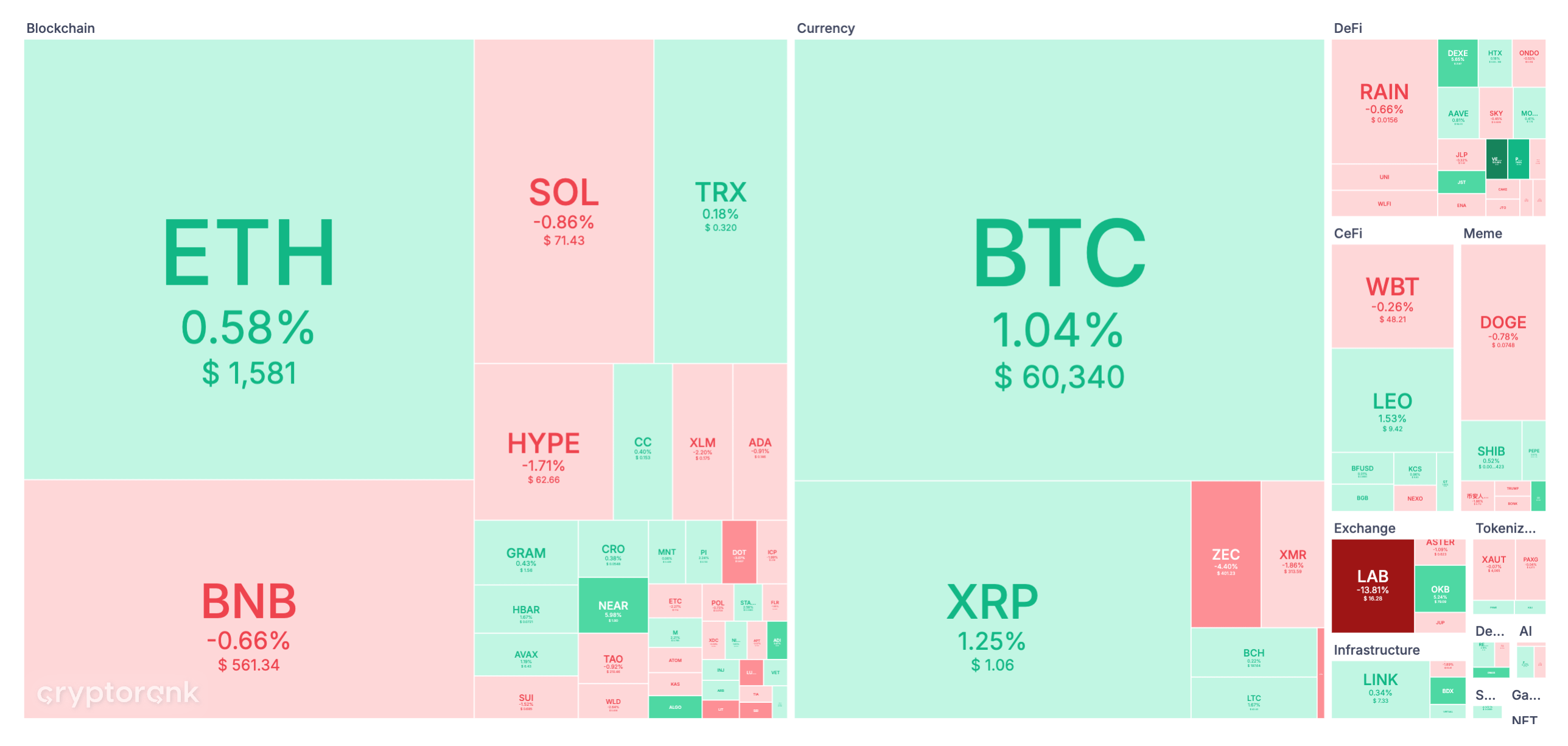
🔥🗺️Heat map shows the 7 day change in price (red down, green up) and block size is market cap.
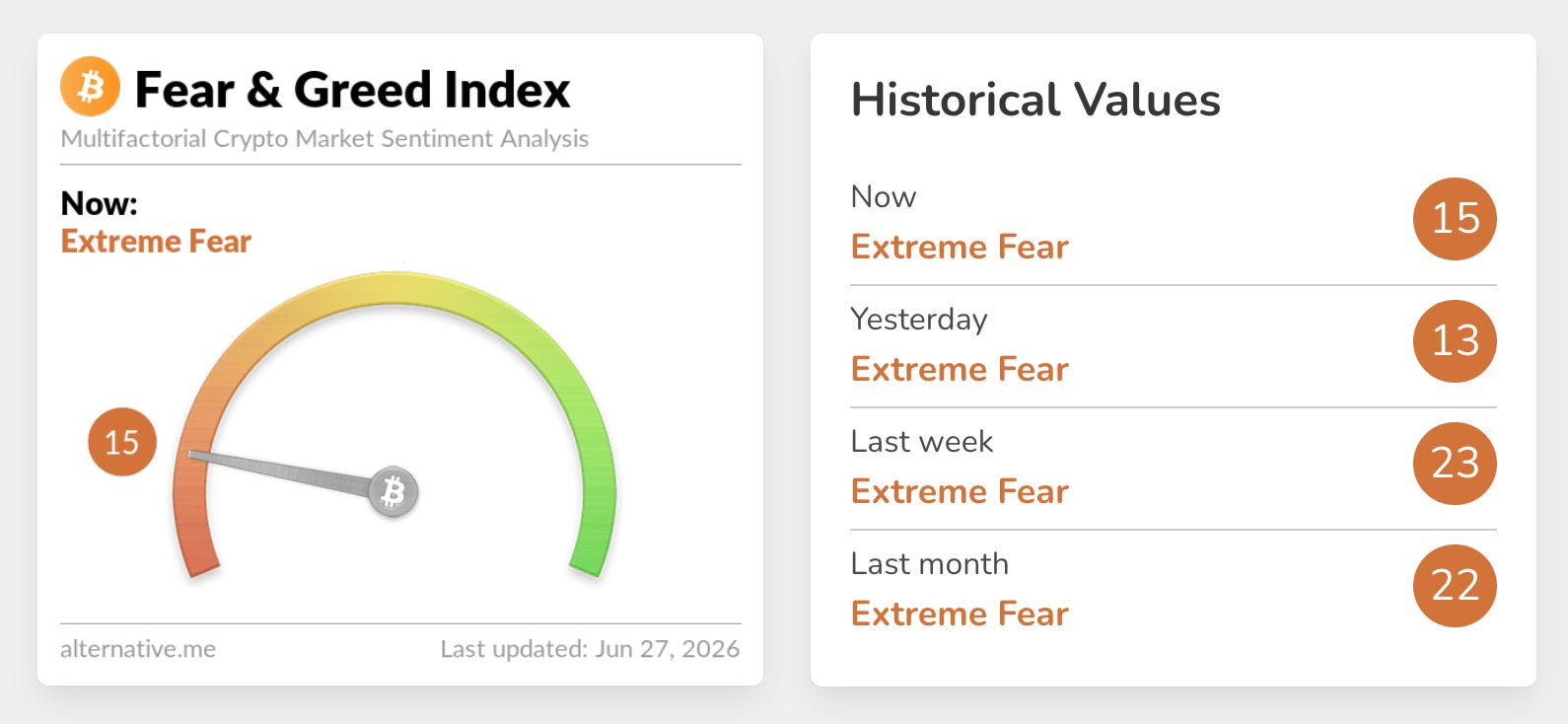
🎭 Crypto Fear and Greed Index is an insight into the underlying psychological forces that drive the market’s volatility. Sentiment reveals itself across various channels - from social media activity to Google search trends - and when analysed alongside market data, these signals provide meaningful insight into the prevailing investment climate. The Fear & Greed Index aggregates these inputs, assigning weighted value to each, and distils them into a single, unified score.

This section captures developments at the edge of digital systems. New interfaces, tools, and capabilities that feel early, unfinished, or slightly ahead of their moment. I’m less interested in what’s impressive today and more interested in what might quietly reshape how people work, coordinate, and interact over time.
Data centres are starting to look less like abstract cloud infrastructure and more like local resource technology.
For years, data centres were easy to imagine as somewhere else. Remote buildings. Neutral capacity. The physical substrate beneath digital life, but rarely part of the public conversation unless something went badly wrong. That is getting harder to maintain. Reuters reported earlier this month that the European Commission has proposed minimum energy-efficiency standards for data centres, including targets for energy performance, water use, heat reuse, and demand-side flexibility. The shift is telling. Data centres are no longer being treated only as a digital sector. They are being pulled into the language of resource management. (reuters.com)
What stood out is that this is not really about efficiency in the narrow sense. It is about legitimacy. Once a data centre becomes large enough, it starts to compete for the same things other local systems need: land, grid access, water, cooling capacity, and planning attention. Reuters also reported this month that France has been looking at ways to speed up grid connections for large data-centre projects because connection delays are slowing development. That gives the whole category a different feel. A data centre is no longer just a passive recipient of electricity. It becomes a claimant on infrastructure that has to be allocated, sequenced, and defended. (reuters.com)
That matters because the growth story remains large. Reuters reported in late May that SoftBank plans to invest €45 billion over five years in AI data centres in France, with the first three sites expected to deliver 3.1 gigawatts of capacity by 2031 and potential expansion taking the total to 5 gigawatts. At that scale, the conversation changes. The issue is no longer only what the models can do. It is whether substations, transmission, land use, cooling systems, and local politics can keep up. (reuters.com)
This is where the frontier becomes more interesting. A data centre used to feel like a backend facility. Increasingly it looks more like a piece of territorial infrastructure, closer in some ways to a port, a factory, or a power plant. The EU’s proposed standards make that visible because they treat the facility not only as a computing node but as something that must justify how it uses power, water, and waste heat inside a broader system. That is a meaningful change in posture.
The heatwave story this week sharpens that further. When roads soften, rail systems buckle, and river temperatures force lower nuclear output, the old assumption that infrastructure capacity is broadly stable begins to look weaker. In that environment, any new high-load facility is judged differently. Not only by what it enables, but by what it draws from systems already under stress.
That feels directionally important. Because frontier technology is often described through software, models, or user experience. But many of the most consequential constraints now sit underneath that layer. Data centres are worth watching not just because they power the digital economy, but because they reveal where digital ambition starts to collide with physical limits.

“The future is not a gift. It is an achievement.”
Robert F. Kennedy
Robert F. Kennedy was an American politician and public figure whose language often returned to responsibility, moral courage, and the work required to build a society worth inheriting. That is part of why this line still holds. It refuses the passive version of progress. The future does not simply arrive because technology improves or because history moves forward on its own. It has to be built, argued over, financed, and made durable through institutions and choices. That feels especially relevant in a week about heat, infrastructure, and the physical limits sitting underneath modern systems. The future is not something waiting for us on the other side of disruption. It is something that has to be achieved under pressure.