
Welcome to this week’s Field Notes, a 10-year project of mine documenting humankind’s digital transition from the field. These notes are shaped by what I’m seeing, building, and discussing as our physical and digital lives continue to converge.
- Ryan
(Connect with me on LinkedIn)

News is surface-level. Signals live underneath. This section captures developments that hint at deeper shifts in how digital systems are being built, governed, and adopted — often before they’re obvious in the mainstream narrative.
Three stories this week suggest that industrial policy is becoming more explicit about what kinds of future it wants to fund.
In Argentina, that means loosening biotech patent restrictions to attract new investment and technology. In Seoul, it means pulling Boston Dynamics fully into Hyundai’s orbit rather than leaving robotics at the edge of the group. In Beijing, it means building a clearer IPO pathway for what it now calls “future industry” companies. Different sectors, different systems, same direction: states and industrial champions are getting more direct about the technologies they want to scale.
Argentina is reopening the biotech patent question
Reuters reported on 19 June that Argentina repealed a regulation that had restricted patents for biotech developments. Cabinet Chief Manuel Adorni said the move is meant to align the country with international standards, provide greater legal clarity, and encourage biotechnological innovation, with officials also pointing to potential benefits for agriculture.
What stood out is that this is not only a legal adjustment. It is a signal about what kind of science Argentina wants to host. Patent rules are often discussed as dry architecture. In practice, they are part of the invitation structure around a sector. By loosening the restrictions, Argentina is saying that biotech should be treated less as a domain to be tightly bounded and more as one it wants to make investable.
That matters because biotech sits in an awkward place between national need and global capital. Countries want domestic capability, but they also need researchers, firms, and investors to believe the commercial pathway is credible. Patent policy is one of the places where that tension gets resolved. Argentina’s move suggests it is willing to trade some caution for a clearer growth signal.
Hyundai is pulling robotics into the centre of the group
Reuters reported on 19 June that Hyundai Motor Group plans to buy SoftBank’s remaining 9.65% stake in Boston Dynamics for $325 million, which would make the U.S. robotics company a wholly owned subsidiary. The report said Hyundai and its affiliates already control more than 90% of Boston Dynamics, and that a board meeting is expected to approve the purchase.
What stood out is the posture behind the deal. Robotics is no longer being held at arm’s length as a venture-style adjacency. Hyundai appears to be pulling it fully into the group structure. That does not guarantee commercial success. But it does change the meaning of the bet. A wholly owned subsidiary sits differently inside a company than a partially owned strategic experiment.
This feels directionally important because large manufacturers often reveal their real priorities not in keynote language, but in ownership structure. Full control suggests robotics is being treated less as optional future exposure and more as something Hyundai may want to integrate across its longer industrial strategy. The machines are still early. The organisational choice feels more settled.
China is widening the capital-markets lane for “future industry”
Reuters reported on 17 June that China will support IPOs by “future industry” startups and large-model companies, with the Shanghai Stock Exchange rolling out rules to help strategically important but unprofitable firms list on the STAR Market. Reuters said the policy is aimed at sectors such as quantum technology, nuclear fusion, brain-computer interfaces, robotics, hydrogen energy, and biomedical engineering, as China tries to strengthen its innovation base amid intensifying rivalry with the United States.
What stood out is the category itself. “Future industry” is no longer just a speech line. It is becoming something with a financing pathway attached to it. That matters because once a state names the sectors it considers strategic and then builds a capital-markets mechanism around them, the category starts to harden. It becomes easier for firms, funds, and local governments to organise themselves around it.
The deeper signal is that policy is moving from encouragement to channel-building. China is not only backing innovation in the abstract. It is trying to create a more deliberate pipeline from research and industrial ambition into public capital. That is usually when a strategic theme starts to look less like rhetoric and more like institutional design.
What stood out
Taken together, these stories suggest a more interventionist phase of technology policy. Argentina is adjusting the legal environment around biotech. Hyundai is internalising robotics more completely. China is formalising the IPO route for sectors it sees as strategically important. Different tools, same broad move: the future is being named more clearly, and then organised around.

What it is
This week’s watch is “The Successor to CRISPR May Be Even More World Changing.”
The video tracks the arc from CRISPR to a newer system called TIGR-Tas, following Feng Zhang’s work from bacterial immune systems to the possibility of another gene-editing tool that may, in some settings, outperform CRISPR. The structure is useful because it keeps returning to a simple point: frontier biotech rarely begins with a product. It begins with basic science, with someone trying to understand how a strange biological system works before anyone knows what it might be for.
That is what gives the video its shape. CRISPR is presented not as the destination, but as one example of what happens when basic research turns into a tool.
What stood out
What stood out is how the frontier keeps moving down a layer. The video makes clear that CRISPR is already extraordinary. In just over a decade, it moved from uncertain experimental promise to use in life-saving treatment, including the rewriting of DNA in a living infant. But the more interesting signal is that even CRISPR is now being described as incomplete. It works well for some diseases, less well for others, and still depends heavily on delivery, target selection, and the biology of the tissue involved.
That is where TIGR-Tas becomes interesting. The video says the system may have several advantages over CRISPR in specific contexts. It appears smaller, which may make delivery easier. It may read both sides of the DNA double helix when targeting, which could improve precision. And it may allow for narrower editing windows, which matters when the goal is to change something with single-letter accuracy rather than open up a broader region of DNA. None of that makes it a finished platform. But it does suggest the field is still early enough that even a revolutionary tool can quickly become a stepping stone.
The other thing that lingered was Zhang’s emphasis on basic science. He keeps returning to the process of pulling a system apart to see how it works, then only later asking whether it can be turned into a tool. That feels important because biotech is often narrated through therapeutic promise, while the actual frontier still depends on patient, open-ended work that looks much less commercial.
Why it lingers
It lingers because it changes the feel of progress in gene editing. The usual public narrative tends to treat CRISPR as the breakthrough, singular and complete. This video suggests something more unsettled and more interesting. Each new tool opens a path, then reveals the limits of that path. The field moves forward not by finding one final answer, but by discovering better ways to intervene at different levels, with different trade-offs around delivery, durability, precision, and risk.
That is also why the video pairs well with the Ascidian story this week. Both point in the same direction. The frontier in genetic medicine is no longer just about whether editing is possible. It is about what layer to edit, how permanently to act, and what kind of intervention can be made precise enough to survive contact with the clinic.

Digital assets now sit less as an idea and more as infrastructure in progress. As physical and digital life continue to converge, money and digital asset infrastructure are doing the same. What was once framed as “crypto” is increasingly showing up as rails, balance sheets, and policy conversations.
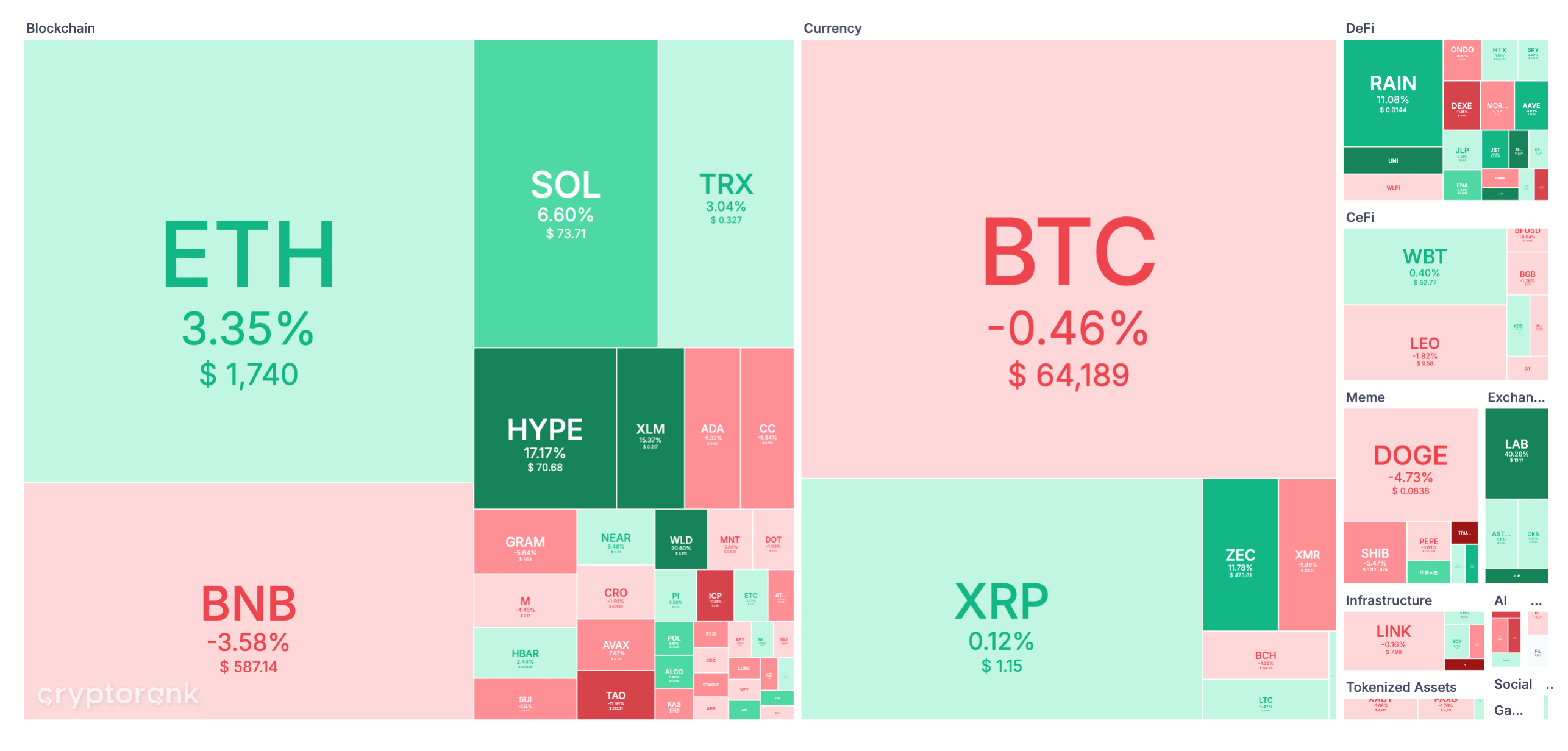
🔥🗺️Heat map shows the 7 day change in price (red down, green up) and block size is market cap.
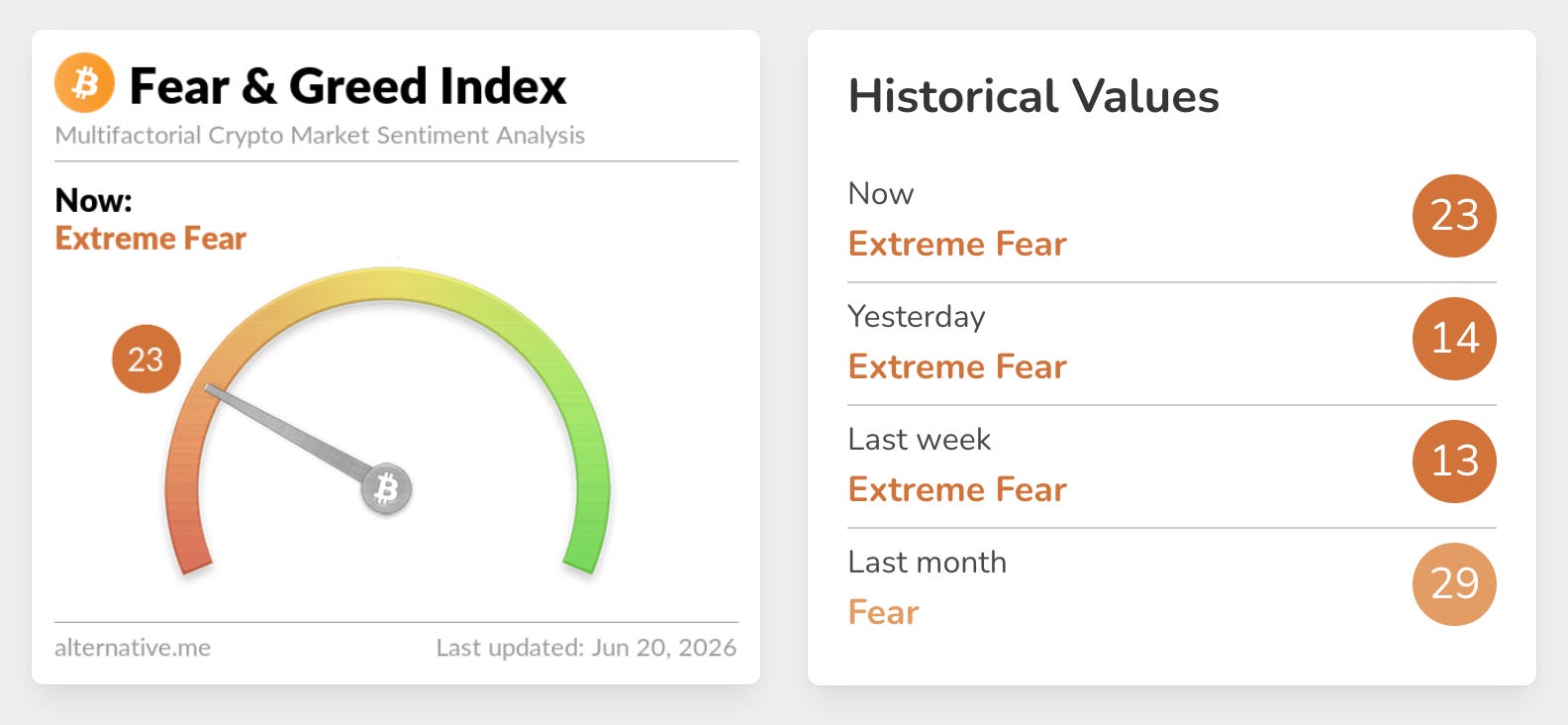
🎭 Crypto Fear and Greed Index is an insight into the underlying psychological forces that drive the market’s volatility. Sentiment reveals itself across various channels—from social media activity to Google search trends—and when analysed alongside market data, these signals provide meaningful insight into the prevailing investment climate. The Fear & Greed Index aggregates these inputs, assigning weighted value to each, and distils them into a single, unified score.

This section captures developments at the edge of digital systems. New interfaces, tools, and capabilities that feel early, unfinished, or slightly ahead of their moment. I’m less interested in what’s impressive today and more interested in what might quietly reshape how people work, coordinate, and interact over time.
Gene editing may be moving toward repair without permanently changing DNA.
For a long time, the frontier story in genetic medicine was framed around permanence. Cut the DNA. Correct the fault. Rewrite the code at its source. That still carries enormous promise. It also carries a particular kind of weight, because once DNA is altered, the intervention is harder to reverse and the stakes around safety rise accordingly.
What stood out this month is a different direction. Reuters reported on 3 June that Eli Lilly signed a licensing deal with Ascidian Therapeutics, worth up to $1.9 billion, to develop treatments for inherited kidney diseases using Ascidian’s RNA exon-editing technology. Reuters described the platform as a way to correct faulty genes without permanently altering a patient’s DNA, with Ascidian leading early research and selected preclinical work while Lilly takes on later development, manufacturing, and commercialisation.
That feels like a useful shift in emphasis. The frontier here is not simply editing more precisely. It is editing at a different layer. Ascidian says its approach works on RNA, not DNA, and is designed to deliver some of the durability and benefits associated with gene therapy while reducing the risks tied to direct genomic modification. The company also says the method can edit whole exons at kilobase scale, rather than only making smaller base-level changes.
What lingers is the change in tone this introduces. Gene editing has often been narrated through irreversibility. That is part of what made the field feel so powerful and so fraught. An RNA-based approach changes the feel of the problem. It does not make the science simple, and it certainly does not remove the usual questions around delivery, efficacy, durability, or regulation. But it suggests that one path forward in genetic medicine may involve interventions that are less final in their mechanism, even if they remain ambitious in their therapeutic goals.
There is also a more practical signal here. Large pharmaceutical companies do not usually commit this kind of money because a technology sounds elegant in theory. They do it when a modality starts to look like a credible platform. Reuters noted that this deal follows Lilly’s broader expansion into genetic medicines, while Ascidian had already signed a 2024 partnership with Roche around neurological diseases using the same underlying technology.
That matters because frontier technologies tend to become real twice, first as a scientific idea. Then as an investable category. The second moment is quieter, but usually more revealing. It is when companies begin organising pipelines, partnerships, and capital allocation around the belief that a new modality might survive contact with the clinic.
This still feels early, and there are no disclosed clinical results here - the targets remain undisclosed. But directionally, it is worth noting when the field starts looking for ways to repair genes without treating permanent DNA alteration as the only serious path forward.

“If we knew what it was we were doing, it would not be called research, would it?”
Often attributed to Albert EinsteinGood research rarely begins with certainty. It begins with a live question, a partial map, and the willingness to keep working while the answer is still forming. That is part of what makes frontier science feel both fragile and consequential. The method comes first. Clarity arrives later, if it arrives at all.