

Welcome to this week’s Field Notes, a 10-year project of mine documenting humankind’s digital transition from the field. These notes are shaped by what I’m seeing, building, and discussing as our physical and digital lives continue to converge.
- Ryan
(Connect with me on LinkedIn)

News is surface-level. Signals live underneath. This section captures developments that hint at deeper shifts in how digital systems are being built, governed, and adopted — often before they’re obvious in the mainstream narrative.
This week I travelled to Timor-Leste for the first time doing some engagement with their govt to explore a national digital-finance infrastructure roadmap. This is happening at a specific moment: Timor-Leste is now inside ASEAN, operates on the US dollar, and appears willing to consider whether modern capital-markets infrastructure can be evaluated before the full weight of legacy systems is rebuilt.
Timor-Leste is testing a straight-to-digital financial strategy
The clearest signal from the trip is that Timor-Leste is not simply looking at a new product. It is exploring a broader digital-finance strategy covering a roadmap spanning sovereign digital bonds, digital capital-markets infrastructure, financial inclusion initiatives, and cross-border investment connectivity. This frames their broader ambition as a chance to “leapfrog legacy financial systems” and accelerate access to modern capital-markets infrastructure.
That feels directionally important because smaller states sometimes have a narrower but cleaner window for institutional design. They do not necessarily have to modernise in the same sequence as larger incumbents. The more interesting question may be whether Timor-Leste can evaluate modern governance frameworks, programmable financial rails, and institutional-grade digital infrastructure early enough that it does not spend the next decade retrofitting systems built for a different era. The phrase “straight-to-digital” is useful here, not as a slogan, but as a description of posture.
ASEAN accession is changing the meaning of infrastructure
The second signal is timing. Timor-Leste uses the United States dollar as its official currency and that, following its accession to ASEAN in October 2025, the initiative supports a broader ambition to deepen regional integration, attract international investment, and participate more fully in Southeast Asia’s economic growth. This investment in digital financial infrastructure is part of a wider effort to strengthen investment connectivity, expand access to capital, and support the country’s next stage of economic development.
That matters because it changes what “financial infrastructure” means. It is not only a domestic modernisation story. It is increasingly a regional positioning story. In that frame, digital bonds and capital-markets infrastructure are not just technical upgrades. They become possible tools for plugging a young state more directly into regional and international capital flows, while still thinking carefully about governance, compliance, and institutional trust. The engagement will explore internationally aligned approaches to governance, compliance, and institutional-grade digital infrastructure, which reinforces that point.
There is a useful contrast here with how financial modernisation often unfolds elsewhere. In many countries, the conversation starts with the limitations of legacy infrastructure and then moves slowly outward. In Timor-Leste, the more interesting possibility is that regional integration may push the question in the other direction. ASEAN accession raises the stakes around connectivity, and that in turn may make the design of financial rails feel more urgent, more strategic, and more outward-facing than it would otherwise.
What stood out in Dili was not a flashy launch. It was the willingness to treat financial infrastructure as a strategic question before the answer had hardened. Timor-Leste appears to be asking whether it can think about sovereign financing, capital-market access, and regional connectivity in digitally native terms from the outset, rather than simply inheriting the default sequence. That still leaves a great deal unresolved. But it is worth noting when a country starts with the roadmap instead of the retrofit.

What it is
This week’s watch is “Bhutan mines bitcoin to offset declining tourism revenue, fund economic growth.”
The report looks at how Bhutan is using hydropower-fed bitcoin mining as part of a broader economic strategy. The government presents bitcoin not simply as a speculative asset, but as a strategic reserve and a revenue source that has already been used to help fund public-sector salaries, alongside healthcare and environmental spending. The core argument in the piece is that Bhutan, as a small country with limited industrial options, is trying to turn surplus renewable energy into a digitally native reserve asset.
What stood out
What stood out is that Bhutan is not buying bitcoin in the market. It is mining it. That distinction matters. The government is framing the activity as a way to convert cheap domestic hydropower into an asset that is globally liquid and, in its view, scarce. That gives the whole project a different logic from a normal sovereign investment story. Instead of exporting hydropower at relatively low rates, Bhutan is using it to run energy-intensive computation in the high mountains and receive bitcoin in return.
The second thing that stood out is how openly the government links this to state capacity. The report says the main use of bitcoin so far has been to help finance the salaries of public servants. That is a surprisingly direct use case. It shifts the story away from ideology and toward fiscal management. Bitcoin stops looking like a parallel system and starts looking, at least in Bhutan’s framing, like a tool inside the state’s balance-sheet logic.
There is also a useful asymmetry here. Bhutan’s constraints are very specific. Large-scale manufacturing is difficult. Agriculture is limited. Much food is imported. So the attraction of bitcoin mining is not only that it is digital. It is that it monetises a resource Bhutan already has, hydropower, without requiring the same kind of physical export infrastructure or industrial footprint that other development paths might.
Why it lingers
It lingers because it suggests a different way to think about digital assets at the state level. Most of the global conversation still treats bitcoin either as a speculative vehicle or as a political symbol. This report points to something more pragmatic. For Bhutan, the question seems to be whether a renewable energy surplus can be turned into a reserve asset that supports fiscal resilience and economic development. That is not a universal model. But it is a real one.
What makes it linger, though, is the tension underneath it. The strategy only works while hydropower remains abundant, mining economics remain favourable, and bitcoin retains enough value and liquidity to justify the trade. So this is not a clean solution. It is a high-conviction wager on how energy, computation, and money may fit together in a small-state context.
It shows that for some countries, the more interesting question is not whether digital assets matter, but whether they can be integrated into national strategy without first passing through the usual private-market sequence.

Digital assets now sit less as an idea and more as infrastructure in progress. As physical and digital life continue to converge, money and assets are doing the same. What was once framed as “crypto” is increasingly showing up as rails, balance sheets, and policy conversations.
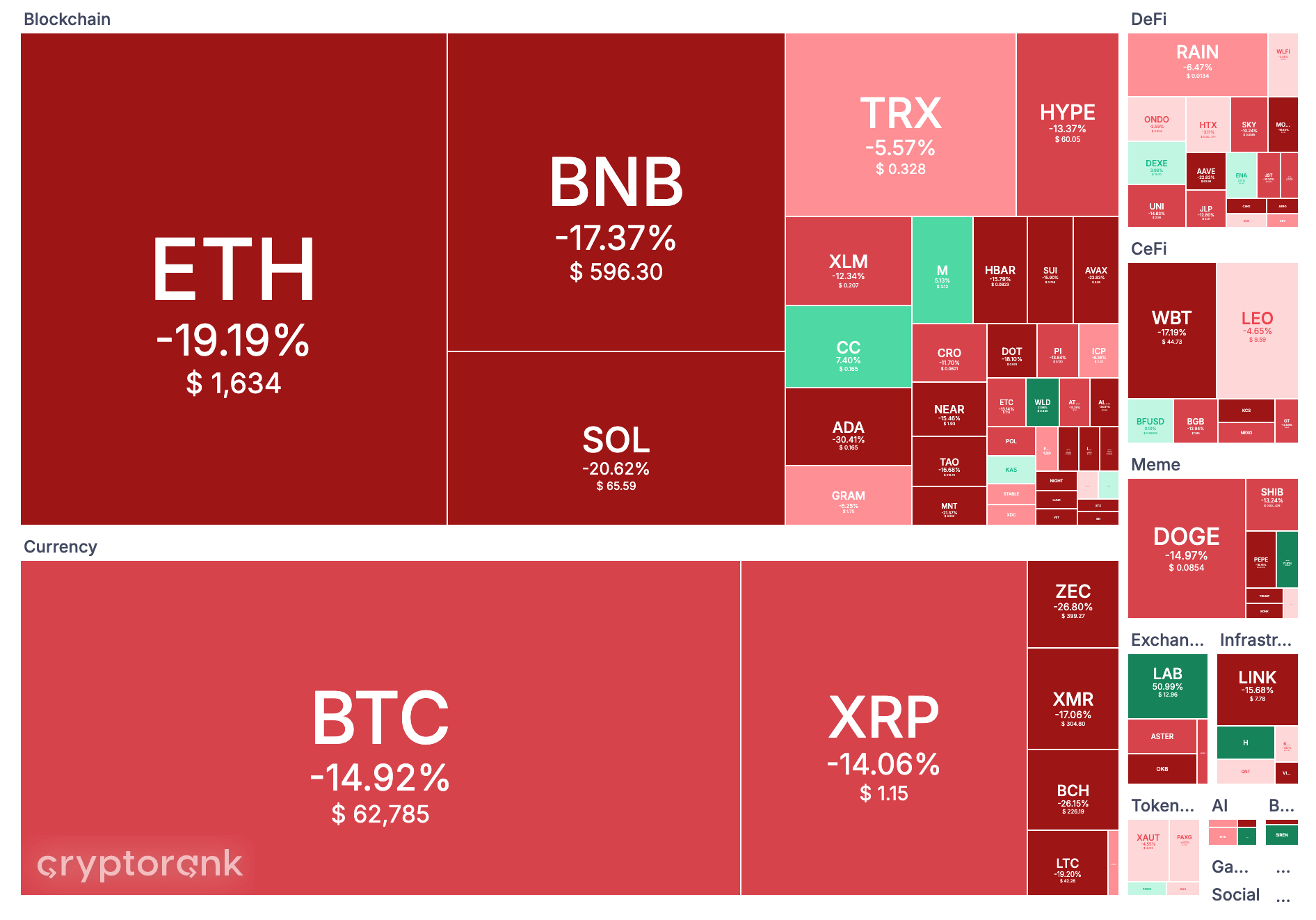
Macro take: bitcoin looks lower over the last week because this has been a risk-off and rotation move more than a crypto-specific one. Capital has been flowing toward AI-linked equities and big upcoming IPOs, while bitcoin has also been hit by institutional selling after Strategy sold some holdings
🔥🗺️Heat map shows the 7 day change in price (red down, green up) and block size is market cap.
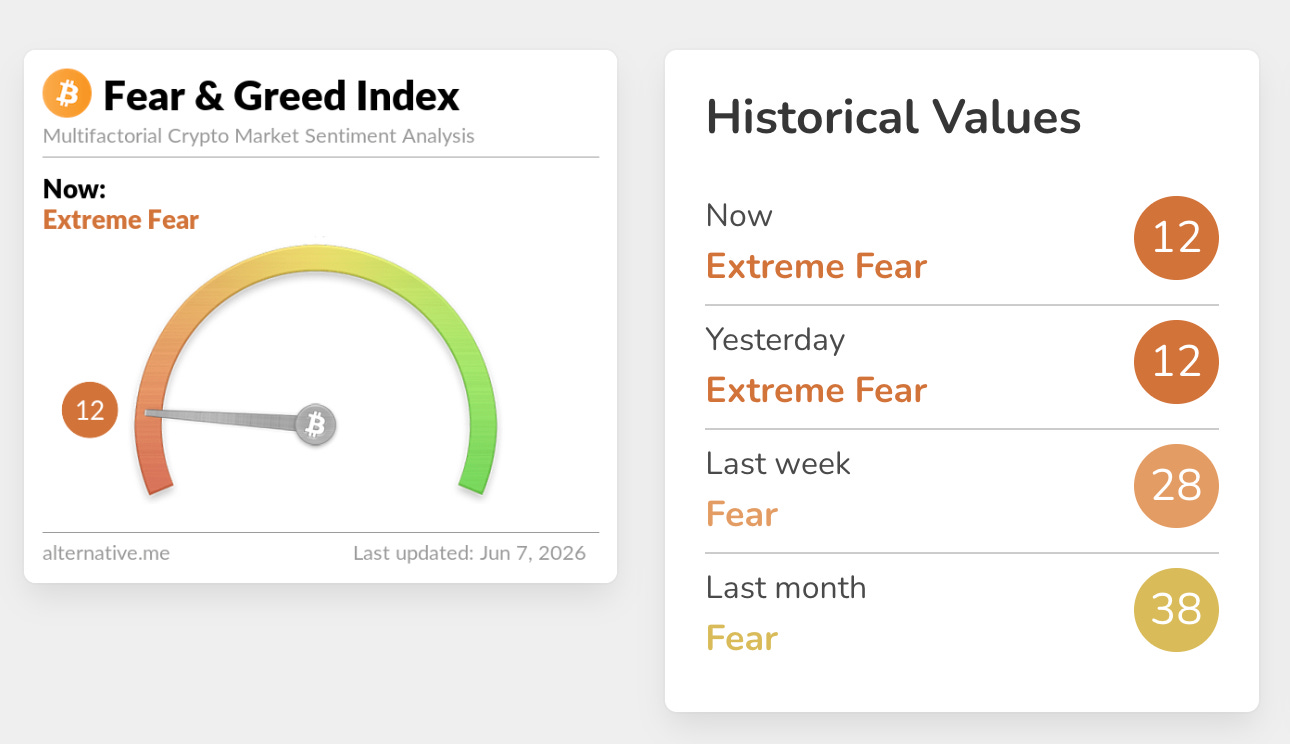
🎭 Crypto Fear and Greed Index is an insight into the underlying psychological forces that drive the market’s volatility. Sentiment reveals itself across various channels—from social media activity to Google search trends—and when analysed alongside market data, these signals provide meaningful insight into the prevailing investment climate. The Fear & Greed Index aggregates these inputs, assigning weighted value to each, and distils them into a single, unified score

This section captures developments at the edge of digital systems. New interfaces, tools, and capabilities that feel early, unfinished, or slightly ahead of their moment. I’m less interested in what’s impressive today and more interested in what might quietly reshape how people work, coordinate, and interact over time.
Bitcoin mining is starting to look less like pure consumption and more like a way to monetise stranded renewable energy. Bhutan is the clearest case study.
The usual argument about bitcoin mining starts with electricity. Too much of it. Too little obvious social value. A blunt conversion of power into speculation. That framing still explains a lot. But it explains less when the electricity in question is renewable, seasonally abundant, and harder to monetise at the moment it is produced. That is what makes Bhutan worth watching.
Reuters reported in April last year that Bhutan has been using its abundant hydropower to mine what officials describe as green cryptocurrency. The sovereign wealth fund’s chief executive said the country began mining in 2019 using hydropower and has since used profits from past crypto investments to help fund government salaries. Reuters also said Bhutan sees the strategy as a way to stimulate the economy, create jobs, respond to youth emigration, and attract firms looking for lower-carbon digital-asset exposure.
What stood out is that the logic is less ideological than it first appears. Bhutan is not presenting mining as a monetary revolution. It is treating it as a conversion mechanism. Hydropower that might otherwise be underused, exported cheaply, or wasted at the margin can instead be turned into a digitally native reserve asset. Reuters noted that Bhutan already runs domestically on hydropower and is looking to expand generation capacity significantly over time. In that context, mining becomes a way of arbitraging surplus electricity into a globally liquid asset.
This is where stranded energy becomes more interesting. Renewables do not always fail because there is not enough demand. Sometimes they fail because demand is in the wrong place, or at the wrong time, or the transmission system is too weak to move the power efficiently. Bitcoin mining is one of the few loads that can be deployed relatively quickly, ramped up and down, and located close to generation. That does not make it universally desirable. But it does make it unusually compatible with energy that is clean, abundant, and otherwise difficult to monetise at the edge of the grid.
Bhutan’s case looks distinctive because the state itself sits close to the strategy. Reuters framed the mining effort as part of Bhutan’s sovereign investment approach rather than as a private scramble for cheap power. That gives the model a different character from places where mining has simply strained fossil-heavy grids. Bhutan points in the opposite direction: renewable oversupply first, mining second.
There are still obvious limits. The economics are volatile. Bitcoin prices move. Hydrology is seasonal. And scaling the model depends on continued investment in hydropower and transmission. Reuters noted that Bhutan’s longer-term success as a green crypto hub will require a major increase in generation capacity over the coming decade. So this is not a universal formula. It is a tactical use of a specific national advantage.
But directionally, it matters. Because it suggests one possible future for renewables at the margin. Not every kilowatt of green energy needs to flow directly into homes, factories, or vehicles the moment it is generated. In some places, especially where grids are thin and power is seasonal, a flexible computational load may be the bridge.
Bhutan is worth watching not because it proves bitcoin mining is good in the abstract, but because it asks a more practical question: what is the highest-value use of clean power that would otherwise be harder to capture?

“It is not the strongest of the species that survives, nor the most intelligent, but the one most responsive to change.”
Often attributed to Charles Darwin