
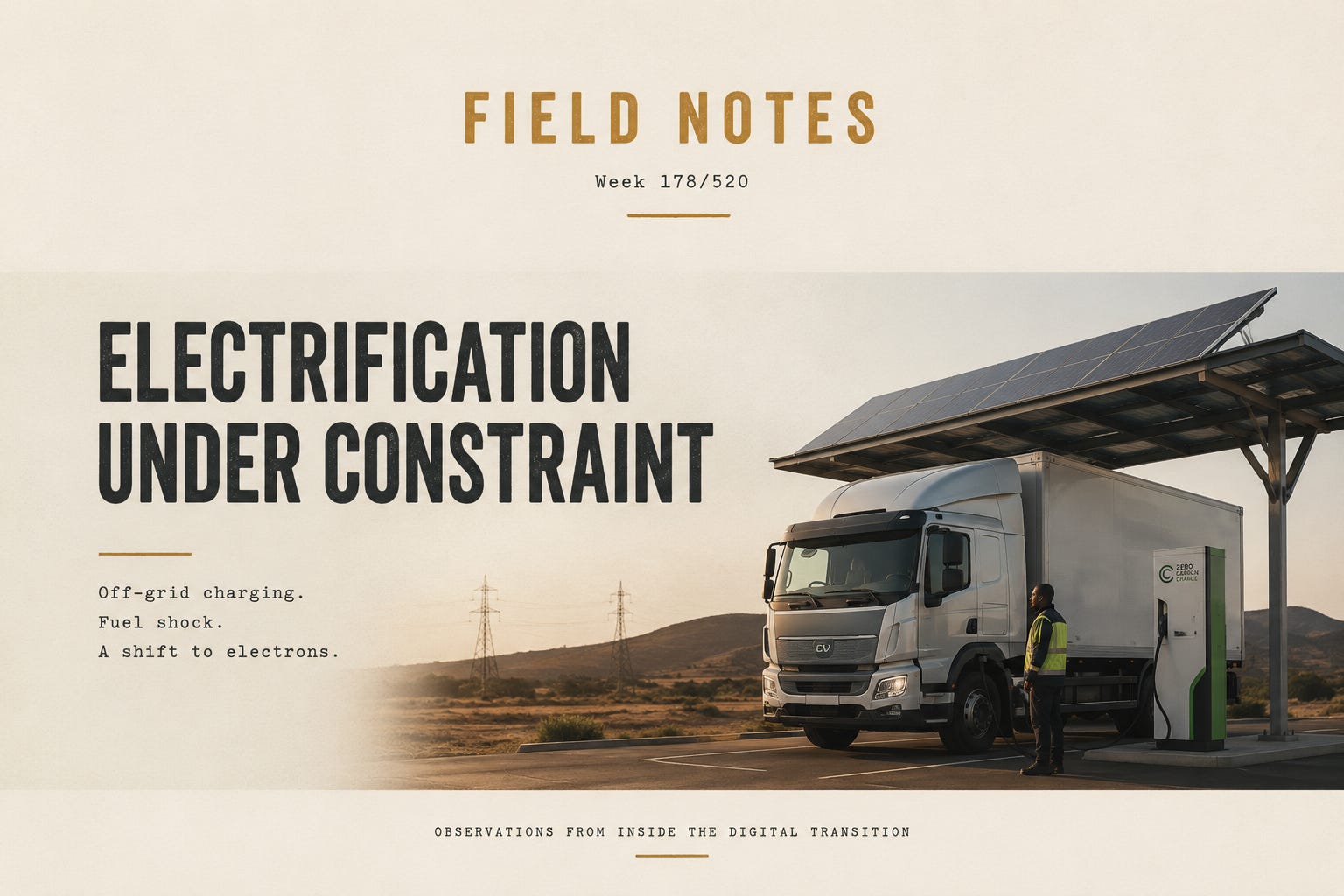
Welcome to this week’s Field Notes, a 10-year project of mine documenting humankind’s digital transition from the field. These notes are shaped by what I’m seeing, building, and discussing as our physical and digital lives continue to converge.
- Ryan
(Connect with me on LinkedIn)

News is surface-level. Signals live underneath. This section captures developments that hint at deeper shifts in how digital systems are being built, governed, and adopted — often before they’re obvious in the mainstream narrative.
Two stories this week suggest that electrification is starting to look less like a standard automotive transition and more like an energy-systems adaptation.
In South Africa, charging infrastructure is being built to avoid the grid rather than depend on it. In Pakistan, an automaker is betting that fuel-price pressure and the spread of rooftop solar will make electric vehicles more viable even in a market where the category still feels early. In both cases, the important shift sits outside the car itself. The surrounding energy environment is doing more of the explanatory work.
In South Africa, EV charging is being designed around grid weakness from the start
Reuters reported on 19 May that Zero Carbon Charge, trading as CHARGE, launched its first off-grid, solar-powered charging station on the Johannesburg to Durban N3 corridor. The system is designed to operate independently of South Africa’s national grid, which remains constrained by aging infrastructure and periodic power cuts. Reuters said CHARGE plans to install 60 off-grid charging stations nationwide by the end of 2027, with eventual expansion beyond passenger vehicles to commercial transport, including electric trucks.
What stood out is that this is not simply a charging-network story. It is a workaround story. In many mature EV markets, the question is how to extend charging coverage. Here, the deeper question is what kind of charging system makes sense when the underlying grid cannot be assumed to be reliable. That produces a different kind of infrastructure logic. Charging becomes a parallel energy system from the outset rather than a layer added neatly on top of the existing one.
That feels directionally important because it shows how transitions adapt to local constraints rather than waiting for ideal conditions. Reuters noted that South Africa’s EV market is still small, with new energy vehicles accounting for 2.8% of new vehicle sales in 2025, but interest is growing. The signal is that uptake may depend less on abstract enthusiasm for electrification and more on whether the surrounding energy architecture can be made workable in the first place.
In Pakistan, EV adoption is starting to ride on rooftop solar and fuel shock
Reuters reported on 22 May that Pakistan’s Lucky Motors has partnered with Chinese state-owned automaker GAC to launch EVs in the local market, betting that rising fuel prices and widespread rooftop solar adoption will help drive demand. Reuters said fuel costs have doubled over the past four years, solar now provides roughly 25% of Pakistan’s electricity, and Lucky Motors plans to begin local assembly of GAC EVs by December 2026. The company is also exploring battery swapping, local battery production subject to policy support, and eventual export potential to other right-hand-drive markets.
What stood out is that this is not being framed as a top-down green transition. It is being framed as a practical response to pressure in the system. High fuel costs make the old model more painful. Rooftop solar makes home charging more plausible. A distributed energy shift begins to make electric mobility feel less like an imported future and more like something that can fit local conditions. That produces a different story from the usual one about subsidy-led adoption or state-led charging rollout.
The deeper signal is that electrification may emerge fastest where adjacent systems start to align. Reuters said EVs still make up a small share of Pakistan’s car market, while electric motorcycles have moved more quickly and now represent about 5% of two-wheeler sales. That divergence is useful. Adoption does not arrive evenly across transport categories. It follows the places where infrastructure, price, and routine behaviour happen to line up first.
What stood out
Taken together, these stories suggest that the next phase of EV adoption will be shaped less by the vehicle itself and more by the energy conditions around it.
South Africa shows what happens when weak grid infrastructure forces a parallel solution. Pakistan shows what happens when fuel shock and distributed solar begin to make EV ownership newly practical. Different markets, different pressures, same underlying lesson: in many places, electrification will not arrive as a clean, standardised rollout. It will emerge through the constraints and asymmetries of the local energy system.

What it is
This week’s watch is a conversation between Michael Maas, CEO and co-founder of Zimi Charge, and Andries Malherbe, founder of Zero Carbon Charge.
On the surface, it is a discussion about EV charging infrastructure in South Africa. But the more useful way to read it is as a conversation about how electrification takes shape in a market where the grid cannot simply be assumed. The two founders talk through the origins of Zero Carbon Charge, the buildout of the N3 corridor, the design logic of solar-powered charging sites, and the overlap between public charging and fleet electrification. What emerges is not just a transport story. It is an infrastructure story.
What stood out
What stood out is how quickly the conversation moves past the car. Malherbe describes the original insight quite plainly: electric vehicles were going to need a huge amount of power, and nobody really knew where it would come from. From there, the project became a land, permitting, route, and infrastructure challenge before it became anything else. That feels important. In mature markets, EV adoption is often discussed through product cycles and consumer preference. Here, the starting point is energy supply.
The second thing that stood out was the design philosophy of the stations themselves. These are not simply chargers placed beside a road. They are modular energy sites built around solar, batteries, circulation, logistics access, convenience retail, and enough flexibility to expand as demand changes. Malherbe’s comment that the sites are designed not to maximise raw output but to minimise the difference between winter and summer power availability was especially telling. That is a systems decision. It suggests the service is being designed around reliability rather than peak performance.
There is also a useful contrast between the public and fleet angles. Maas explains that many South African fleet operators are under pressure to decarbonise, but do not know where to begin because electric fleets require a different kind of operational thinking. The issue is not just the vehicle. It is route planning, charging behaviour, energy cost predictability, maintenance, and driver experience. The point returns again and again: the transition depends on making the economics and the infrastructure legible enough for operators to move.
Why it lingers
It lingers because it shows how electrification adapts under constraint. In places where the national grid is strong, charging can look like an extension of existing infrastructure. In South Africa, the logic is different. Charging is being built as a parallel energy system from the outset. Solar matters because it reduces exposure to diesel volatility and weak grid conditions. Station design matters because each site has to function as a self-contained node rather than a simple plug-in point.
That feels directionally important. Because the future of EV adoption may not be defined by a single global template. It may emerge through local workarounds, with each market building around its own constraints. This conversation captures that well. The car is part of the story, but only part. The larger shift is in how energy, charging, logistics, and transport begin to reorganise around one another.

Digital assets now sit less as an idea and more as infrastructure in progress. As physical and digital life continue to converge, money and assets are doing the same. What was once framed as “crypto” is increasingly showing up as rails, balance sheets, and policy conversations.
🔥🗺️Heat map shows the 7 day change in price (red down, green up) and block size is market cap.

🎭 Crypto Fear and Greed Index is an insight into the underlying psychological forces that drive the market’s volatility. Sentiment reveals itself across various channels—from social media activity to Google search trends—and when analysed alongside market data, these signals provide meaningful insight into the prevailing investment climate. The Fear & Greed Index aggregates these inputs, assigning weighted value to each, and distils them into a single, unified score


This section captures developments at the edge of digital systems. New interfaces, tools, and capabilities that feel early, unfinished, or slightly ahead of their moment. I’m less interested in what’s impressive today and more interested in what might quietly reshape how people work, coordinate, and interact over time.
The Iran war is turning electrification into a resilience story.
For years, the energy transition was often framed in moral or environmental terms.
This feels different. Reuters argued in late April that the war with Iran is becoming a “lightbulb moment” for Asia, the region most exposed to oil and LNG disruptions through the Strait of Hormuz. The immediate shock is obvious enough: around 10 million barrels a day of crude and refined products, and roughly 20% of global LNG, move through that corridor. When that flow is threatened, the costs land quickly (source)
What stood out is where the response is showing up. Not only in large national energy strategies, but in the faster-moving edges of transport and power systems. Reuters pointed to rising adoption of electric two- and three-wheelers and to more rapid deployment of battery energy storage systems across South and Southeast Asia. The useful signal is that electrification begins to look more practical when fossil-fuel dependence starts to feel less like a market assumption and more like an exposure.
That matters because it changes the logic of the transition. In this frame, batteries are not just climate hardware. They are shock absorbers. Two-wheel EVs are not just cleaner mobility. They are a hedge against imported fuel volatility. Reuters noted that Asia was already moving in this direction, led in large part by China, but argued that the Iran war is broadening and accelerating that shift across the rest of the region as well.
The most interesting part is that the frontier here is not a single breakthrough device. It is a change in the surrounding conditions. Technologies that looked optional in calmer markets begin to look strategic in unstable ones. That can happen faster in two- and three-wheelers than in passenger cars, and faster in storage than in full grid redesign, because the capital requirements are lower and the pain point is easier to see. The war does not invent those systems. It changes their urgency.
This also helps explain why the shift can feel uneven. Some markets will move first where rooftop solar, batteries, and light electric transport are already within reach. Others will keep absorbing the shock through subsidies, fiscal pain, or slower demand destruction. But the direction is clearer when fuel disruption becomes part of ordinary planning. Reuters’ framing was that the conflict is pushing Asia to reduce fossil-fuel dependence not only for climate reasons, but because the old system now looks more visibly fragile.
That feels directionally important. Because frontier technologies often become real not when they are perfected, but when the world around them changes enough that they stop feeling like experiments. In that sense, the Iran war is not just an energy shock. It is a reminder that resilience can be a stronger adoption driver than ambition.

“Children are the living messages we send to a time we will not see.”
John F. Kennedy