
Welcome to this week’s Field Notes, a 10-year project of mine documenting humankind’s digital transition from the field. These notes are shaped by what I’m seeing, building, and discussing as our physical and digital lives continue to converge.
- Ryan
(Connect with me on LinkedIn)

News is surface-level. Signals live underneath. This section captures developments that hint at deeper shifts in how digital systems are being built, governed, and adopted — often before they’re obvious in the mainstream narrative.
The Pentagon–Anthropic clash exposes the new politics of AI infrastructure
Last week Anthropic publicly refused a Pentagon request to broaden the military use of its AI system Claude, drawing a line around two specific applications: mass surveillance of Americans and fully autonomous weapons. CEO Dario Amodei said the company could not “in good conscience” allow those uses, even while continuing to support other national-security work. (Defense News)
The disagreement escalated quickly. U.S. defence officials warned the company it could be designated a “supply-chain risk” and lose its government contracts if it refused to allow the model to be used for “all lawful purposes.” (Military.com) OpenAI swooped in at the 11th hour to secure the contract, willing to work under those broader terms. (AP News)
Yet the episode reveals a deeper tension. Despite the standoff, Claude remains embedded in parts of the U.S. defence AI stack, where switching systems is neither immediate nor trivial. Large models integrated into intelligence analysis and classified workflows are difficult to replace once operational dependencies form.
The signal here is structural. Frontier AI models are becoming something closer to strategic infrastructure than software products. Governments want unconditional access to tools they view as essential to national security. Companies, meanwhile, attempt to set boundaries around how their systems are used. When those boundaries clash, the leverage lies not only in contracts but in how deeply the technology is already woven into institutional systems.
This episode hints at a new dynamic: in an era where AI systems sit inside military and intelligence pipelines, the relationship between sovereign power and private technology providers begins to resemble a negotiation between states and infrastructure owners.
AI infrastructure targeted by Iran
Recent reporting suggests Iranian strikes on the Gulf damaged Amazon Web Services data centres in the UAE and Bahrain, causing outages that affected banking, payments, and other everyday services. Reuters reported structural damage, power disruption, and service degradation across AWS facilities in the region. (Reuters)
What makes this stand out is not only the disruption, but the type of asset involved. The Guardian described the incident as what is believed to be the first deliberate targeting of a commercial data centre by the armed forces of a country at war, with Iranian state media framing the facilities as supporting enemy military and intelligence activity. (The Guardian)
The signal here is structural. Data centres are no longer just commercial real estate for cloud workloads. In regions positioning themselves as AI and cloud hubs, they increasingly look like critical infrastructure with dual-use characteristics: civilian, financial, logistical, and potentially military all at once. Once that perception hardens, the logic of warfare shifts with it. A server hall starts to resemble an oil terminal, a telecom exchange, or a port.
If commercial cloud infrastructure is now targetable in war, then AI infrastructure has crossed a threshold from background utility to strategic terrain.

What it is
A short interview with Yanis Varoufakis reflecting on the concentration of power within large technology platforms and the macroeconomic implications of what he calls “technofeudalism”.
What stood out
The framing shifts from technology to ownership. Platforms are not simply tools for communication or commerce. They are behavioural infrastructure. The algorithms determine what is seen, amplified, and monetised. Value is extracted less through traditional market exchange and more through rent generated from attention and data.
Varoufakis suggests that the power of these platforms lies not only in scale, but in switching costs. Networks become difficult to leave once social graphs and audiences are locked inside them. His proposed remedy is structural rather than behavioural: mandated interoperability between platforms to weaken the gravitational pull of dominant networks.
Why it lingers
The argument connects back to a broader pattern. In earlier eras, economic power concentrated around land, factories, or capital. Today it may be concentrating around data, compute, and behavioural influence. The infrastructure that mediates everyday interaction is increasingly privately owned.
That concentration may help explain other emerging signals: the steepening of a K-shaped economy, the outsized productivity gains accruing to a small number of firms, and the growing political attention on digital infrastructure. Still unresolved is whether interoperability and regulation can meaningfully dilute platform power once network effects have fully matured.


Digital assets now sit less as an idea and more as infrastructure in progress. As physical and digital life continue to converge, money and assets are doing the same. What was once framed as “crypto” is increasingly showing up as rails, balance sheets, and policy conversations.
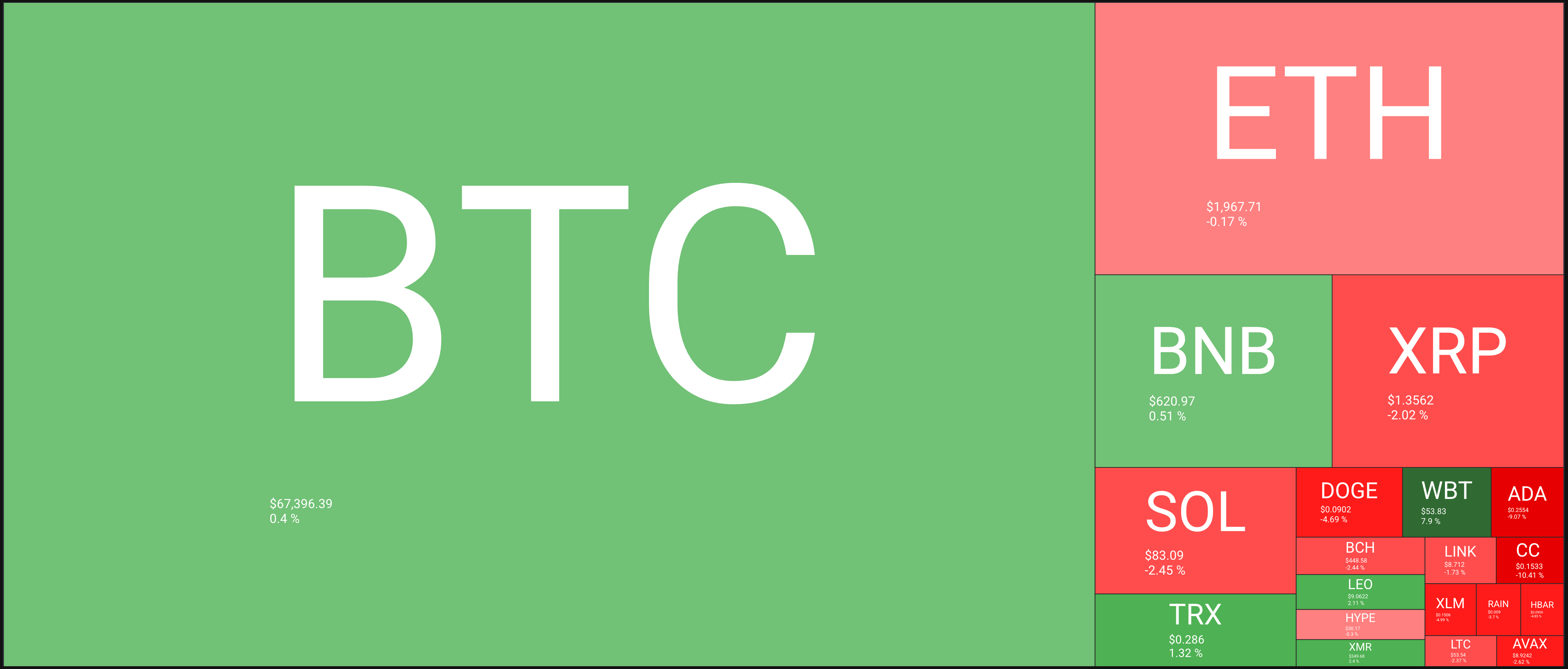
🔥🗺️Heat map shows the 7 day change in price (red down, green up) and block size is market cap.
🎭 Crypto Fear and Greed Index is an insight into the underlying psychological forces that drive the market’s volatility. Sentiment reveals itself across various channels—from social media activity to Google search trends—and when analysed alongside market data, these signals provide meaningful insight into the prevailing investment climate. The Fear & Greed Index aggregates these inputs, assigning weighted value to each, and distils them into a single, unified score.


This section captures developments at the edge of digital systems. New interfaces, tools, and capabilities that feel early, unfinished, or slightly ahead of their moment. I’m less interested in what’s impressive today and more interested in what might quietly reshape how people work, coordinate, and interact over time.
Technofeudalism: platform power and the question of a new economic order
Over the past few years a new term has circulated through political economy debates: technofeudalism. The idea is simple but provocative. Rather than capitalism evolving in a straight line, some theorists argue the digital economy is drifting toward a structure that resembles feudal power relationships, where a small number of platform owners control essential infrastructure and extract ongoing rents from the rest of society. The argument has gained traction among economists, political theorists, and technology critics. But it remains contested. Whether technofeudalism describes a genuine transformation of capitalism or simply a new phase of it is still unresolved.
The basic thesis is that in classical capitalism, profit emerges primarily through investment, production, and productivity gains. Firms build factories, employ labour, produce goods, and compete in markets. The technofeudalism thesis claims something different is happening in the digital economy. Instead of expanding production, dominant firms increasingly build platform infrastructure that captures rents from participation itself.
French economist Cédric Durand describes platforms as infrastructure rather than ordinary companies. Once they become indispensable, they resemble utilities. Under this view, companies such as Google, Amazon, Apple, Microsoft, and Meta function less like manufacturers and more like digital landlords. Participation in the digital economy requires passing through their platforms, which allows them to collect fees, data, and influence.
Much of the technofeudalism debate traces back to Shoshana Zuboff’s influential 2018 book The Age of Surveillance Capitalism. Zuboff argued that tech firms discovered a new resource: behavioural data. Rather than simply selling services, companies collect enormous volumes of user activity — searches, location data, browsing behaviour — and transform it into predictive products for advertisers and other customers. Zuboff described this as a self-reinforcing system where data extraction becomes the primary engine of growth. In the technofeudalism interpretation, this data infrastructure functions as a kind of perpetual rent machine. Users generate value simply by existing within the system
The appeal of the technofeudalism thesis lies in its intuitive resonance with everyday digital life, the concpet of users as "digital tenants” Most people spend significant time interacting with systems that continuously record and analyse behaviour. Even outside traditional employment, participation in digital networks generates economic value. The result is a strange inversion. Individuals may work for a specific employer, but their everyday digital activity produces value for platform owners regardless of who signs their paycheck.
Platforms do not simply observe behaviour. They also shape it. Recommendation systems, targeted advertising, and algorithmic feeds guide attention and consumption patterns, feeding the same data loops that sustain the system. Critics argue this begins to resemble a managed digital environment rather than an open market.
Yet the technofeudalism thesis also faces substantial criticism, one central is the “Infrastructure without ownership” objection - many of the most powerful tech firms do not actually control the deepest layers of digital infrastructure. Data centres, for example, are often owned by real estate investment trusts rather than technology companies themselves. Perhaps the true landlords of the internet may not be the platforms but the investors who own the buildings and cables that host their servers. Behind the scenes, even the largest tech companies are frequently tenants within a larger infrastructure ecosystem. This complicates the technofeudal analogy. If platforms rely on external infrastructure providers and financial markets, the system may still be recognisably capitalist.
Another criticism is conceptual. Declaring the end of capitalism has been a recurring theme in political economy for centuries. For sceptics, platform dominance represents an extreme form of monopoly capitalism, not a new system. Many platform companies still rely on traditional revenue models. Facebook, for instance, derives most of its income from advertising. Amazon’s core profits often come from logistics and cloud services rather than pure platform rent extraction. Even the companies most often cited as technofeudal lords face competitive pressures, regulatory scrutiny, and volatile market valuations. In this interpretation, the digital economy remains firmly rooted in capitalist dynamics such as cost-cutting, labour exploitation, and investor expectations.
The technofeudalism thesis ultimately functions as a lens for examining how power operates in the digital age. Some scholars see the rise of platform infrastructure as the beginning of a new economic regime centred on digital rents and behavioural extraction. Others argue that the system still behaves like capitalism, albeit with unusually powerful monopolies. What is clear is that digital platforms have become deeply embedded in everyday life. Communication, commerce, entertainment, and work increasingly pass through a handful of global systems. Whether we describe those systems as markets, monopolies, or digital fiefdoms, they have become the terrain on which much of modern economic life unfolds.
The deeper question remains unresolved, are these platforms simply powerful companies within capitalism…or the early architecture of something else entirely?

“Having become indispensable, the platforms should be thought of as infrastructure, in the same category as electricity providers, railroads, or telecoms.”
— Cédric Durand, Technoféodalisme: Critique de l’Économie Numérique
Cédric Durand is a French economist known for examining how digital platforms reshape power inside modern capitalism. His work sits within the growing “technofeudalism” debate, which asks whether the largest technology platforms now function less like competitive firms and more like private infrastructure operators. In this framing, platforms do not simply participate in markets. They organise them.
Durand’s observation is less about technology than about dependency. Once a system becomes indispensable, the question shifts from innovation to governance. Electricity grids, rail networks, and telecoms all followed this path. What begins as a private network eventually becomes a structural layer beneath the economy.