
Welcome to this week’s Field Notes, a 10-year project of mine documenting humankind’s digital transition from the field. These notes are shaped by what I’m seeing, building, and discussing as our physical and digital lives continue to converge.
- Ryan
(Connect with me on LinkedIn)

News is surface-level. Signals live underneath. This section captures developments that hint at deeper shifts in how digital systems are being built, governed, and adopted — often before they’re obvious in the mainstream narrative.
Low-Earth-Orbit connectivity nudges into core infrastructure planning
Last week’s announcement that AT&T is expanding its partnership with Amazon Web Services to integrate Amazon Leo, the company’s low-Earth-orbit (LEO) satellite network, into fixed broadband service offerings for business customers marks a subtle shift in how satellite connectivity is being positioned. The deal will see LEO satellites extend broadband reach, especially in areas where traditional infrastructure is weaker, while terrestrial fibre continues to undergird core connectivity (source).
What stands out is not just commercial collaboration but how satellite networks are being stitched into national infrastructure logic. Instead of LEO satellites being fringe solutions for niche users, deals like this show carriers treating them as complementary components of broader network resilience and coverage plans. That shift suggests governments and large network operators are implicitly recognising LEO constellations as part of baseline connectivity — a contingency and expansion layer rather than an exotic add-on.
My take is that this points to something structural: as terrestrial networks strain under demand and planning frictions, LEO becomes a tacit partner in connectivity strategy, revealing how digital infrastructure is increasingly multi-modal.
Compute export controls drift from executive discretion toward legislative oversight
Reporting this week notes that a U.S. House panel is moving to advance legislation that would give US Congress greater authority to review or block export licences for advanced AI chips, a role currently exercised primarily by the executive branch. The proposal reflects unease with how consequential decisions about high-end compute are being made, particularly as chips become strategic assets rather than commercial components (source).
What stands out is the reframing of semiconductors as governance infrastructure. Oversight debates are less about individual firms or destinations and more about who gets to decide how scarce, high-leverage capabilities move across borders. This suggests compute is beginning to be treated like energy or defence supply, where legitimacy and accountability matter as much as efficiency.
Worth noting how control over digital capacity is being pulled closer to political institutions, even as the technology itself remains global.

What it is
A policy and technology overview on Australia’s move toward Low Earth Orbit satellites as a way to extend mobile coverage across a continent where device adoption is near-universal, but network reach is not.
What stood out
The mismatch is stark. Around 90% of Australians carry a smartphone, yet only roughly 30% of the landmass has mobile coverage. The constraint is not demand, nor behaviour, but geography. LEO satellites are framed less as an alternative network and more as an extension of existing mobile infrastructure, acting as base stations in space where towers cannot reasonably exist.
Equally notable is the policy response. The proposed Universal Outdoor Mobile Obligation treats connectivity as a baseline utility, not a premium service. Coverage is defined by access, not postcode.
Why it lingers
This feels like a shift in how infrastructure gaps are addressed. Instead of forcing terrestrial networks to stretch ever further, the architecture moves upward. Coverage becomes orbital rather than local. In that model, resilience and equity arrive together, particularly in a country shaped by fire, flood, and distance.
Still unresolved is how these space-based layers will be governed once they become critical national infrastructure. But the direction is clear. When the ground runs out, the network doesn’t stop. It changes altitude.
For those who want something a bit more in depth, I really enjoyed this watch:

Digital assets now sit less as an idea and more as infrastructure in progress. As physical and digital life continue to converge, money and assets are doing the same. What was once framed as “crypto” is increasingly showing up as rails, balance sheets, and policy conversations.
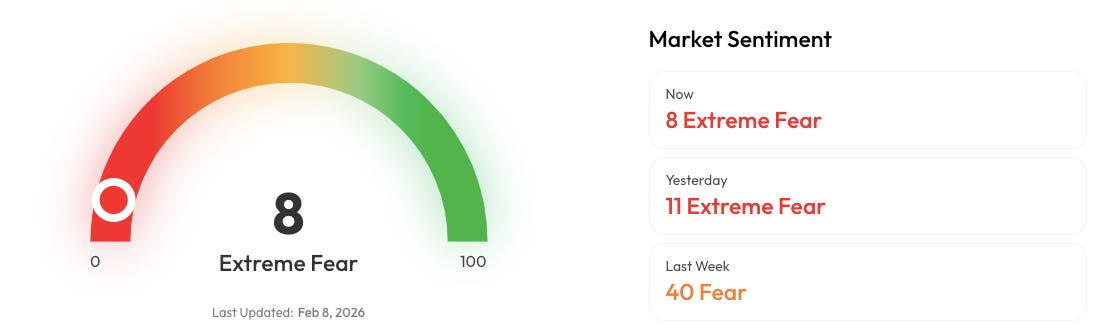
Bitcoin plunged sharply toward US$60,000 this week, briefly touching levels not seen since late 2024 before stabilising back above key support. The move marked one of the steepest short-term drawdowns in several years and sent market participants scrambling for explanations. Traders on social platforms floated a range of theories from a large, unreported hedge-fund or institutional blow-up in Asia to stressed yen-funding trades and even renewed talk of longer-term security risks, though none of these narratives has been confirmed with hard evidence. The price action unfolded alongside a broader crypto and risk-asset sell-off fuelled by forced liquidations, ETF outflows and waning appetite from leveraged positions, leaving sentiment thin and volatility elevated – reportedly the highest since the FTX era. The episode has left Bitcoin’s path forward unclear, with the $60K level now a psychological battleground as buyers and sellers reassess risk.
🔥🗺️Heat map shows the 7 day change in price (red down, green up) and block size is market cap.

🎭 Crypto Fear and Greed Index is an insight into the underlying psychological forces that drive the market’s volatility. Sentiment reveals itself across various channels—from social media activity to Google search trends—and when analysed alongside market data, these signals provide meaningful insight into the prevailing investment climate. The Fear & Greed Index aggregates these inputs, assigning weighted value to each, and distils them into a single, unified score.

This section captures developments at the edge of digital systems. New interfaces, tools, and capabilities that feel early, unfinished, or slightly ahead of their moment. I’m less interested in what’s impressive today and more interested in what might quietly reshape how people work, coordinate, and interact over time.
Satellite networks as quasi-public infrastructure
Low-Earth-Orbit satellite networks are drifting into an unfamiliar role. They are no longer niche connectivity experiments or emergency stopgaps. In practice, they are starting to function as parallel internet layers that sit outside national telecom regimes, switching on when terrestrial networks are throttled, censored, or fail altogether.
The frontier signal is not the technology itself, but the shift in governance assumptions. Connectivity is no longer guaranteed by states, nor fully controlled by them. Instead, it is provisioned by private actors operating at planetary scale, governed by commercial incentives, export controls, and geopolitical pressure rather than public mandate. This quietly reorders power. When access to the network bypasses borders, so do the institutions built on top of it, including payments, identity, and information flows.
Over the next five to ten years, this raises unresolved questions. If satellite connectivity becomes a de facto human right in practice, but not in law, who is accountable when access is restricted, repriced, or politicised? Financial inclusion efforts that rely on “neutral” connectivity may simply be shifting dependence from local infrastructure to global providers. The inclusion story improves in the short term, but the control surface does not disappear. It moves upward, becoming harder to see, harder to contest, and harder to govern.

“The danger is not that computers will begin to think like humans, but that humans will begin to think like computers.”
Sydney J. Harris
A reminder that abstraction cuts both ways. Efficiency can quietly displace judgment if left unchecked.
Sydney J. Harris (1917–1986) was an American journalist and author best known for his long-running syndicated column “Strictly Personal.” Writing for the Chicago Daily News and later the Chicago Sun-Times, Harris explored human behaviour, education, and ethics in clear, reflective prose that reached readers across North America.