
Welcome to this week’s Field Notes, a 10-year project of mine documenting humankind’s digital transition from the field. These notes are shaped by what I’m seeing, building, and discussing as our physical and digital lives continue to converge.
- Ryan
(Connect with me on LinkedIn)

News is surface-level. Signals live underneath. This section captures developments that hint at deeper shifts in how digital systems are being built, governed, and adopted — often before they’re obvious in the mainstream narrative.
BlackRock surfaces indirectly in Canton’s institutional orbit
A recent Schedule 13G filing shows BlackRock holding a passive stake of just over 2% in Tharimmune, a publicly listed company that has repositioned itself around building a digital asset treasury and validator presence linked to the Canton Network. The filing frames the position as ordinary-course and non-activist.
What matters here is not the size of the holding, nor speculative estimates about token exposure, but the choice of exposure. Tharimmune currently represents one of the few public-market vehicles aligned with Canton’s ecosystem, at a time when DTCC has confirmed plans to tokenise U.S. Treasury settlement on Canton, and has taken a governance role alongside Euroclear. That work follows DTCC receiving regulatory clarity in the form of a no-action position, with production timelines signalled for 2026.
The signal is subtle but worth noting. BlackRock has consistently avoided noisy experimentation in public blockchain markets, favouring regulated, institutionally compatible rails. A passive position in the only listed company structurally tied to the network chosen by DTCC for Treasury tokenisation suggests observation with optionality, not conviction capital, but observation from a very specific vantage point.
Still early. But this looks less like a bet on tokens, and more like a quiet seat near the table where post-trade market structure is being rewritten

What it is
A long-form discussion on DTCC’s preparation to tokenize the top 1,000 US equities, alongside parallel moves in stablecoins, bank settlement rails, and tokenised funds.
What stood out
The emphasis is consistently on legal reality, not wrappers. Tokenisation is framed as an extension of existing market structure rather than a replacement. DTCC sits at the centre, but the supporting signals matter just as much: Visa settling with stablecoins, banks exploring issuance-as-a-service, and JPMorgan pushing tokenised money market funds onto public chains. The conversation treats these as coordination problems, not experiments.
Why it lingers
This feels like a threshold moment. When incumbents move, they do so by compressing uncertainty, not by chasing upside. Tokenisation here is less about speed or novelty and more about control, interoperability, and jurisdictional clarity. The implication is subtle but important: once the core plumbing shifts, everything built above it inherits those assumptions.

Digital assets now sit less as an idea and more as infrastructure in progress. As physical and digital life continue to converge, money and assets are doing the same. What was once framed as “crypto” is increasingly showing up as rails, balance sheets, and policy conversations.
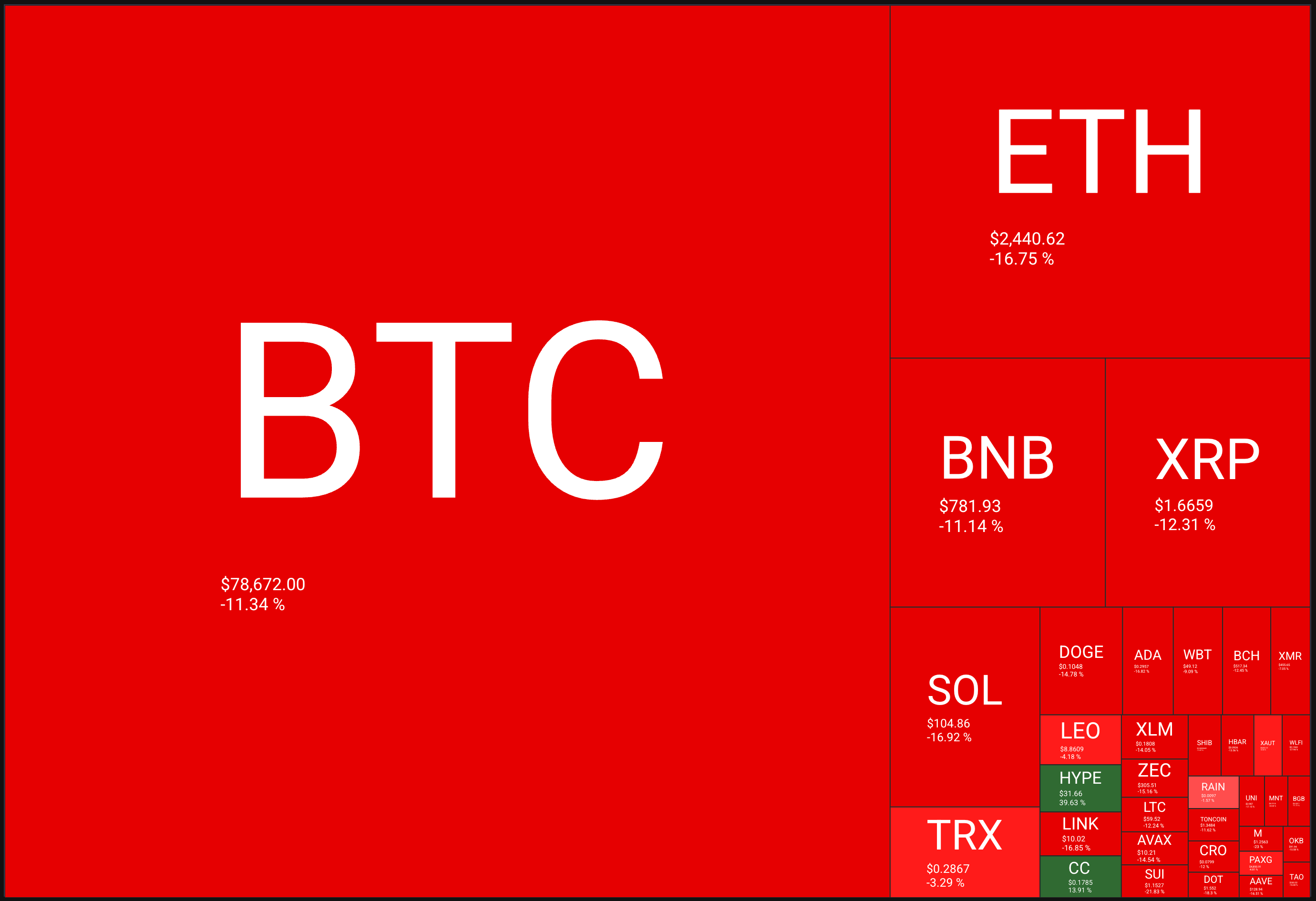
🔥🗺️Heat map shows the 7 day change in price (red down, green up) and block size is market cap.
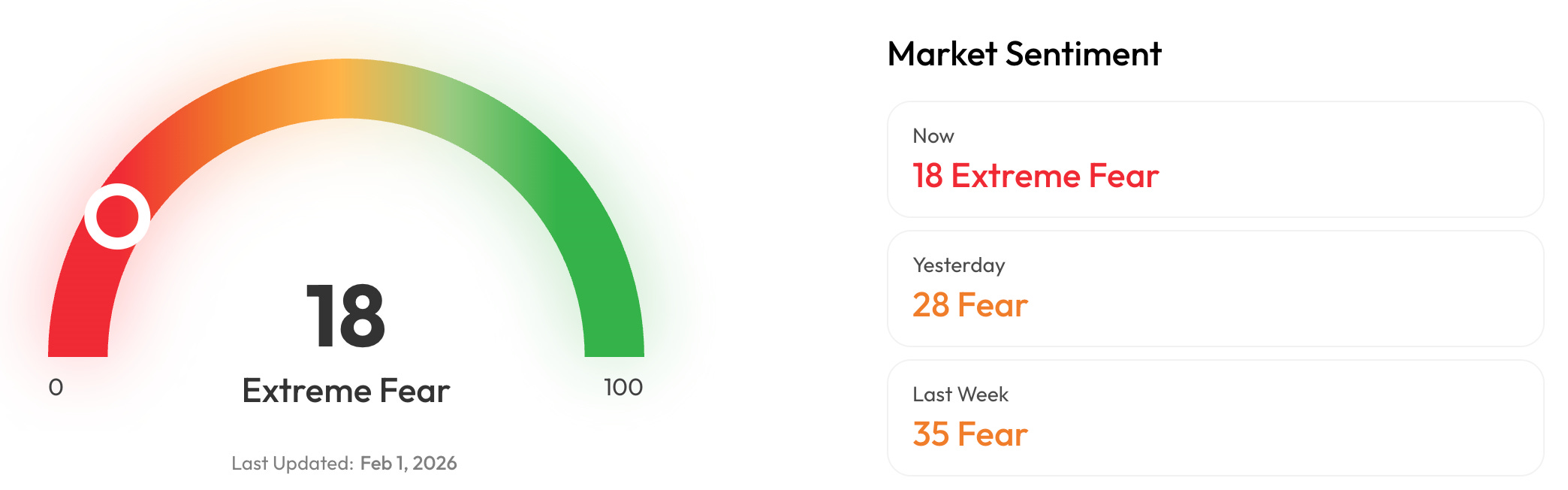
🎭 Crypto Fear and Greed Index is an insight into the underlying psychological forces that drive the market’s volatility. Sentiment reveals itself across various channels—from social media activity to Google search trends—and when analysed alongside market data, these signals provide meaningful insight into the prevailing investment climate. The Fear & Greed Index aggregates these inputs, assigning weighted value to each, and distils them into a single, unified score.

This section captures developments at the edge of digital systems. New interfaces, tools, and capabilities that feel early, unfinished, or slightly ahead of their moment. I’m less interested in what’s impressive today and more interested in what might quietly reshape how people work, coordinate, and interact over time.
A recent Chatham House analysis examines Iran’s expanding use of internet shutdowns as a deliberate governance tool, treating connectivity as conditional infrastructure rather than a public utility. The piece situates recent blackouts within a longer pattern where states selectively degrade networks to manage political risk, with cascading effects on communication, commerce, and daily life. Source: Chatham House – Iran’s internet shutdown signals a new stage of digital isolation
Viewed through the lens of digital finance, this surfaces a structural fork in the road over the next decade. One pathway treats internet access itself as a human right, pushing momentum toward global, non-terrestrial networks such as satellite constellations that bypass national choke points. In this model, financial inclusion depends on resilient connectivity layers that sit above state control. The other pathway assumes outages and throttling are normal, shifting attention to blockchain-based systems designed to tolerate partial or temporary disconnection, including offline settlement mechanisms and safeguards against double-spending. Each approach carries different incentives and risks. One externalises power to global infrastructure providers. The other embeds resilience into protocols, at the cost of complexity and slower coordination. What matters is not which path wins, but that inclusion in digital finance increasingly depends on how systems behave when the network is missing, not when it works perfectly.

“What we see depends mainly on what we look for.”
John Lubbock
John Lubbock was a 19th-century British polymath, banker, scientist, and parliamentarian, moving easily between finance, biology, and public policy.
Lubbock’s observation is easy to overlook because it feels obvious. But it matters in systems work. Attention acts like a filter. If you look for novelty, you’ll see disruption everywhere. If you look for continuity, you’ll notice how much persists beneath the surface. The signal doesn’t change, only the lens. From the field, this is a reminder that interpretation often says more about the observer than the system being observed.