
Welcome to this week’s Field Notes, a 10-year project of mine documenting humankind’s digital transition from the field. These notes are shaped by what I’m seeing, building, and discussing as our physical and digital lives continue to converge.
- Ryan
(Connect with me on LinkedIn)

News is surface-level. Signals live underneath. This section captures developments that hint at deeper shifts in how digital systems are being built, governed, and adopted — often before they’re obvious in the mainstream narrative.
Policy access concentrates around large tech firms
An investigation published this week found that major US technology companies have met UK ministers far more frequently than child safety advocates, creators, or civil society groups involved in digital harm debates. The imbalance is not hidden, but it is structural, embedded in how consultation and access are organised (source).
What stands out is less the number of meetings and more what sustained proximity enables. As digital policy becomes more technical and continuous, influence appears to accrue to actors with the resources to remain present, fluent, and persistent inside government processes. Access itself begins to function like infrastructure.
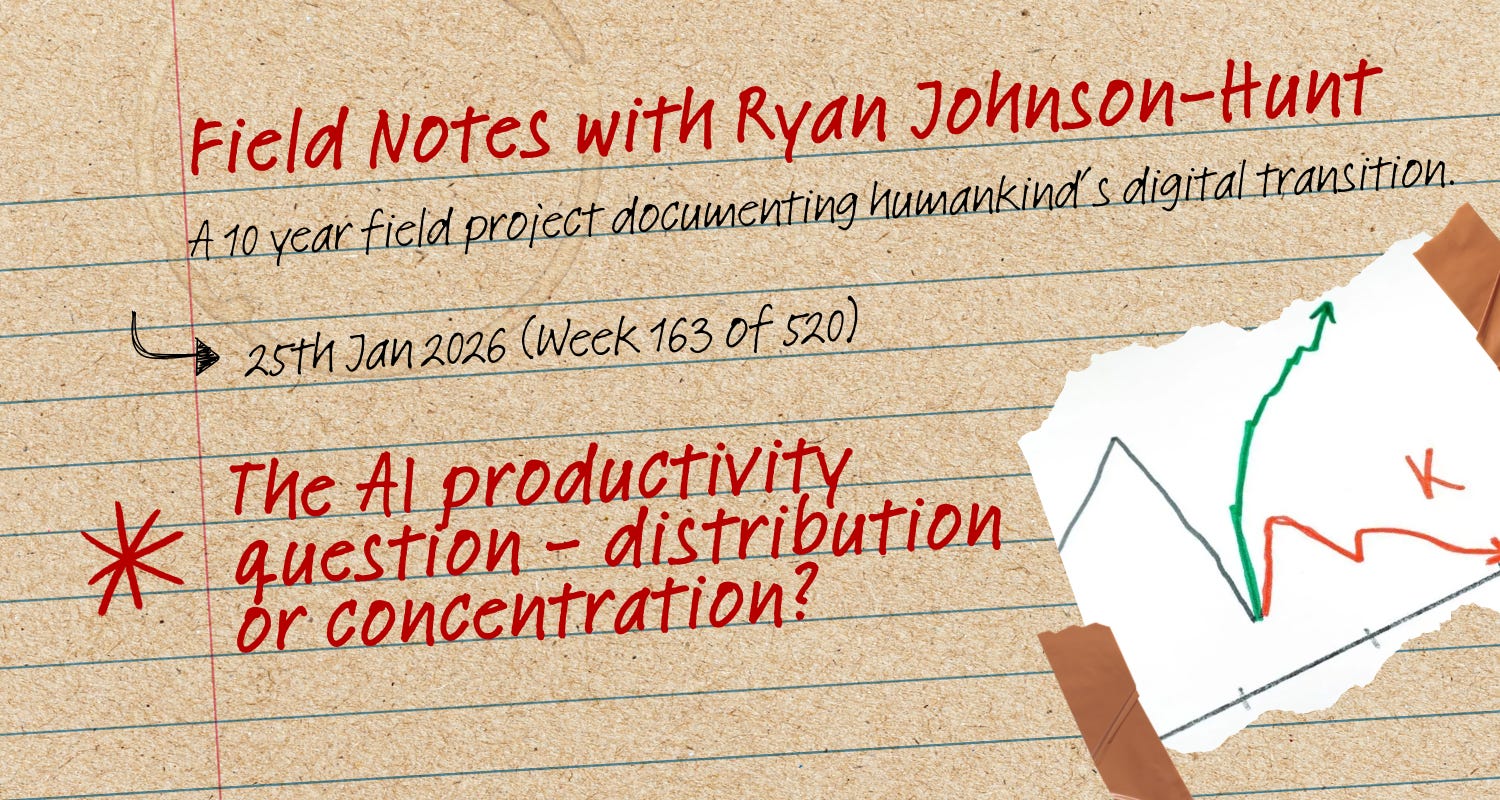
This lands amid a wider, unresolved debate about where AI-driven productivity gains ultimately flow. One pathway imagines broad distribution, through mechanisms like universal basic income or public dividends tied to automation. The other points toward concentration, where scale advantages allow a small number of firms to capture outsized economic and political power, reinforcing a K-shaped economy. The pattern of access visible here quietly favours the latter, not by declaration, but through accumulation.
I think about this a lot given that I have a 5-year-old son, I need to prepare for an uncertain future. Worth noting how governance pathways may be set long before redistribution questions are formally asked.
Boards scramble to adjust to AI governance pressures
Recent reporting notes a rise in board-level concern about how artificial intelligence is being deployed across organisations, with directors seeking new playbooks to oversee AI risk, accountability, and decision-making authority. What is being discussed is not the technology itself, but who carries responsibility when automated systems shape outcomes at scale. Source: Company boards scramble to adjust to AI
What stands out is the shift in framing. AI is no longer treated as an operational tool delegated to management or IT committees, but as a governance issue touching fiduciary duty, audit, and risk oversight. Boards appear to be feeling pressure to intervene earlier, even as they lack clear standards, shared language, or precedent for what “good” oversight looks like in this context.
There is also a quiet tension here. As AI systems promise productivity gains and efficiency, boards are being asked to absorb new categories of risk without parallel changes to legal clarity or regulatory guidance. This suggests governance may lag capability, leaving directors exposed in ways that traditional control frameworks were never designed to handle.

What it is
A short news explainer on the idea of a K-shaped economy, where income, spending, and resilience diverge sharply between the top and bottom of the distribution.
What stood out
The framing is behavioural rather than abstract. Consumption patterns tell the story. The top decile continues to spend, concentrate market share, and set the pace of growth, while the majority adjusts downward, optimising for price and necessity. Productivity gains exist, but they are unevenly captured.
Why it lingers
Viewed alongside current AI and data-centre constraints, this begins to look less like a temporary distortion and more like a structural outcome. When productivity gains are gated by access to capital, power, data, and infrastructure, they compound upward. Big tech captures the efficiency dividend while the physical limits of grids and labour cap diffusion elsewhere. One plausible path from here is not universal uplift, but a steeper K. Growth at the top, constraint below.
I’m not sure that policy, infrastructure investment, or redistribution mechanisms can meaningfully flatten that shape once it hardens.

Digital assets now sit less as an idea and more as infrastructure in progress. As physical and digital life continue to converge, money and assets are doing the same. What was once framed as “crypto” is increasingly showing up as rails, balance sheets, and policy conversations.
🔥🗺️Heat map shows the 7 day change in price (red down, green up) and block size is market cap.

🎭 Crypto Fear and Greed Index is an insight into the underlying psychological forces that drive the market’s volatility. Sentiment reveals itself across various channels—from social media activity to Google search trends—and when analysed alongside market data, these signals provide meaningful insight into the prevailing investment climate. The Fear & Greed Index aggregates these inputs, assigning weighted value to each, and distils them into a single, unified score.


This section captures developments at the edge of digital systems. New interfaces, tools, and capabilities that feel early, unfinished, or slightly ahead of their moment. I’m less interested in what’s impressive today and more interested in what might quietly reshape how people work, coordinate, and interact over time.
This week’s CES 2026 and adjacent industry reporting continue to surface spatial computing not as a headset spectacle but as infrastructure quietly deployed into real work contexts such as logistics, planning and transport management. Partnerships like Raven Connected and Swift Navigation’s AI spatial intelligence for road networks signal early efforts to automate real-time infrastructure inspection and digital twin creation for increasingly responsive cities and transport systems. Source: Raven Connected & Swift Navigation partner for AI spatial intelligence (5 Jan 2026).
This feels early but important because spatial computing is being stitched into workflows that shape physical outcomes rather than immersive experiences. Industrial examples such as digital twin models in warehouses and factories show how spatial overlays improve operational decisions on the floor, cutting training time and error rates even before headsets reach consumers. (Medium) The behavioural signal here is subtle: organisations are beginning to treat space not as static geography but as live data to be sensed, modelled and acted upon, reshaping coordination incentives across fleets, supply chains and public assets. A second-order effect is governance tension; when infrastructure becomes spatially intelligent, questions of control, privacy and liability arise before standards or norms have settled.

“Most change is additive, not substitutive.”
Kevin Kelly
Kevin Kelly is a technology writer and co-founder of Wired magazine, known for long-horizon thinking about how technological systems evolve, compound, and reshape human behaviour over time.
Traditional finance looks messy because it is the product of decades of additions layered on top of one another. New rails were bolted onto old ones. Workarounds became permanent. Exceptions hardened into standards. Payments, custody, settlement, compliance, and reporting all evolved separately, then were stitched together just tightly enough to function. Blockchain, tokenisation, and stablecoins matter not because they are faster or newer, but because they allow a rare reset. Value, movement, and settlement collapse back into a single layer. The interesting question now is not what gets replaced, but how much of the accumulated complexity proves unnecessary once that reset is available.