
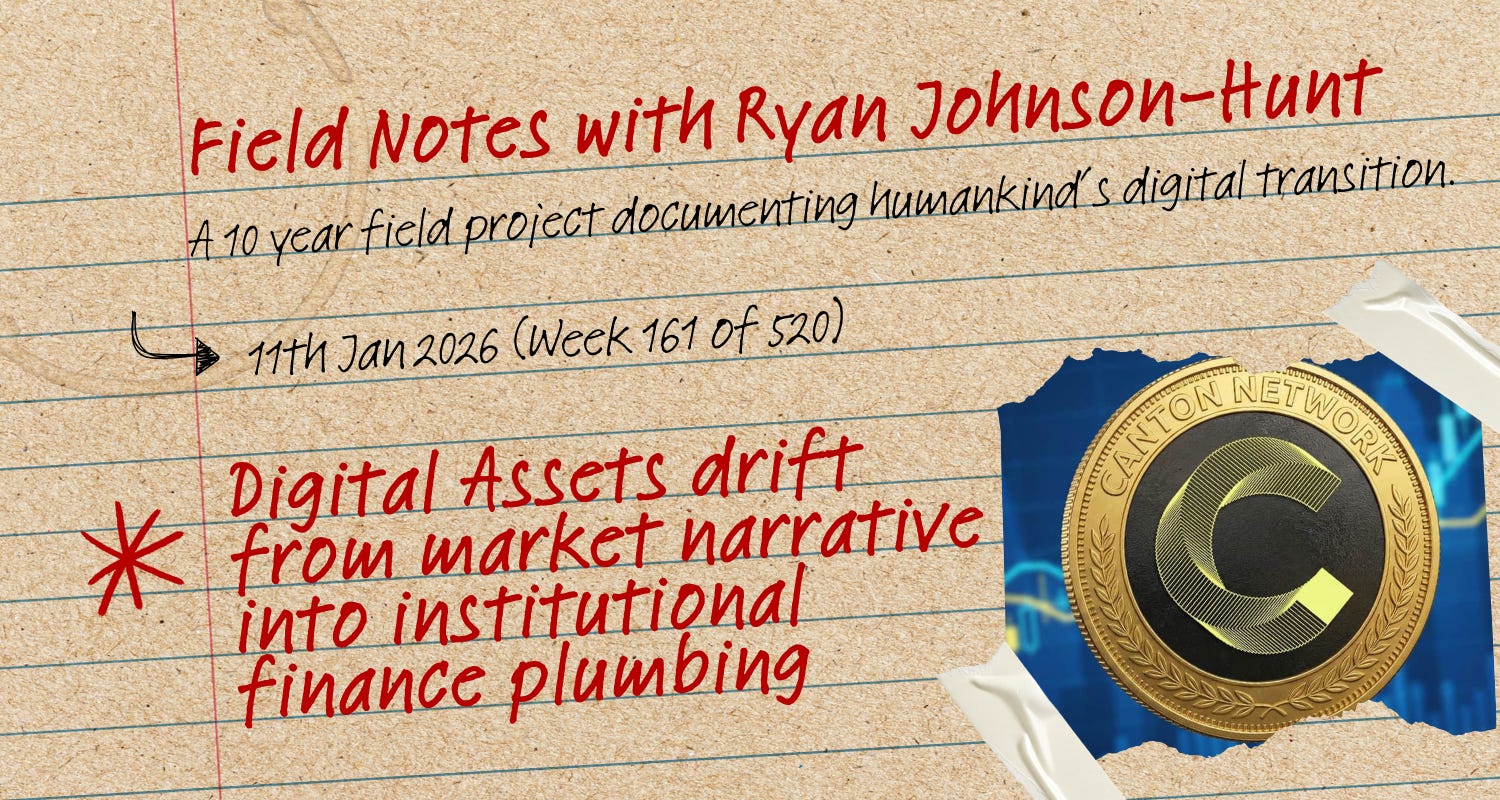
Welcome to this week’s Field Notes, a 10-year project of mine documenting humankind’s digital transition from the field. These notes are shaped by what I’m seeing, building, and discussing as our physical and digital lives continue to converge.
- Ryan
(Connect with me on LinkedIn)

News is surface-level. Signals live underneath. This section captures developments that hint at deeper shifts in how digital systems are being built, governed, and adopted — often before they’re obvious in the mainstream narrative.
Biometrics faces new pressure from AI-enabled fraud and service use
Recent reporting highlights how biometric systems are being stressed from both sides at once: generative AI is making spoofing and synthetic identity attacks easier, while governments and service providers continue to expand biometric use for access, authentication, and service delivery. The same tools that increase convenience and reduce friction are also lowering the cost of fraud and error (source).
United States – ID.me has signed a US$1 billion, five-year Blanket Purchase Agreement with the U.S. Treasury Department to provide identity verification and authentication for external users, extending its footprint across federal services.
Japan – Around 80% of residents now hold a My Number Card, with government plans to accelerate public service digitisation and launch a new “Myna” app in 2026, reflecting lessons from slow service delivery during the pandemic.
Zambia – The government plans to issue digital ID cards by the end of this year under its Digital Zambia Acceleration Project, with officials citing steady progress in digitised public services and positive feedback from the World Bank.
Global development – The Gates Foundation spent US$150 million on financial inclusion in 2024, including support for digital ID adoption in developing economies, and now plans to exit the sector by 2030 as systems reach scale and sustainability.
United States – Despite two decades of investment, a REAL ID case revealed that a state-issued identity document was deemed insufficient proof of citizenship by a federal court, surfacing lingering trust gaps in federally recognised IDs.
Netherlands – EUDI Wallets continue moving toward production, with a municipality testing integration with the Once-Only Technical System; an eIDAS-compliant proof-of-birth credential has passed technical checks, with attribute-retrieval tests next.
Japan / Global enterprise – Accenture and NTT Docomo have partnered to build Universal Wallet Infrastructure for decentralised, enterprise-grade digital trust services, with FaceTec contributing liveness detection.
United Kingdom – Labour MP Josh Simon has been appointed minister for digital reform to lead development of the UK’s digital identity system, signalling renewed political ownership of a long-running policy challenge.
What stands out is not the technology itself, but the narrowing margin for trust. Biometrics are increasingly treated as infrastructure rather than security, yet their reliability now depends on surrounding controls, fallback processes, and governance choices. This suggests identity systems may be shifting from “proof” mechanisms to probabilistic signals that require layered validation, ongoing monitoring, and social consent, rather than quiet acceptance.
Worth noting how identity, once assumed to be a stable anchor, is becoming a moving surface under AI pressure.
Market plumbing, not market products
A recent outlook from Moody’s described digital finance as evolving into a foundational infrastructure layer for financial services, a notable shift in framing away from assets and towards plumbing. Around the same time, Temple Digital launched a 24/7 institutional trading venue built on Canton Network (the first privacy-enabled open blockchain network), ensuring limitless connections that preserve privacy), extending execution beyond traditional exchange hours and venues.
Taken together, these developments suggest a reframing of what “digital finance” is for. Rather than being positioned as a new asset class competing for attention, it is increasingly treated as a substrate that supports continuous settlement, coordination, and execution across systems. The signal is less about volume or adoption today, and more about who is doing the building and how quietly these assumptions are being normalised.
Still early, but worth noting how language from rating agencies and design choices in execution venues are beginning to align around infrastructure, not speculation.


What it is
A short documentary on Estonia’s digital state, often presented as the reference model for national digital identity and interoperable public services.
What stood out
The tone is calm, almost settled. Digital ID is treated as civic plumbing rather than political choice. Identity, authentication, and data sharing are framed as administrative problems already solved, with trust embedded by default through law, architecture, and cultural alignment.
Why it lingers
What feels easy to miss is how context-heavy this model is. Scale, history, and social contract do much of the work. The video invites admiration, but it also quietly raises the question of portability. When digital identity works this smoothly, it is because legitimacy arrived before the infrastructure, not after.
Worth noting how rarely that sequencing is discussed elsewhere.

Digital assets now sit less as an idea and more as infrastructure in progress. As physical and digital life continue to converge, money and assets are doing the same. What was once framed as “crypto” is increasingly showing up as rails, balance sheets, and policy conversations.
🔥🗺️Heat map shows the 7 day change in price (red down, green up) and block size is market cap.

🎭 Crypto Fear and Greed Index is an insight into the underlying psychological forces that drive the market’s volatility. Sentiment reveals itself across various channels—from social media activity to Google search trends—and when analysed alongside market data, these signals provide meaningful insight into the prevailing investment climate. The Fear & Greed Index aggregates these inputs, assigning weighted value to each, and distils them into a single, unified score.


This section captures developments at the edge of digital systems. New interfaces, tools, and capabilities that feel early, unfinished, or slightly ahead of their moment. I’m less interested in what’s impressive today and more interested in what might quietly reshape how people work, coordinate, and interact over time.
As protests in Iran continue under intermittent internet shutdowns and currency pressure, recent reporting has again surfaced the role of Starlink connectivity and censorship-resistant digital assets in keeping economic and informational activity alive when formal systems are constrained. Satellite internet terminals, alongside peer-to-peer tools such as Bitcoin, are being discussed not as abstractions but as practical backstops when domestic networks and financial rails become unreliable (source).
This feels early but important because it highlights technology operating at the level of infrastructure resilience rather than expression. Starlink’s strength is not speed or novelty, but its ability to reintroduce connectivity when terrestrial networks are deliberately degraded. Bitcoin’s role here is less about speculation and more about behavioural hedging: preserving value and enabling transactions when local currency trust erodes and banks become points of control. The second-order effect is subtle. Tools designed to bypass authority also shift risk onto individuals, demanding technical literacy and personal exposure. What surfaces is a pattern where “anti-authoritarian stacks” are not ideological statements, but contingency systems that remain invisible until traditional ones fail, then suddenly matter a great deal.

“Progress happens too slowly to notice, until it happens too fast to stop.”
Ruth Bader Ginsburg, who served on the US Supreme Court from 1993 to 2020 and became a defining figure in the long, incremental expansion of civil rights.
Most progress feels underwhelming while it is underway. Accumulation looks like inertia from the inside. Then, suddenly, the surrounding context shifts and yesterday’s groundwork becomes today’s baseline. From the field, it is rarely clear which efforts will compound and which will quietly dissolve