
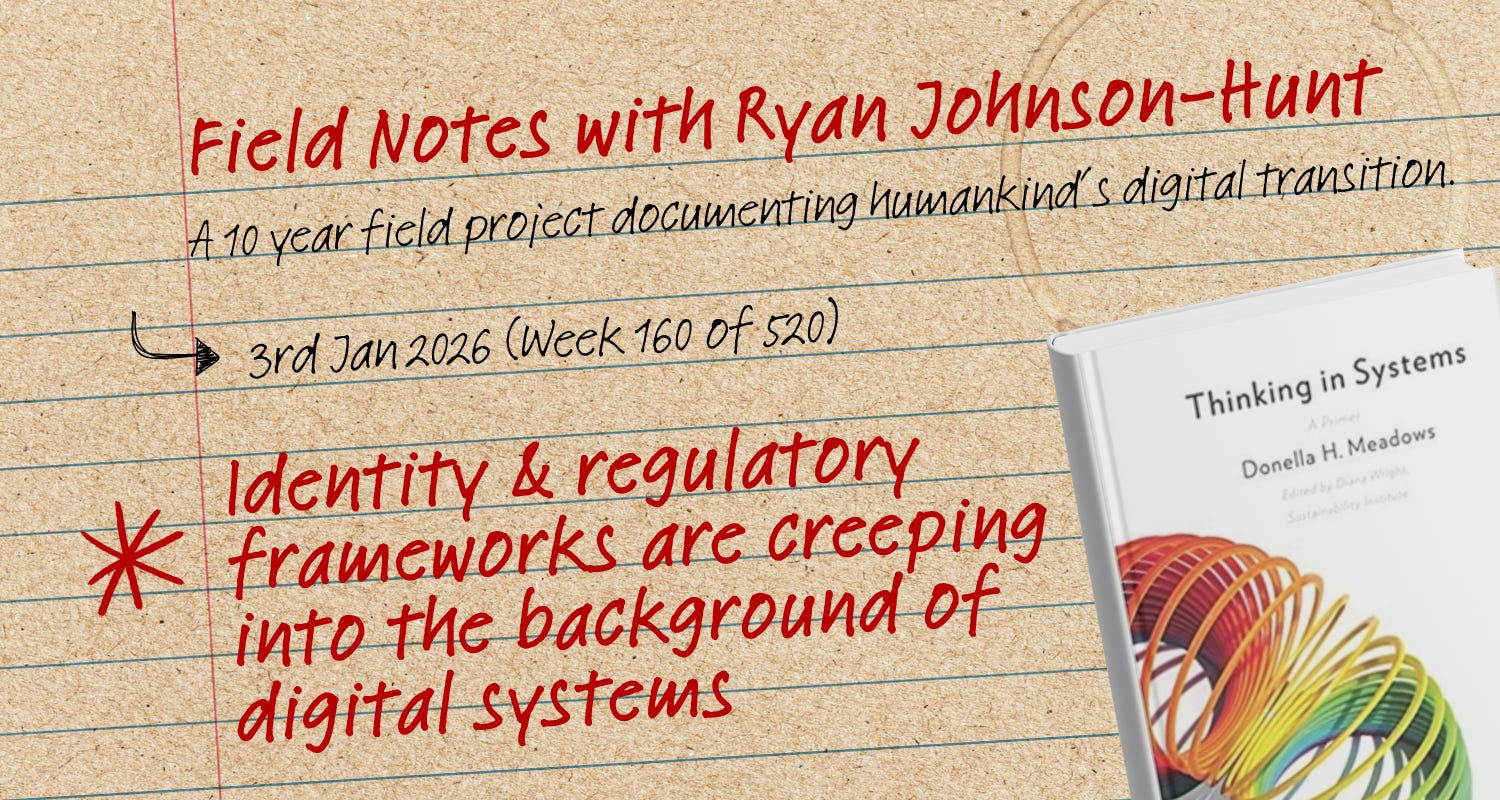
Welcome to this week’s Field Notes, a 10-year project of mine documenting humankind’s digital transition from the field. These notes are shaped by what I’m seeing, building, and discussing as our physical and digital lives continue to converge.
- Ryan
(Connect with me on LinkedIn)

News is surface-level. Signals live underneath. This section captures developments that hint at deeper shifts in how digital systems are being built, governed, and adopted — often before they’re obvious in the mainstream narrative.
I’m noticing how accountability, identity, and regulatory frameworks are creeping into the background of digital systems, often through court orders or local laws rather than headline-grabbing national acts. 3 recent examples:
Court-mandated e-KYC reshapes foundational internet identifiers
A Delhi High Court decision now requires strict electronic know-your-customer checks for anyone registering an internet domain name, linking identity verification directly to a foundational layer of internet addressing and fraud prevention. This move suggests judicial appetite for anchoring real-world identity to digital identifiers as a means to curb fraud, not just in finance but across digital services, possibly foreshadowing similar approaches elsewhere. The Times of IndiaState-level digital laws layer new duties on platforms and data
A wave of new U.S. state tech laws taking effect covers AI transparency, data privacy, consumer protections and even cryptocurrency ATM rules. Each law is distinct, yet collectively they point to fragmented regulatory terrain where digital services are governed through varied local norms rather than one national standard, which may shape how platforms and intermediaries design compliance systems. The VergeCrypto regulation surfaces in unlikely jurisdictions
Turkmenistan’s formal legalisation of cryptocurrency mining and exchange under civil law, with a centralised licensing regime, is unexpected given its historically restrictive stance. This development hints at a broader pattern where even tightly controlled states see regulated digital asset activity as legitimate economic infrastructure, prompting questions about how varying governance models reconcile control with market openness. AP News

What it is
A long-form YouTube explainer tracing the re-emergence of digital ID in the UK, framed through Tony Blair’s shifting position on identity systems, the role of the Tony Blair Institute, and the growing presence of Oracle and its founder Larry Ellison in UK government data infrastructure.
What stood out
The video spends less time on technology and more on process. Meetings, donations, policy papers, and timing. Digital ID appears not as a discrete product decision but as the outcome of overlapping institutions that already know how to work together. Much of the argument rests in public records and fine print rather than leaks or revelations.
Why it lingers
What feels directionally important is the reframing of digital ID as inevitability rather than choice. The system advances through alignment, not mandate. By the time it becomes visible to the public, most of the structural decisions appear already made. Trust, in this telling, is not designed into the system but assumed to follow later.
Key Note: It’s still unclear where consent meaningfully enters once infrastructure hardens.

Digital assets now sit less as an idea and more as infrastructure in progress. As physical and digital life continue to converge, money and assets are doing the same. What was once framed as “crypto” is increasingly showing up as rails, balance sheets, and policy conversations.
🔥🗺️Heat map shows the 7 day change in price (red down, green up) and block size is market cap.

🎭 Crypto Fear and Greed Index is an insight into the underlying psychological forces that drive the market’s volatility. Sentiment reveals itself across various channels—from social media activity to Google search trends—and when analysed alongside market data, these signals provide meaningful insight into the prevailing investment climate. The Fear & Greed Index aggregates these inputs, assigning weighted value to each, and distils them into a single, unified score.


This section captures developments at the edge of digital systems. New interfaces, tools, and capabilities that feel early, unfinished, or slightly ahead of their moment. I’m less interested in what’s impressive today and more interested in what might quietly reshape how people work, coordinate, and interact over time.
A late-December report from KoreaTechDesk on the CES 2026 Innovation Awards highlighted an unusually strong showing from Korean startups, particularly in spatial computing and AI-driven spatial intelligence. Many of the awarded projects focused less on consumer hardware and more on systems that interpret, model, and respond to physical environments, spanning mobility, industrial automation, and environmental sensing. (Source)

This feels early but important because spatial computing still lacks a settled interface or dominant metaphor, yet it is quietly moving into infrastructure rather than devices. The signal here is not about headsets or novelty experiences, but about how machines are beginning to hold persistent, contextual models of space and act on them with limited human instruction. It exposes an incentive shift toward systems that disappear into logistics, factories, and cities, where reliability and alignment matter more than delight. A second-order effect worth noting is governance: as spatial intelligence migrates into public and industrial domains, questions of control, liability, and data ownership surface long before most people realise they are interacting with these systems at all.

“The most powerful frameworks are invisible.”
- Donella Meadows (1941–2001) was an American systems scientist, environmental researcher, and writer. She was a pioneering figure in systems thinking and sustainability studies, best known as the lead author of The Limits to Growth (1972), a landmark model-based analysis of global ecological and economic trends that reshaped environmental debate.
What governs a system is often not the headline rule, but the quiet assumptions beneath it. Defaults, constraints, and incentives do most of the work. Paying attention to those hidden structures can tell you more about where things are heading than any surface-level narrative.